
Recycling stages: from bin to new raw material
So we once brought a skip to a construction site in Bostandyk. Tiles, chunks of drywall, pipe offcuts, bags of cement — all in one pile. The foreman stands there pleased: "Haul it away and it's clean." And I look at it and realize: half of what's in there isn't trash, it's raw material that just happens to be lying in the wrong pile. Drywall can go for recycling, metal can go for scrap, but the cement leftovers are done for. The difference only shows once it's all been sorted into fractions.
Primary collection and separation at the source
The first stage of recycling doesn't start at a plant or a landfill — it starts at your home or on your site. If a plastic bottle goes in the same bag as food scraps, and glass goes in the same sack as paper, then further down the line it all has to be sorted by hand. And some of it just ends up as waste, because nobody's going to wash and clean every single piece. Separation at the source isn't bureaucracy for a checkmark — it's how you keep material usable.
Honestly: in Almaty, few people sort at home systematically. Usually it's two bins — one for food, one for everything else. That's already not bad. But if you want to understand the key technologies for solid waste disposal, start here: the cleaner the material is separated at the start, the more useful stuff you get out of it later.
Transport and transfer at the sorting station
The next stage is transport. A truck collects the containers and takes the contents to where they'll be worked on next. Seems simple, right? But it's exactly along this stretch that some of the material gets lost: some spills, some gets soaked in the rain, some falls apart during transfer. Wet cardboard or paper is no longer raw material — it's dead weight.
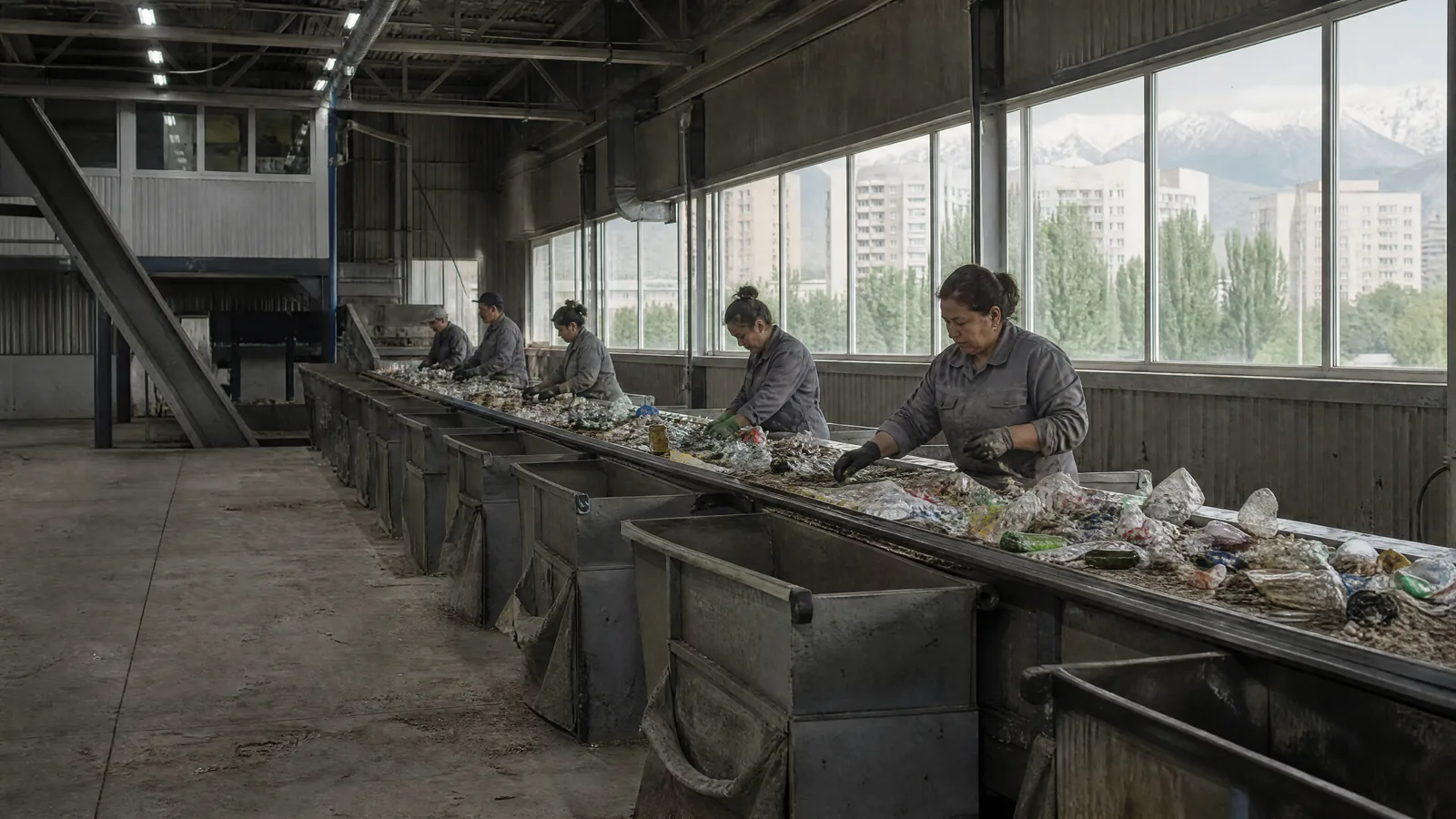
At the sorting station, the waste is unloaded and transferred onto a conveyor. This is where you first see that what was declared as "construction waste" actually contains old tires, linoleum offcuts and bags of something unclear. Surprises like that slow the whole process down. If you're ordering a truck, it's better to say right away what exactly you're planning to load. It's not a formality — it determines how fast the material moves on.
- Food waste mixed with packaging is the most common reason paper and cardboard end up rejected.
- Wet drywall loses its strength and crumbles so badly it can no longer be separated from the fine fraction.
- Linoleum and carpet offcuts belong to the textile group, but only if they're dry and glue-free.
- Metal in a shared pile snags on plastic, and separating them on the conveyor isn't always possible.
- Glass mixed with ceramics breaks, and broken glass is no longer sorted by color.
- Leftover cement and plaster in bags spread as dust and ruin the neighboring fractions.
Manual and automatic sorting
Next comes sorting. Some of the work is done by hand: people pull large items off the belt and toss out obvious trash. Some is done by machines: a magnet pulls out ferrous metal, eddy currents separate out non-ferrous, optical sensors recognize plastic by its marking. PET goes one way, low-density polyethylene goes another.
But here's the catch: automation isn't all-powerful. The equipment can't make sense of dirty materials. If there's a bottle with oil residue on the belt, the sensor won't recognize it. And it drops into the general stream. That's why recycling is always a compromise between what can be separated and what's easier to just throw away.
From experience I'll say: manual sorting still takes a noticeable share on any line. People pick out what the machine can't see. It's not backwardness, it's reality: while the material is mixed, automation chokes.
What happens to waste after sorting
After sorting, the streams split. Clean plastic, glass, metal and paper go for processing — they're washed, crushed, pressed into bales or pellets. The mixed residue that's good for nothing goes to landfill. That's part of recycling too, just without returning to the loop.
Waste incineration is a separate branch, we'll talk about it below. There's also waste pyrolysis and plasma waste processing — that's complex technology, but the principle is the same: first separate what can be recovered, and only then think about energy.
And here's what matters. At every stage, some material is lost. Not because someone's doing a bad job, but because materials don't always survive multiple cycles. Paper fiber gets shorter each time, plastic loses strength, glass shatters into fine fractions that can't be melted back into containers. Recycling isn't an endless circle, it's more like a spiral: each turn makes the material a little worse, until it becomes unusable.
That's why new methods are usually aimed not at recycling endlessly, but at extending a material's life by at least one cycle. Sometimes it works, sometimes it doesn't. And the honest answer to «why isn't everything recycled» is this: after sorting and preparation, what's left is a mixture that can't be separated at a profit. It costs more than extracting raw material from scratch.
And if you're ordering a pickup, remember: what you neatly stacked and labeled has a chance of making it to recycling. What's dumped in a heap will almost certainly go to landfill. That's not a reproach, it's just a fact worth knowing.
Key technologies for solid waste disposal: an overview
First, honestly: there's no single magic technology that takes a bag from your balcony and turns it into a treat. There's a set of approaches — from burial, ancient as the world, to plasma waste disposal, which gets talked about at conferences. The main technologies for solid waste disposal fall into four big families: bury it, burn it, compost organics, and return material to the loop. Below is a short take on each, without advertising slogans.
Landfill burial: why it's still the main route
Landfilling is the simplest and cheapest option there is. Trucks bring it in, bulldozers level it, it gets covered with a layer of soil, and machinery compacts it. A landfill takes almost everything: construction debris, old furniture, bags, shoes, linoleum scraps. There's usually no sorting at the gate — well, maybe oversized items that would jam the entrance get pulled out.
But this route has a price, and it's not paid by the one who threw it away. The landfill takes up land, leachate goes down, methane goes up. That's why in Europe burial has long been taxed, while here it holds on thanks to being cheap. For you, if you're just hauling junk out of your apartment, there's not much difference — the truck goes to the site anyway. But for the city, the difference is huge.
Another problem: the landfill doesn't sort what you brought. If there was a battery or a can with paint residue in the truck, they'll go wherever the sofa goes. No one catches that by eye — unless you say so yourself.
Waste incineration: pros, cons and what goes up the chimney
Burning trash shrinks the volume many times over. What filled a truck bed turns into a handful of slag and a cloud of gas after the furnace. That's the main upside: landfills get relief, and the heat released can go into the grid. That's how waste-to-energy works at big plants — burn, heat water, spin a turbine.
The downside is just as obvious. It's not only smoke going up the stack: at the wrong temperature, dangerous compounds form and later settle on rooftops. That's why a modern furnace isn't a campfire but a complex setup with multi-stage scrubbing. And it costs so much that not every city can afford one.
Burning trash at your dacha is a whole different story. We're not talking about a plant here, just a barrel in the corner of the plot. Technically, you can burn grass and paper, but not plastic, PVC, or rubber: stench, soot, and neighbors filing complaints. We pick up piles like that and haul them away, because in a barrel they won't burn properly — they'll just smoke up everything around.
Composting organics: where it works and where it doesn't
Composting is when organics aren't burned or buried but left for bacteria to turn into humus. Food scraps, cut grass, leaves, thin branches — under the right conditions, all of it becomes a dark, crumbly mass. In the private sector, where there's room for a bin and time to turn it, the scheme works without any plant.
In a high-rise city, composting barely stands a chance. The reason is simple: you need a site, you need to sort in the kitchen, you need to haul away the finished product. If a bag of batteries ends up in the bin next to the food scraps, the whole batch goes to waste. That's why in Almaty organics usually go to the landfill with everything else — not because the technology is bad, but because the city isn't ready to collect it separately yet.
Mechanical recycling into secondary raw materials
Mechanical recycling is what most people mean when they say "recycling." Sorting, baling, shredding, washing, pellets or a new sheet. That's how metal, glass, paper, and some plastics go back into circulation. The key word here is "some": not every plastic is accepted, and not every time is it worth hauling.
New recycling technologies are pushing that boundary. Some places have optical sorters, others have lines for separating film by type. But the principle stays the same: the cleaner and more uniform the input, the better the chance it becomes something new instead of heading to the landfill.
Here's how these four approaches differ at their core:
| Approach | What happens to the waste | Main limitation |
|---|---|---|
| Landfilling | Hauled to a site, compacted, covered with soil | Takes up land, leachate and methane |
| Incineration | Volume drops sharply, heat can be used | Expensive flue gas cleaning, emission risk |
| Composting | Organics rot into humus | Needs a dedicated site, hard in the city |
| Mechanical recycling | Sorting, baling, shredding, new pellets | Only works with clean, uniform material |
What actually shows up in everyday trash from an apartment or office:
- Glass and metal — almost always go to remelting if separated from the general bag.
- Paper and cardboard — readily accepted, but wet or greasy stuff isn't taken.
- Plastic bottles — yes, if you remove the cap and don't mix them with film.
- Film, bags, packaging — mostly not recyclable, they go to the landfill.
- Kitchen organics — in the city without separate collection, they're simply buried with the rest.
- Construction debris and old windows — not pure recyclables, but sometimes used for backfill.
In short, for ourselves: landfilling is "out of sight," incineration is "shrink it and get warm," composting is "give it back to the earth," mechanical recycling is "put it back to work." None of these paths cancels out the others. In a real city they work together, and the only question is the proportions.
Waste-to-energy: what it looks like in practice
Not everything gets hauled to the landfill. Part of the flow — what can't be recycled into new raw materials — goes to energy recovery. This isn't an alternative to sorting, it's a complement to it. First glass, metal, plastic, and textiles are pulled from the general mass; what's left can be burned for heat or electricity. That way waste-to-energy becomes the final stage, not a competitor to sorting.
Incineration with heat recovery
Waste incineration with recovery is when the heat from burning doesn't just fly up the stack but is captured and fed into the grid or to industry. Important: you don't burn everything that burns, only a prepared mass — no batteries, no large metal, no wet organic waste that burns poorly and smothers the process. Skip that, and the plant runs unstable and the emissions get dirtier. So before burning, the mass is checked again and, if needed, dried.
We have a rule on our crew: if there's something clearly not meant for burning in the container — say, an aerosol can or paint leftovers — we set it aside. Not because we're so virtuous, but because later on site it causes problems. Easier to pull it out now than to explain later. It's not even about ecology, it's about common sense.
People used to think incineration was just a big stove. Nope. I once brought bags with construction insulation mixed in with organics — had to explain that's not allowed. Now I always ask the dispatcher what the load is before sending a truck.
Gasification and syngas
Gasification is when waste isn't burned in the usual sense but heated with limited oxygen. The output is syngas, which can be burned for heat or used as fuel. The technology is finicky: if the mass has too much moisture or foreign matter, you get little gas and lots of tar. That's why gasification usually runs not on mixed waste but on prepared feedstock — wood residues, certain plastics, organics after sorting.
For Almaty this isn't mainstream yet. But when it comes to waste-to-energy, gasification is one of the options being considered for flows that would otherwise just sit in a landfill. Important to understand: it's not a replacement for sorting. Without pre-selecting glass, metal, and hazardous waste, any energy plant will run worse and dirtier.
What's left after energy recovery
After incineration you're left with ash and slag. That's not "nothing" — it has to go somewhere, and that's part of the chain too. Some ash can be used in construction, but only if it's been tested and doesn't contain heavy metals above the limit. Slag usually goes to backfill or landfill. So energy recovery doesn't turn waste into zero: it reduces volume but doesn't cancel responsibility for the residue.
The list of what needs separate handling after energy recovery:
- Ash from incineration — can contain heavy metals, needs testing before use.
- Slag — the heavy fraction, most often sent to landfill or backfill.
- Flue gases — cleaned at modern plants, but they're exactly why incineration without filters is considered a dirty technology.
- Gasification leftovers — tars and solid residue that need to be disposed of separately.
- Metal extracted from slag — it can be remelted, but only after being separated from the general mass.
- Wastewater from wet gas cleaning — another stream that needs treatment.
Someone will say: "Why burn at all if ash remains?" Fair point. But compare: instead of a mountain of trash — a small volume of residue that can be controlled. It's like compacting waste: we don't eliminate it, we reduce the space it takes up so it's easier to handle later.
When waste-to-energy makes sense
Waste-to-energy makes sense when sorting has already taken out everything recyclable, and the remainder still has to go somewhere. If there's a heat consumer nearby — a plant, a greenhouse, a neighborhood — burning with recovery is worth it. If not, the economics aren't so rosy. And another thing: burning trash at your dacha is a whole different story. There people burn dry branches and paper, and that's not industrial disposal but household burning, which is often banned within city limits.
The main solid waste disposal technologies that actually work today are sorting, baling, recycling into raw materials and energy recovery of what's left. Modern facilities add gasification, pyrolysis and plasma waste processing, but all of them require prepared feedstock. There's no such thing as a unit that takes mixed trash and produces clean fuel without pre-sorting. So when you hear about a miracle technology, ask what it does with batteries and glass.
In practice, in Almaty we mostly deal with household waste and construction debris. Waste-to-energy for us is more about what happens further down the chain, after we've hauled the waste away and handed it to a sorting site. We don't burn trash ourselves. But we try not to mix what can be recycled with what will go to energy recovery — as much as one truck allows.
Textile waste recycling: a story of its own
Look: a plastic bottle is one material, it can be melted and recast. Glass too. But an old sweater? It has cotton, acrylic, elastane, maybe nylon, and threads of other compositions. And that mix is the main reason textile waste recycling is so different from everything else. The fibers are tangled at the thread level, and separating them mechanically is nearly impossible.
I'm Aigul, and I often see people putting old clothes, rags, fabric scraps into a bag for pickup and thinking it will go to recycling. Sometimes it will. But more often — no. And here's why.
Why blended fabrics are almost never recycled
Pure cotton is easier to hand in. Pure wool too. But modern clothing is almost always blended: a bit of elastane for stretch, a bit of polyester for strength. These additives are in tiny fractions, but they get in the way a lot. Mechanical fiberizing yields short fibers that can't be spun into decent yarn. Chemical breakdown of the blend behaves unpredictably.
So it turns out: what looks like solid fabric is actually a composite. And recycling it as easily as PET won't work. No new waste recycling technology has fully solved this problem yet, though experiments are ongoing.
Textile sorting: what goes to reuse
The first thing that happens to collected clothes isn't tearing them into rags — it's checking whether they can still be worn. Good items go to reuse: sold in second-hand stores, sent to the regions, given to charities. It's not recycling in the strict sense, but it's an honest way to give a thing a longer life.
Here's the thing: sorting is done by hand. No machine can tell a kid's jacket from an adult's, or figure out that this sweater is still good while the one next to it isn't. That's why textiles are the niche where people are still more useful than machines.
Mechanical fiber recycling and rags
What can't be worn anymore gets torn down into fiber. The fabric is ripped into scraps, fed through a machine that shreds it into individual fibers. The result is so-called rags — a loose mass. It's used to make fillers, insulation, industrial wipes, and sometimes non-woven materials for construction.
This is where waste compaction comes in — though at a different stage. Rags and offcuts are pressed into bales so they're easy to load and haul to the recycling site. Without a press, the volume is so big the truck leaves half empty.
But here's what definitely can't be recycled: oil-soaked rags, rags with paint, shoes with glue-based soles. Their only route is disposal. And that's where the main solid waste disposal technologies come in: either incineration or landfilling. Burning waste like that requires filters, otherwise all the chemicals from the coating go straight into the air.
Where to take textiles in Almaty and outside the city
Almaty has clothing drop-off points and textile containers. But if you've got bags of rags, old carpets, or fabric scraps left after a renovation or move, it's easier to order a pickup. We take textiles as part of a general load, as long as they're not oil-soaked or soaked in chemicals.
Outside the city it's simpler in one way and trickier in another: more space, but farther to haul. If you're outside the city, the mileage adds to the distance. And here's what matters: don't mix textiles with wet waste. If something leaky ends up in the bag of rags, the whole batch may go to landfill instead of fiber recycling.
- First, check if the clothes can still be worn — that extends their life better than any recycling.
- Separate oil-soaked and chemically treated rags — they can't be dropped off or burned in a regular stove.
- Keep dry, clean rags and offcuts separate from wet waste, or you'll ruin the whole batch.
- Big items — rugs, mattresses, jackets — are best not shoved into the general bag but taken out separately: mattress disposal runs on its own stream.
- If you have a lot of stuff, order a truck in advance: textiles are light but bulky, and a GAZelle can leave in one trip.
- Outside the city, count the mileage to the site — it'll be added to the pickup cost.
| Type of textile | What's done with it | Where it ends up |
|---|---|---|
| Good clothing | Sorted by hand, checked for wear | Reuse |
| Clean offcuts and rags | Torn into fiber, pressed into bales | Fillers, insulation |
| Blended fabrics | Barely separated into fibers | Mostly landfill |
| Oil-soaked rags | Not accepted for recycling | Special disposal |
| Carpets and mattresses | Hauled separately, pressed | Landfill or incineration |
So it turns out textiles are a story of their own within the bigger picture. It's not enough to just collect and haul them away. You need to figure out at the bag stage what you're dealing with: a wearable item, a rag, or waste that's good for nothing. And that decides whether your textiles get recycled or just go to the landfill.
Read this far and still not sure about the volume? Send us a photo — we'll calculate and give you a price.
Message us on WhatsAppWaste pyrolysis: how it works and who it suits
The first time I heard about pyrolysis was from a guy who brought old tires from a tire shop. He asks: will you take them? I said: we'll take them, but only into the general flow. He winced — said it's a shame, because they make fuel out of them. And that got me thinking. Fuel from a tire is not a fairy tale, but it's also not something you can set up in your backyard. Waste pyrolysis is a serious process, and it's worth understanding it without the myths.
The essence of the process: heating without oxygen
A regular campfire is combustion, that is, oxidation with air access. Pyrolysis is the opposite: the material is heated, but oxygen is cut off. Without oxygen, it doesn't burn — it breaks down into parts. It breaks organics into simpler substances. Plastic, rubber, old wood, bones, oiled rags — all of this behaves differently in a closed furnace than in an open flame.
I'm not a chemist, so I'll explain in plain terms. Organics are heated in a closed chamber, and air isn't allowed in. Molecular chains start breaking on their own, without a flame. The output is three things: gas, a liquid fraction, and a solid residue. Which one dominates depends on the feedstock and on how the process is run. Clean dry organics give one result, wet and contaminated ones give a completely different one.
An important detail: pyrolysis doesn't solve the waste problem completely. It processes what you load into it, but the residue still has to go somewhere. If glass or metal ends up in the batch, they won't break down — they'll just pass through the furnace as ballast. That's why preparing the feedstock here is no less important than the reactor itself.
Slow and fast pyrolysis: what's the difference
The difference is in time and temperature. Slow pyrolysis is run without rushing, gradually raising the heat. The material sits in the chamber for a long time, manages to break down thoroughly, and there's a lot of solid residue at the output — that's charcoal, coke, semicoke. There's less liquid fraction, and less gas too. This mode is closer to good old charcoal burning, only in a closed furnace.
Fast pyrolysis is the opposite. The temperature is higher, the time is short, and the material breaks down almost instantly. Here the bet is on the liquid fraction — what's called pyrolysis tar or bio-oil. Gas is produced too, but it's more often burned right on site to maintain the heating. There's less solid residue, but it can be more activated.
Why am I even telling you all this? Because the mode determines what you get. Want charcoal — one way. Need liquid — another. There's simply no universal setup that does everything at once and does it well. And these nuances are exactly what sets modern recycling apart from "just burning it."
What comes out: gas, liquid, solid residue
Gas is a mixture that can be burned. Often it's used to fire the furnace itself, so you don't have to buy separate fuel. Sometimes it's captured and used for generation. The liquid is that very 'pyrolysis diesel' that can be refined into fuel. The solid residue is charcoal or coke, suitable as a sorbent, fertilizer, or fuel.
Sounds nice, but honestly: the yield and quality depend on what you load in. A clean tire gives one thing, and mixed household waste gives something completely different. That's why industrial pyrolysis likes homogeneous feedstock. And this is where the difference begins between a plant installation and an attempt to replicate it in a garage.
By the way, about the garage. Talk that pyrolysis can be done with your own hands isn't empty — there are DIY setups. But they have a different goal: to get rid of specific waste on site, not to produce a marketable product. I say this without judgment, just so you understand the difference in goals.
The household and industrial niche of pyrolysis
In everyday life, pyrolysis lives in small kilns for garden waste, in units for disposing of manure or sawdust. The goal is the same: reduce volume, not make money. In industry, it's a whole different scale: reactors, gas cleaning, product sales. There's a gulf between these two worlds, and they shouldn't be confused.
Pyrolysis is also often tacked on here as a "new technology" — and that's partly fair. The process really has changed: there are units with better cleaning, heat recovery, automation. But the basics are the same as they were decades ago: heating without oxygen.
Here's a list of what most often goes into pyrolysis processing:
- Worn-out car tires that can't just be thrown in a landfill.
- Mixed and heavily contaminated films that regular plastic recycling won't take.
- Oily and resin-soaked rags from auto shops and factories.
- Woodworking waste: sawdust, chips, bark, old furniture without lacquer coating.
- Sewage sludge from treatment plants — a dense and wet fraction.
- Spent sorbents, filters, and other porous materials with contaminants.
Notice: almost everything on the list is what regular landfills don't want to accept or accept with reservations. Pyrolysis here works as a way to reduce volume and get at least something useful. Plasma waste processing, which I'll talk about next, is the next level of the same idea.
And another important thing for an Almaty resident. If old tires or oily rags have piled up on your property, don't try to set up pyrolysis in your yard. Smoke from a homemade kiln is many times dirtier than from an industrial unit with cleaning. It's simpler and cleaner to send it into the normal stream, where it'll be handled according to the rules.
Plasma waste recycling: myths and reality
People write about plasma as if it's the solution to all problems at once. Like, toss in a bag — out comes clean gas and stone, and no landfill. Honestly, when I read that, I want to ask: have you seen how much it costs? Plasma waste processing isn't a magic pill, but a very expensive industrial process that only a handful of cities in the world can afford so far. And Almaty isn't on that list. Yet.
Let's immediately separate two concepts that are constantly confused. Plasma isn't about burning a bag harder. It's about an electric arc heated to the point where organics break down into simple molecules and the inorganic part melts into a glassy slag. The temperature there is so high that ordinary materials can't withstand it — you need special reactors, cooling, gas cleaning. That's why it'll never appear in everyday life.
How plasma differs from ordinary incineration
Waste incineration is what happens in a furnace at the usual temperature for furnaces. Fire, smoke, ash. Plasma waste disposal works on a different level: the arc gives temperatures many times higher, and what comes out isn't ash but molten slag. The difference is fundamental — but so is the price, and not in plasma's favor.
Ordinary waste incineration leaves ash that has to be disposed of somewhere. The volatile part goes into gas cleaning. With plasma, there's less residue, but the process requires so much electricity that the bill outweighs everything you save on volume.
Let me compare simply, without percentages or numbers:
| Feature | Ordinary incineration | Plasma processing |
|---|---|---|
| What's left after | Ash that has to be hauled away | Glassy slag, almost inert |
| How much energy is needed | Moderate, some heat is recovered | Very much, almost all from outside |
| Equipment complexity | Understandable, proven over decades | High, needs special reactors |
| Availability | Works in many cities | Only a few units worldwide |
| What about emissions | Requires multi-stage cleaning | Also requires it, but the composition is different |
Why are these plants so expensive
It all comes down to electricity. Plasma isn't a free flame — it's an arc that devours energy constantly while it runs. And the more waste you want to process, the more powerful the plant has to be. And power means a substation, cooling, maintenance, specialists. One reactor drags a whole infrastructure behind it.
The second point is materials. The inner parts of the reactor operate under conditions that would burn ordinary steel. You need special alloys, ceramics, control systems. All of that costs money, and costs so much that one city can't handle it alone. Usually we're talking about government programs or large consortia.
The third point is maintenance. This isn't a furnace you can clean with a shovel. It's a high-tech facility where every shutdown is downtime, and every breakdown is a serious repair. That's why plasma waste processing remains a story for big industrial centers.
What happens to the slag after plasma disposal
Slag is probably the main advantage of plasma. It comes out glassy, meaning it barely leaches into water and doesn't produce dust. This material can be used as construction filler, laid into road foundations, or simply stored without the harm that ordinary ash causes.
But there's a catch here too. The slag needs to be classified. If the original waste contained heavy metals or something else nasty, it stays in the glassy mass. So before use, the slag is tested, not just dumped anywhere. That doesn't make the process cheap at all.
And another thing: the volume of slag still exists. Less than ash, denser — but it's not zero. So even plasma doesn't cancel the very idea of reducing waste at the input.
Is it worth waiting for plasma in Almaty
My honest answer is no in the foreseeable future. And it's not that we're behind. It's economics: for such a plant to work, you need a constant flow of sorted waste and very cheap electricity. We currently don't have either in the required volume.
What to do right now? Look at real things. Sort. Waste compaction, by the way, gives more benefit than it seems: it reduces volume, saves trips, and lowers the load on the landfill. And that already works, without any plasma.
Steps to take if you want to move toward proper disposal:
- Separate waste into at least two categories — what can be recycled and everything else.
- Check with your waste removal service which fractions they accept separately and which go into the general stream.
- Don't mix bulky and construction waste with household — it's easier to deliver to the right site that way.
- Keep textiles, metal, and glass separate, even if you rarely hand them in for now.
- Before ordering a truck, take a photo of the pile — volume is calculated more accurately from a photo than by eye.
- If you're planning a renovation, decide in advance what you'll carry out yourself and what you'll give to the movers.
- Don't wait for plasma to arrive one day and solve everything. What you do today is what solves it.
That's all about plasma. The technology is good, but not for us yet. Incineration, pyrolysis, and ordinary sorting are what we can work with right now. And that's in other sections.
The bottom line
If you don't have time to read the whole article, here's the gist. Modern waste recycling isn't one magic machine — it's a chain: collection, sorting, pressing, and only then the actual recycling. Each stage does its own job, and you can't skip any — otherwise the material is ruined and won't be used.
The key thing about recycling stages
First, waste is collected and taken to sorting. There, manually and automatically, what can be recycled is separated from what can't. Then comes baling: baling waste reduces its volume so transportation is cost-effective. And only after that does the material go to recycling. Without sorting and baling, any technology stalls. This is the foundation, and it's the same for plastic, textiles, and construction waste.
Which technologies actually work
The ones that have been proven for decades. Mechanical sorting, baling, remelting, composting organics. Waste-to-energy also works, but only where the waste stream is stable and large. Waste pyrolysis and plasma waste recycling are more niche stories; they require serious investment and aren't for everyone. The main technologies for solid waste disposal in Almaty are still sorting and landfill, not futuristic machines.
Where recycling hits the economics wall
The main brake is economics. Recycling isn't always cheaper than extracting raw materials anew. Recycling textile waste, for example, is expensive: fabric needs to be sorted by composition, and that's manual labor. Incinerating waste requires gas cleaning, otherwise it's harmful. Plasma waste disposal is a story for big cities with big budgets. So choosing a technology is always a compromise between cost, benefit, and harm.
What you can do right now
Even if you don't run a plant, you can influence recycling. Just separate what you hand in. Here's what really helps:
- Keep plastic separate from organics — that way its chance of being recycled is higher.
- Keep paper and cardboard dry; wet cardboard isn't accepted for recycling.
- Don't smash glass into tiny shards: whole bottles are easier to sort.
- Put textiles in a separate bag, don't mix with household waste.
- Take construction debris separately from household waste: they're different streams.
- If in doubt, ask your hauler what they do with the load.
And remember: burning waste at your dacha isn't recycling, it's just a bonfire. The smoke is harmful, and within city limits it's prohibited. Better to call a truck and take everything for disposal.


