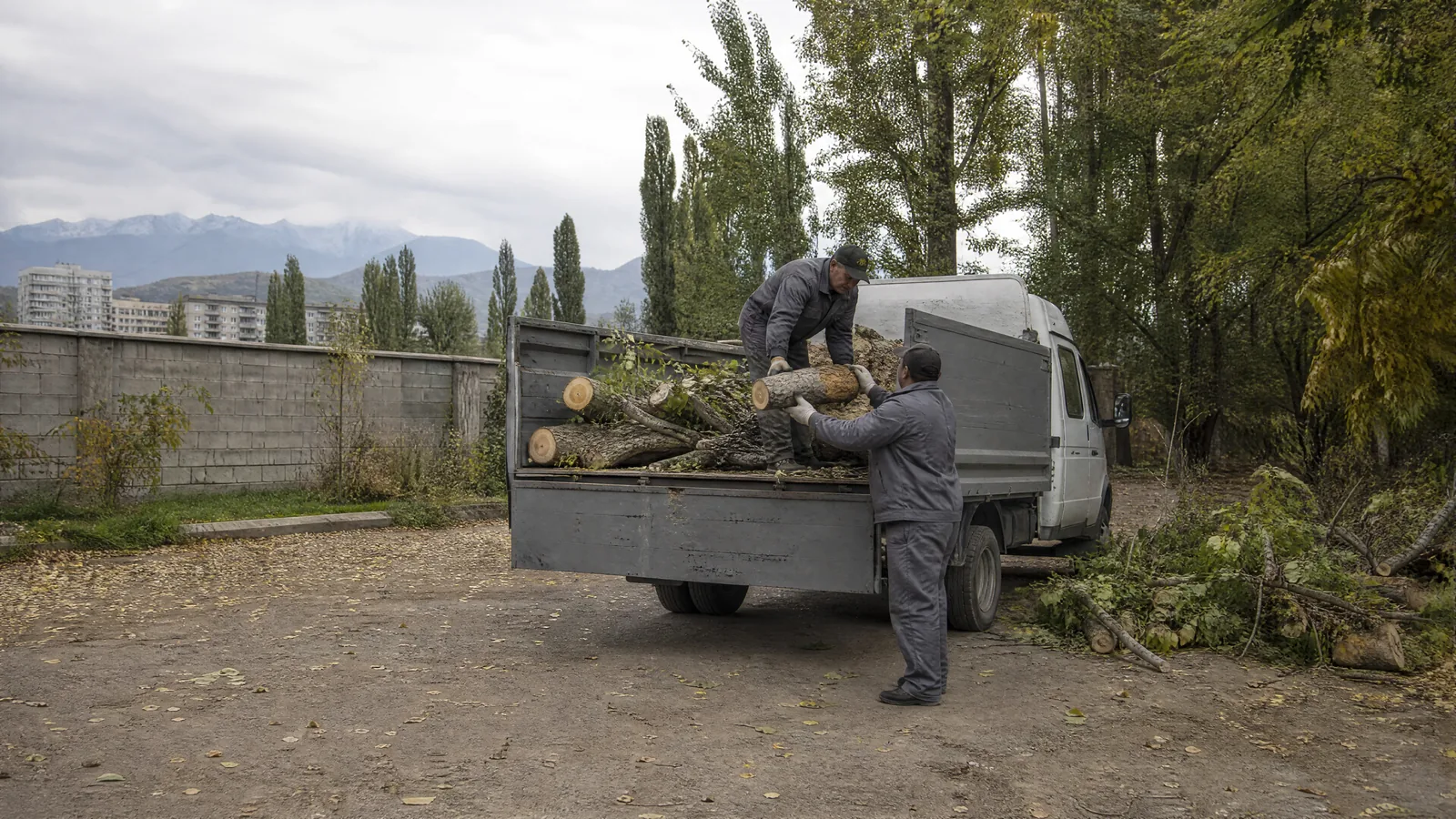
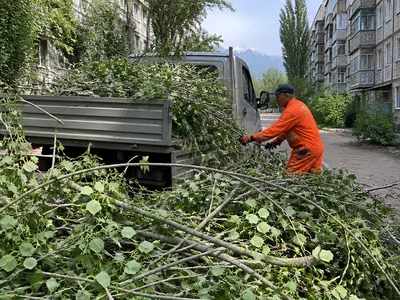
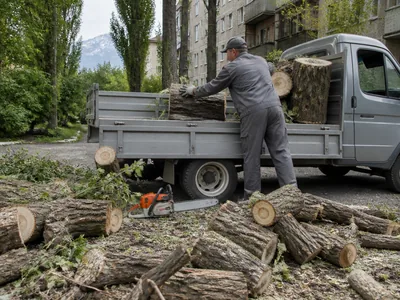
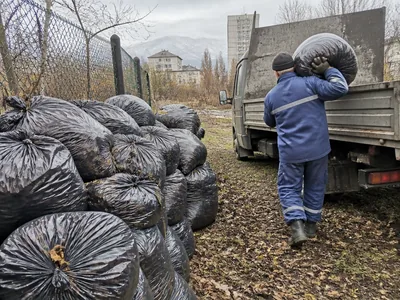
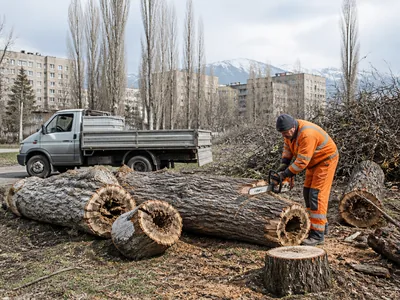
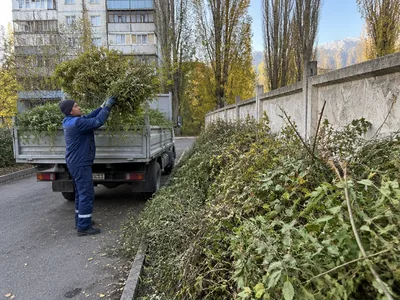
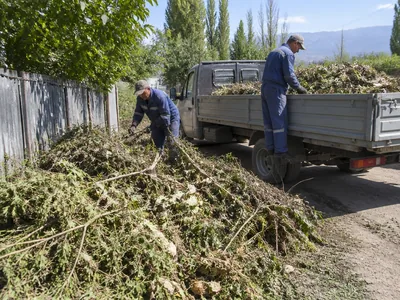
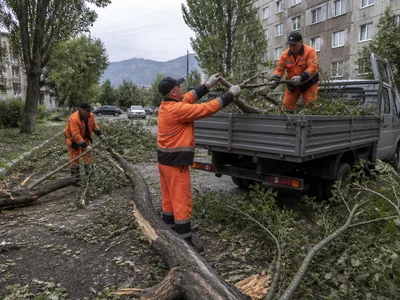
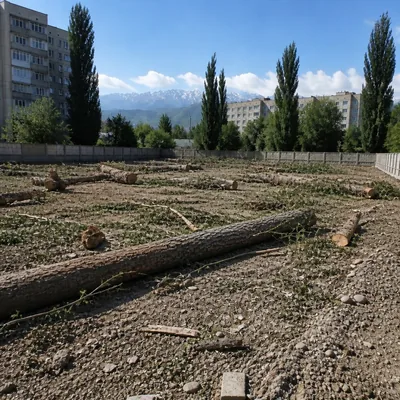
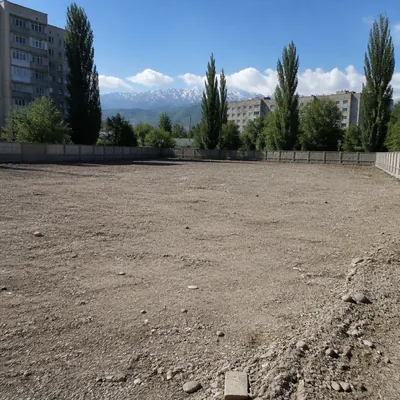
Tell us the address and what the load is: dry branches, a felled tree or a pile of leaves — we'll estimate the volume and give you a price before the truck arrives.
From 30 000 ₸ per run, price locked in before arrival
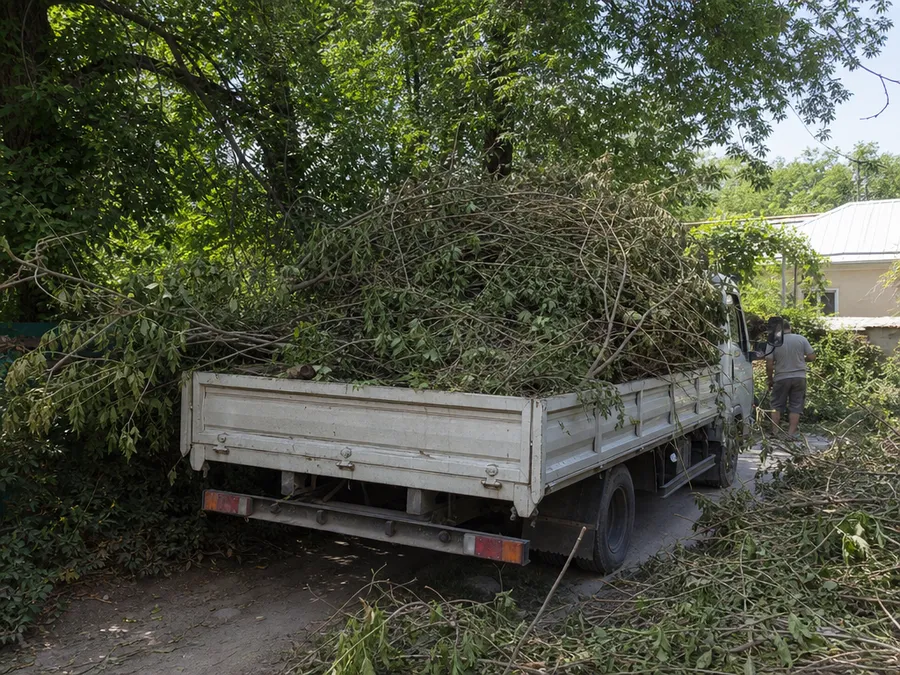
A GAZelle takes up to 12 m³ of branches
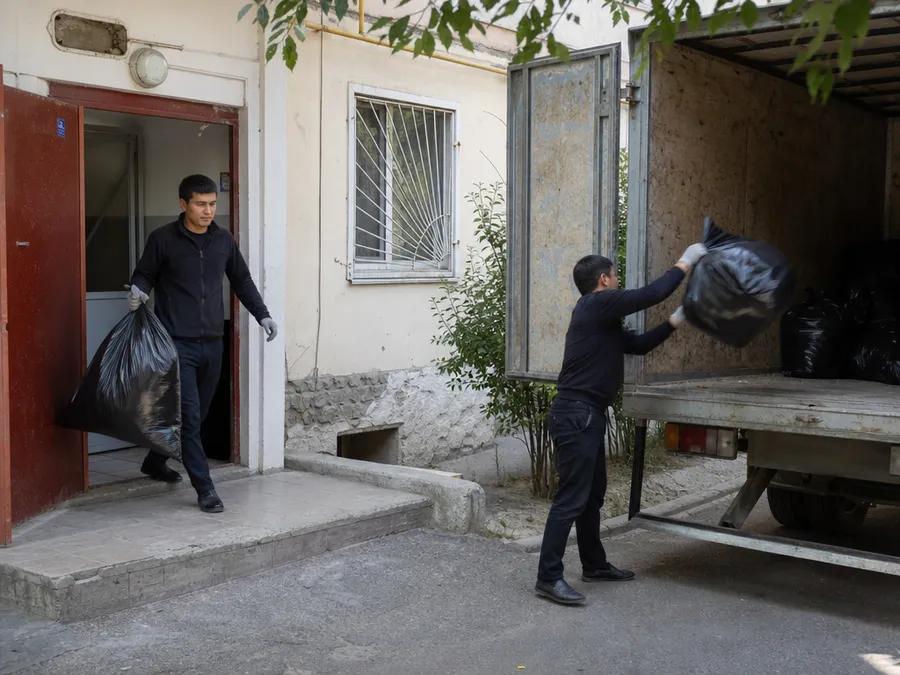
Our own movers saw and load
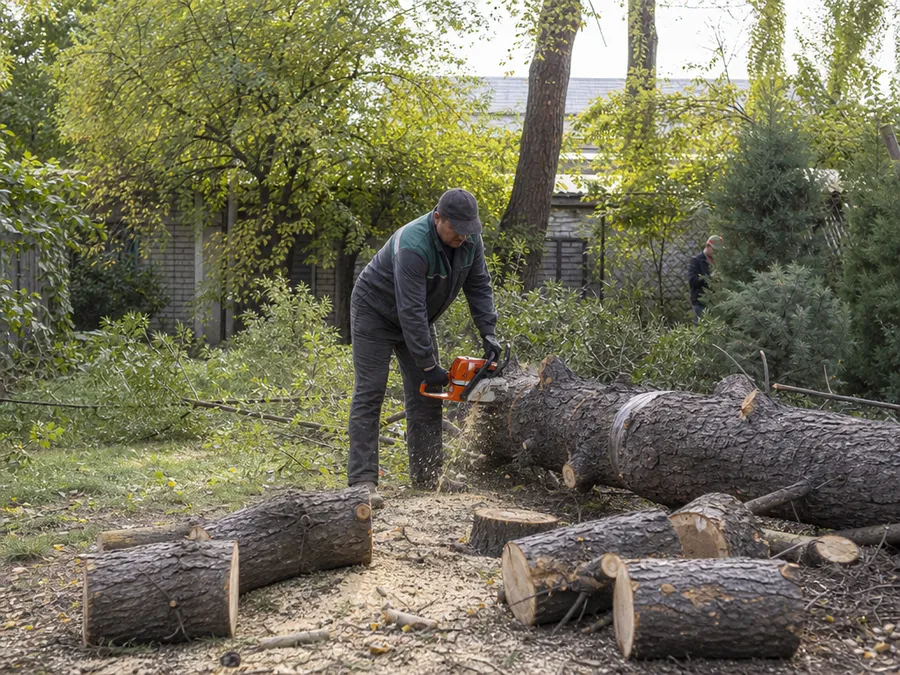
We saw trunks before loading
We work in Almaty and outside the city
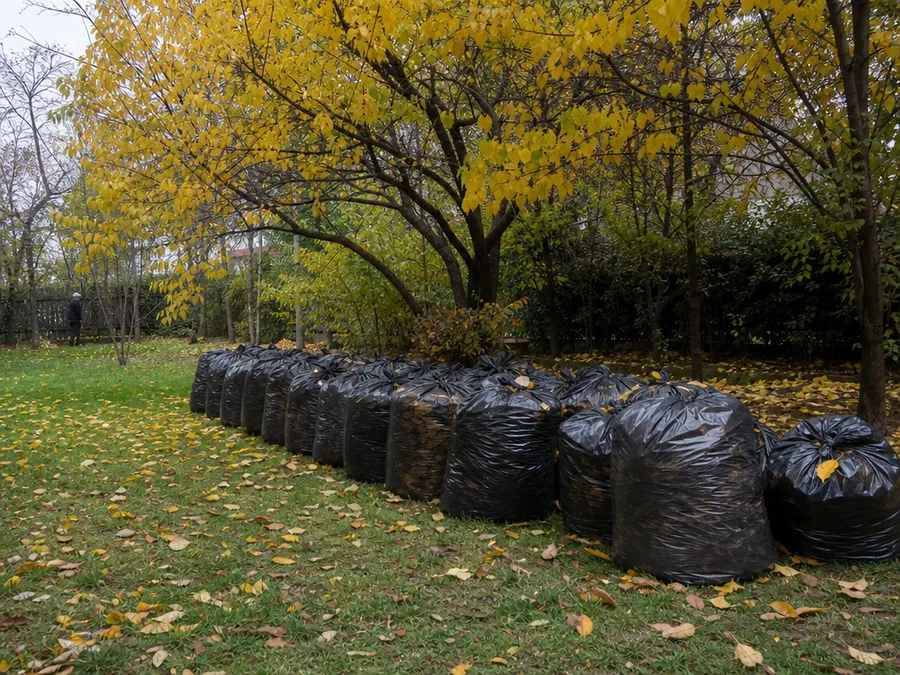
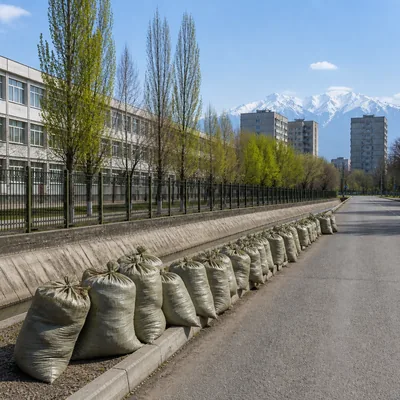
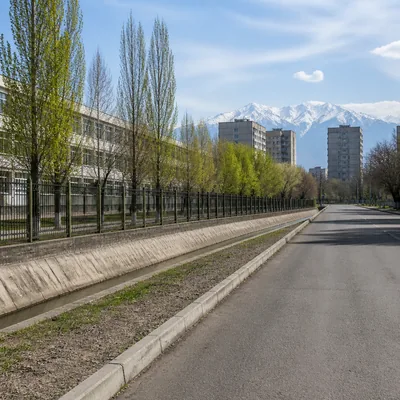
We take leaves in bags and loose
🧮 Estimate
Branch, tree and leaf removal calculator — we estimate the pile's volume and give you a price
Choose what you're removing and how, add sawing or movers — you'll see an approximate total. We'll estimate the volume of branches from a photo: they take up three times more space than they look.
Estimated cost: 0 ₸
We'll give you the exact total after a photo or a quick call. The price doesn't change once the truck arrives.
Thin twigs and branches up to 5 cm in diameter left after spring or sanitary pruning. We take them by GAZelle — the volume is usually no more than the bed.
A two-person crew collects and loads the branches if you don't want to deal with it yourself. We carry them from the gate to the truck and stack them tightly to fit more.
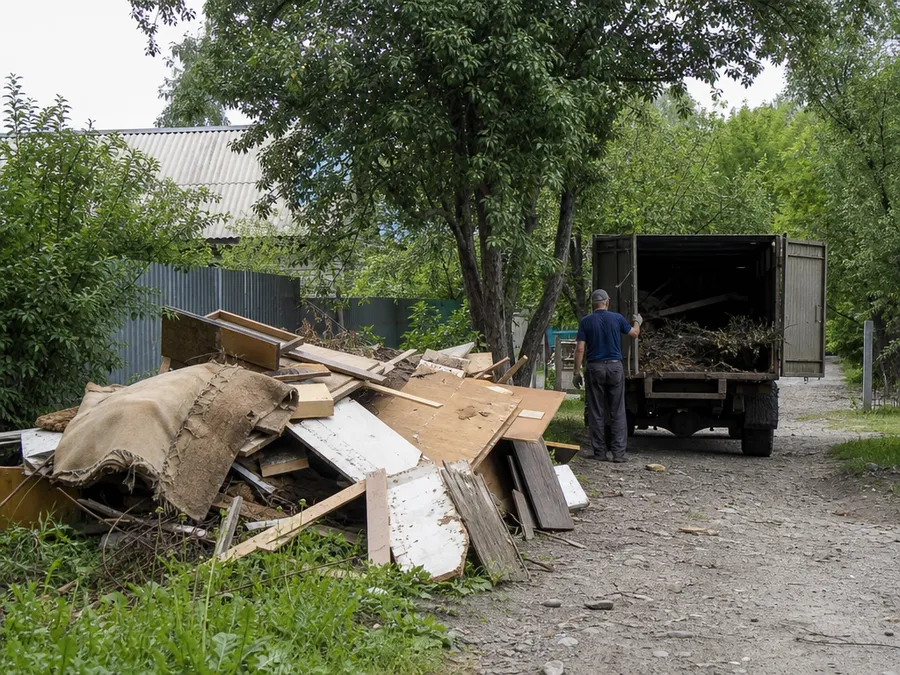
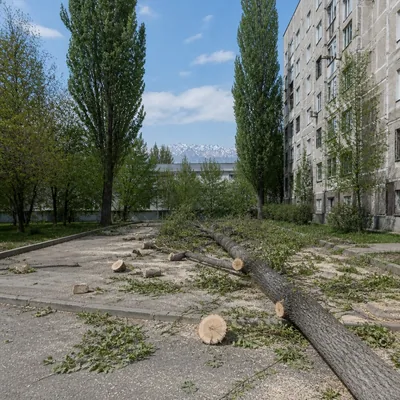
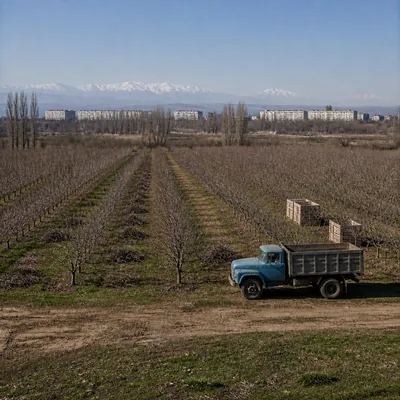
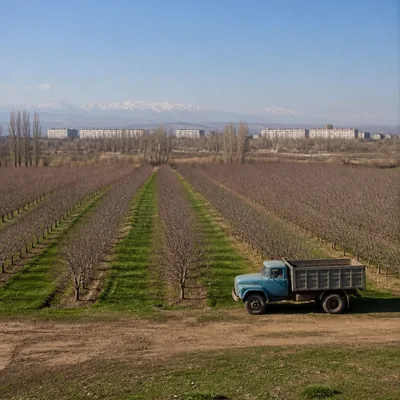
We cut the tree down piece by piece and load the trunk and branches into a ZIL dump truck. People order this when a tree is in the way of construction or hanging over the roof.
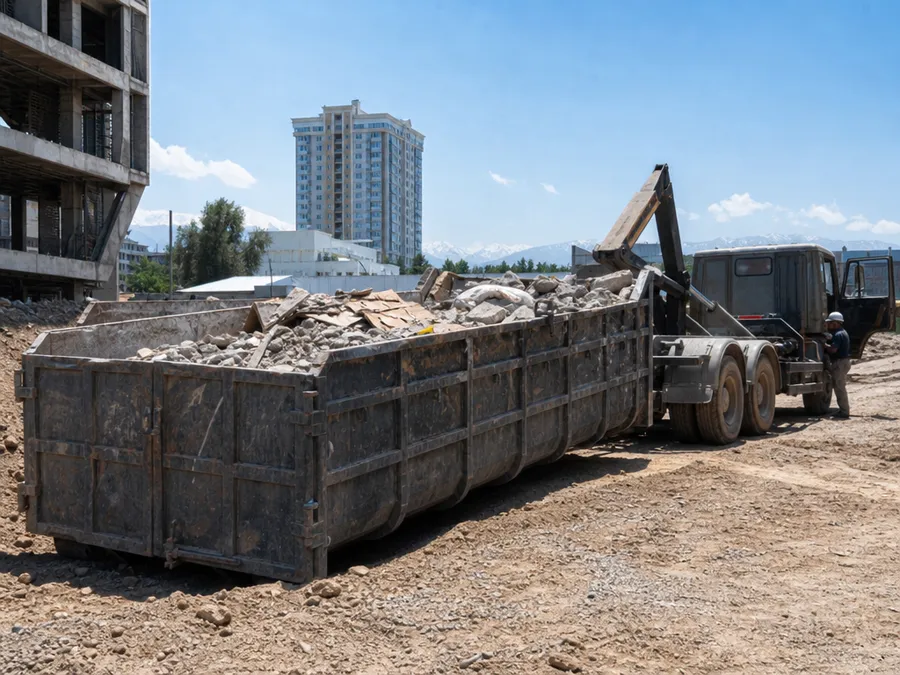
Equipment for branch, felled tree and leaf removal — from GAZelle to dump truck, with body specs
Every pile gets the right truck: thin branches go in a GAZelle, while a trunk as thick as your arm needs a dump truck. Below is what we have and how much it holds.
GAZelle 1.5 t
Bed volume
12 m³
Payload capacity
up to 1.5 t
ZIL dump truck
Bed volume
7–12 m³
Payload capacity
up to 7 t
KAMAZ dump truck
Bed volume
15 m³
Payload capacity
up to 20 t
Skip
Bed volume
27 m³
Payload capacity
up to 15 t
Price list for waste removal in Almaty
Valid from August 2026 · price per trip within the city
Price list for waste removal in Almaty, August 2026
Equipment
Volume
Payload capacity
Price per trip
Extra hour
GAZelle 1.5 t
12 m³
up to 1.5 t
30 000 ₸
6 000 ₸
GAZelle 2.5 t
16 m³
up to 2.5 t
35 000 ₸
9 000 ₸
Truck 5 t
25 m³
up to 5 t
40 000 ₸
12 500 ₸
ZIL dump truck
7–12 m³
up to 7 t
40 000 ₸
12 500 ₸
KAMAZ dump truck
15 m³
up to 20 t
55 000 ₸
15 000 ₸
Howo dump truck
25 m³
up to 40 t
60 000 ₸
15 000 ₸
PUHTO (skip)
8–10 m³
up to 7 t
45 000 ₸
—
Multilift
20 m³
up to 12 t
100 000 ₸
—
Skip
27 m³
up to 15 t
135 000 ₸
—
Max skip
32 m³
up to 20 t
160 000 ₸
—
Loaders:6 000 ₸/hour per person · 20 000 ₸ for a 2-person crew with a GAZelle · 48 000 ₸ for a 3–4 person crew with a ZIL · 80 000 ₸ for a crew with a KAMAZ
By volume:8 000 ₸ per m³, if it's easier to count in cubes rather than trips
Typical estimates:post-renovation 1-bedroom — 50 000 ₸ · facade work — from 60 000 ₸ with a skip · partition demolition — 88 000–135 000 ₸
Prices apply within Almaty city limits. Outside the city, mileage is added — we calculate it in chat before dispatch.
Not sure which truck you need? Send a photo — we'll pick one for you.
What we do in addition to removing branches, trees and leaves — sawing, cutting, stump removal, cleanup
Branches rarely lie there on their own: there's lumber nearby, an old stump, a pile of leaves from the lawn. Tell us right away — we'll come with the right tools.
🪚
Cutting the trunk on site
We saw the trunk and large branches into pieces you can lift and load into the truck. We bring our own chainsaw, no outlet needed.
🪓
Stump removal
We uproot stumps if they're in the way on your property. We take the roots away along with the rest of the branches.
🧹
Sweeping the site after loading
We sweep the spot where the branches were and clean up small debris. The property stays clean, with no wood chips or leaves.
📦
Carrying branches to the truck
The loaders carry the branches from deep in the yard or from behind the house themselves. You don't have to drag them to the gate.
🗓️
Scheduled removal
If your pruning is regular, we schedule pickups on set days. We show up on time, no reminders needed.
📸
Volume estimate from a photo
Send a photo of your pile of branches to WhatsApp, and we'll quote a price before the truck even arrives. A photo saves you an extra visit.
📋 Steps
How branch, felled tree and leaf removal works — from request to empty site
Five steps — from a WhatsApp message to a swept lot. No "the truck will come after lunch, but not today."
Describe the job or send a photo of the branches. Tell us the address and approximate volume — that's enough for a quote.
2
Estimate and equipment selection
We calculate the volume, pick the truck and crew. We lock in the price, and it won't change after we arrive.
3
Truck dispatch
We arrive within 30 minutes in the city, seven days a week. If you need tree felling, we bring a chainsaw and all the gear for working at height.
4
Felling, cutting and loading
We take the tree down piece by piece, cut the trunk into sections, and load branches and leaves. Our loaders carry everything to the truck — you don't have to lift a finger.
5
Removal and cleanup
We take the branches to be recycled and sweep the lot after loading. Your property stays clean.
⭐ Why us
Why people order branch, felled tree and leaf removal from us — six reasons without fluff
Our own equipment for any volume
From a GAZelle to a KAMAZ — we match the truck to the actual volume of branches, not what you think it might be. If there's only a little, we won't send a dump truck.
Loaders who aren't afraid of thorns
We have our own crews, not random people off the street. They work in gloves, carefully carry out branches, and don't leave trash on your lawn.
Price locked before dispatch
We agree on a price — and it stays the same, even if there are a few more branches than expected. No extra charges for floors, mileage or a "tricky driveway."
We work seven days a week
We take requests every day from 9:00 to 21:00. If you need branches removed urgently on a Saturday or Sunday, we'll come.
We pick up and recycle
We don't dump branches in the nearest vacant lot — we take them for recycling. And we sweep the lot after loading.
We know Almaty's private sector
We work in Verkhneye and Nizhneye Selo, Kamenskoye Plato, and Alatau. We know where the streets are narrow and where a dump truck can get in.
📸 Portfolio
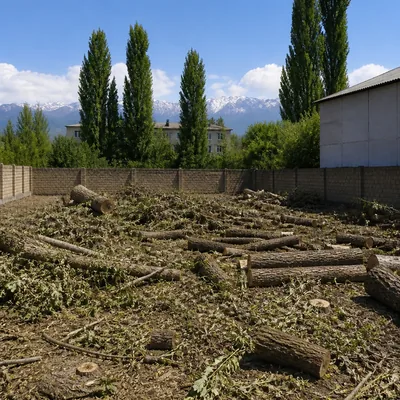
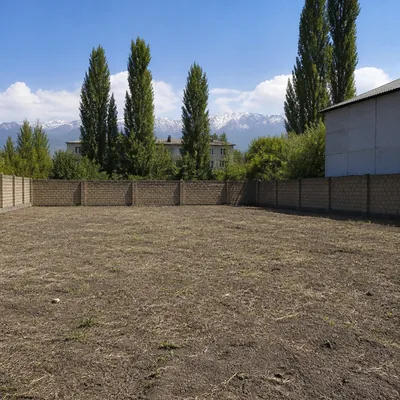
Branch, tree and leaf removal jobs — before and after photos
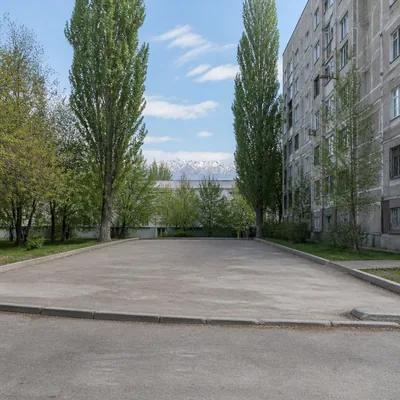
We show you what the property looked like before and after loading. The difference usually speaks for itself in a single photo.
Branch, felled tree and leaf removal: a detailed breakdown — season, volumes, mistakes, landfill
Daniyar Ospanov
Loader foreman
Published: Updated:
They cut down an old elm in the yard — and there it is, a pile. Branches, leaves, a couple of thicker logs, all of it lying along the fence and blocking the way out of the yard. A familiar sight for a private house in Almaty, and for a country dacha too. People call and the first thing they ask is: how much will branch removal cost. And the first thing I ask is: do you have a photo? Because one person's "a few branches" is two bags, and another's is a KAMAZ and a half, and you can't guess that over the phone.
I'm Daniyar, I work as a foreman of loaders. We remove branches, trees and leaves every day, and I can already tell by eye when someone's underestimating the volume by about three times. It's not greed, it's normal — from the outside a pile always looks small. So in this article I'll break it down honestly: how to estimate the volume, what fits in one trip and what needs a second, why dry leaves are deceptively light and wet ones heavy, and where it all goes after loading. No vague talk about a "professional approach" — only what we actually do with our hands.
I'll also explain why "free tree removal" is almost never about you, which branches you can't stuff into a GAZelle even for money, and in which season an order comes out cheaper. If you still have questions after the article — message us on WhatsApp, send a photo, we'll figure it out together.
How to estimate the volume of branches and leaves before the truck arrives
Let me start with an example that repeats every week. A call: "There are branches after pruning, about five cubes, I think." We arrive — a pile two by three meters and chest-high. In reality that's eight cubes, maybe nine. The person looked at it from above and guessed. Because by eye the volume of branches always seems smaller than it is.
So let's figure out how to estimate at least roughly. Not so you can give me an exact number — I'll double-check from photos anyway. But so you know whether to order one trip or two. And so we don't end up with the truck arriving and nothing to load.
A pile of branches by eye vs. a pile of branches in the truck bed: why they don't match
The eye is built to see the top layer. Branches lie loose, with air between them, and that looseness fools you. When we load, we tramp them down, trim them, stack them tighter — and the volume drops by one and a half to two times. But not always.
If the branches are fresh, with leaves, they stack poorly. They spring back, catch on each other, and the bed fills slowly. Dry ones without leaves, on the other hand, pack into a GAZelle almost completely. So the same pile by eye can give different results in the bed.
Another thing: shape. A pile swept into one spot always looks more compact than the same branches scattered around the yard along the fence. By area it seems like a lot, by volume it's the same six cubes.
A bag, a wheelbarrow, a trailer — converting to cubic meters without a ruler
A ruler is a poor helper here. It's easier to count in everyday units everyone has on hand. Here's the scale I use myself when sizing things up on site:
A standard sugar sack packed with dry leaves is about 50–60 liters, that is, 0.05–0.06 cubic meters.
A bag of wet leaves after rain weighs close to 20 kilograms and gives the same 0.05–0.06 cubic meters, just heavy ones.
A 100-liter garden wheelbarrow heaped with branches is 0.15–0.2 cubes, if the branches are small and packed tight.
A passenger car trailer heaped with branches is about 1.5 cubes, but only if the branches are dry and without leaves.
A pile of branches waist-high to an adult and about five paces long is already 3–4 cubes.
Leaves collected in bags and stacked in a pile take up more than you'd think: ten bags is only half a cube.
Now about removing branches from your property. If after pruning you have five to seven bags of leaves and a couple of piles of branches, that's one GAZelle trip. If the branches are from three large trees, plus logs, get ready for two trips or a ZIL right away.
And one more thing: don't try to tramp branches into bags with your feet. It doesn't help much and the bags tear. Better to leave them as they are and show us.
What two-angle photos give you and why one photo is worse than two
When you message us on WhatsApp about removing branches, trees or leaves, send two photos. One — a wide shot so I can see where the pile is: by the fence, deep in the yard, behind the house. The second — from the side, to understand height and density.
Why two? From one photo I see either the area or the height. I can't combine them. But from two, the picture comes together and I can say: GAZelle, ZIL or skip. Sometimes a photo of the pile next to something of known size is enough — a car, a fence, a gate, a person.
What's useless to photograph: individual twigs up close, leaves in bags without scale, a pile at dusk. Volume can't be estimated from such shots, and I'll still have to ask again.
When the volume honestly can't be guessed and an estimator's visit is needed
There are cases when neither photos nor your estimates work. For example, a property in the foothills, a pile of branches going down a slope, and you can't photograph it whole. Or a tree fell and lies mixed with other debris. Or the leaves are wet, compacted over the winter, and it's unclear how many cubes there really are.
In cases like that, I'm honest: come and take a look. An estimator's visit isn't a separate paid service — it's how you avoid picking the wrong truck. If the photos show the volume is borderline, somewhere between a GAZelle and a ZIL, it's better to spend twenty minutes on an inspection than to send equipment out twice.
And one last thing. If you're looking for free wood removal — that doesn't exist. The tree has to be cut down, sawn up, loaded and hauled away. Nobody's going to do that for free, unless you haul it yourself on your own trailer. So don't waste time searching — just message us and we'll tell you what it'll cost.
That's the whole calculation. Rough, no tape measure, but it works. If you're still unsure after reading this — that's normal. Send photos and I'll give you a more precise answer. In my experience, after two shots and a couple of follow-up questions, the volume almost always lines up.
What a GAZelle will take, what a ZIL will, and what only a dumpster
Let me start with what I see every week. We show up to remove branches from a plot in the Alatau district, and along the fence there are three piles of different density. Two neatly tied, one scattered across the lawn. And the owner says confidently: "That's a GAZelle load, easy." In the end we make two trips, because the tied branches fit and the scattered ones with leaves didn't. That's what this is about.
GAZelle: how many branches fit if you stack them smart
A 1.5 t GAZelle holds 12 m³. Sounds impressive — until you start stuffing branches in. Fresh ones, still leafy, and after rain on top of that: they don't stack well, there's air between them, and you actually load far less. If the branches are dry and bundled, you can pack them tighter. Cut trunks, about a metre each — that's a whole different story, and here the GAZelle is almost as good as anything.
An important point: a GAZelle is great for driveways a ZIL can't get into. Narrow courtyards downtown, barriers, low wires. Sometimes wood removal from a plot isn't about volume but about the fact that a big truck physically can't get in. Then the GAZelle is the only option, even if it takes several trips.
ZIL and dump truck: when the branches no longer fit in a light vehicle
A ZIL dump truck — 7–12 m³, and its main advantage isn't the volume, it's the tipping bed. Tilt it and the branches slide out on their own. With a GAZelle you unload every branch by hand; with a ZIL you don't. On tree removal from a plot, where the trunks are thick and heavy, that saves you an hour and a half.
But the ZIL has a price — its size. It can't get into every yard, and it clears wires with room to spare, but not always. And if you already have a corrugated fence on your plot and a three-metre gate, a ZIL won't get through. We check that from photos before dispatch so we don't send the truck out for nothing.
32 m³ bunker: who needs it and why it's not always worth it
A bunker is for when the branches are lying there and nobody's going to tie them up. You bring a container, drop it by the fence, and people toss everything in for a week. For large plots where the cleanup happens gradually, it's convenient. But there's a catch: it has to go somewhere, and not every plot has room for a crane truck to get in.
And another thing: people often order a bunker for no reason. They think "just in case," and end up filling it halfway. Branch removal from a country plot costs more precisely because of the empty space you're hauling too. Honestly: if the pile is already gathered and visible in the photos, you usually don't need a bunker.
How many branches actually fit in a truck
Equipment
Bed volume
Branches actually loaded
When it fits
GAZelle
12 m³
8–10 m³ fresh, up to 12 dry
Narrow yard, little space, short pile
ZIL
7–12 m³
7–9 m³, trunks with almost no loss
Clear access, lots of trunks, dump truck
Dump truck
12–15 m³
10–13 m³, but you need a driveway
Big pile, wide street, room to park
Dumpster 32 m³
32 m³
you won't gather that much at once
Long cleanup, space for a crane truck
Why two GAZelle runs almost never cost half as much as one
People think it's simple: a GAZelle is smaller than a ZIL, so two GAZelle runs are like one ZIL, only cheaper. It adds up on paper, not in real life. Every run means dispatch, loading, driving to the site, unloading and coming back. Loaders' time is spent twice, fuel twice, and you're not paying for the truck body but for the work around it.
Plus the second run is often half-empty. The first trip was packed to the brim, the leftovers went into the second — and you're driving a half-empty truck across the whole city. That's exactly why hauling tree branches with one big truck usually makes more sense than running a small one three times.
But not always. If a ZIL can't get into the yard and the pile is medium-sized, two GAZelle runs will be the only option. That's no longer about saving money — it's about having no other way.
What we check in photos before sending a truck
A photo tells more than a phone call. From a picture you can see whether the branches are bundled or scattered, whether there are trunks among them, whether they're wet or dry. And most importantly — you can see where to load from: the ground, the side, or the third floor after pruning a tree in the yard.
Here's what really affects the choice of truck when hauling branches from a property:
Bundled branches take up a third less space than the same pile scattered loose.
A freshly cut trunk is one and a half to two times heavier than a dry one, and that's about tonnage, not volume.
A narrow yard entrance rules out a ZIL right away, even if the pile is huge.
Leaves separate from branches are two different loads with different loading logic.
Stumps and roots don't go in the same truck body — they're counted as a separate line item.
A pile wet after rain weighs more than it looks, and you need more loaders.
There's also the case where someone asks to haul away a tree for free — saying the wood is valuable, just take it. I get the logic, but free doesn't work out: the saw, the loaders, the truck, the drive to the site — those are all costs. The only free option is self-pickup, if you come with your own trailer and take the logs. We don't do that — we haul and dispose.
And one last thing about choosing. There's no such thing as a "right truck" in general — only one that fits a specific yard and a specific pile. That's why I ask for photos: two minutes for a picture saves both you and us half a day of redoing things.
Branches, trunks and leaves: why these are three different orders
I show up for a job and everything's in one pile: cut branches, dry leaves, a couple of logs. The owner says, "Looks like not much." But I look and realize — these are three different loads that behave differently. They need different trucks, different loading times, and that's why the price can't be the same. Let me break it down one by one.
Leaves: why a bag is light but a truck is packed to the brim
Dry leaves are air. A 120-liter bag will hold about three kilos, no more. But they hold volume like nothing else: once they settle under pressure, the truck body is full and the weight is next to nothing. That's why hauling leaves costs almost as much as branches. Fresh, just-raked leaves are a different story. After rain they get several times heavier, and one person can't lift a bag anymore. I always ask: are the leaves dry or wet? If they're wet, they're not leaves anymore — they're almost soil by weight. And they need to be loaded differently, and hauled out urgently before they start rotting. Leaves are not all the same, and you can't tell over the phone — only from a photo.
Another thing: leaves take up space unpredictably. You think you've gathered them neatly, but during loading they compress and the truck fills up faster than you expect. That's why for leaves we often use a truck with high sides so we don't lose them on the road. And yes, it's better not to mix leaves with branches — otherwise the leaves fall to the bottom, the branches stay on top and you can't tamp them down properly.
Branches: how we stack them so you don't pay for air
Branches are the bulkiest load. If you just toss them in the truck bed, they'll take up three times the space they could. We stack them tight, weave them together, press them down. Sometimes we even have to climb up and stomp on them to pack them in. That's not crude — it's saving your money: the tighter we stack, the fewer trips. But there's a limit: dry branches snap and splinter, while fresh, just-cut ones bend and spring back. Fresh branches are more of a hassle.
And branches come in all kinds. Thin twigs from shrubs can be tied into bundles and take up little space. But thick branches from an old tree are almost logs — heavier to load, and they sit tight in the truck bed but weigh a fair bit. So when you order branch removal from your property, specify: are they thin or thick? That determines both the truck and the time.
And most importantly: branches can't be left outside overnight. In Almaty the wind scatters them, neighbors complain. We try to pick up the same day, but if the volume is large, sometimes we come the next morning. We warn you in advance.
Trunks and logs: when you need a saw, not just loaders
A trunk is a category of its own. A fresh elm or poplar trunk weighs so much two people can't lift it. You need a saw: cut it into 50–70 cm logs, or it won't fit in the truck. We always carry a chainsaw, but we factor in cutting time separately. If the trunk is over 30 cm in diameter, that's not loaders — that's sawyers. And yes, the logs can be left for the owner afterward — some people take them for firewood. But if you don't need them, we haul them away.
Sometimes the trunk is already cut and lying in pieces — then it's easier. But if it's still in the ground or hanging, we don't cut it: that's a job for arborists, our specialty is different. We'll be honest: you need someone who knows how to fell trees. We remove what's already cut.
A trunk's weight is water weight. Fresh wood is 60% water. Let it sit for a month and it'll be half as heavy. So if you can let the trunk dry out, removal will cost less. But not everyone can wait.
Mixed pile: how to estimate when everything's in one spot
The most common case: branches, leaves and logs all dumped together. The key here is not to try to size it all up at a glance. We break the pile down mentally: branches — bulky, leaves — light but take up space, trunks — heavy. If leaves are more than half, we send a truck sized for volume, not weight. If there are lots of trunks, it's the opposite — we watch for overload. Sometimes it's cheaper to do two runs: first leaves and branches, then trunks. But that's rare.
To make things easier, here's what we ask when you request branch and leaf removal:
A photo of the pile — at least one, from different angles.
Approximate diameter of the trunks, if any.
Are the leaves dry or wet, fresh or old.
Are the branches thin or thick, are there thorny shrubs.
Access: can the truck park at the gate or will we have to carry everything through the house.
Floor and elevator, if it's an apartment or office.
Is there other trash to pick up along the way.
From these points we can tell you right away which truck you need and how long loading will take. Without photos we might get it wrong, so we always ask.
I remember going to remove branches from a dacha near Almaty. The owner said, "It's not much, two apple trees." Right, two apple trees — that's four cubic meters of branches and a trunk we sawed for an hour. She was surprised it took so long. I said: an apple tree is dense, heavy. Good thing we brought a GAZelle, not a car.
One more thing: don't try to burn branches on your property. In Almaty you'll get fined for that, and fire safety is no joke. Better to call a truck and forget about it.
Branch removal from a property and from a dacha: what changes outside the city
We go to Talgar, Kaskelen, Uzynagash, Turgen, Boraldai. The road adds mileage, but it's not always more expensive. If a GAZelle circles the city for an hour in traffic, out of town that same hour gets you there. Removing branches from a country plot often goes faster: no traffic lights, no other cars. Though mileage is still mileage — fuel, time, wear and tear. We count honestly.
Can the truck get to the pile: three typical situations on a plot
First: driveway right up close, wide gates — we load straight into the bed, work fast. Second: narrow passage, truck stops ten meters away — we carry branches by hand, that's plus twenty to thirty minutes. Third: dirt road after rain, a GAZelle makes it, a ZIL gets stuck — then either we wait for the weather, or we reload into a GAZelle and make two trips.
Before dispatch I ask: what's the entrance like, is there a barrier, is the driveway blocked by neighbors. A small thing, but it causes more failed dispatches than volume does.
Dirt road, slope, narrow gates — what makes loading harder
Dirt road is the main enemy. After rain there are ruts, the truck spins, we have to add gravel or wait. Slope is second: if the plot is on a hill, we position the bed lower than the pile so branches don't roll back. Narrow gates are third: a GAZelle squeezes through, a ZIL doesn't. I ask about these three things in advance so we don't send a truck for nothing.
Sometimes you can't get into the yard at all — then we work from the street. It takes longer, but it's doable.
Fall and spring: when people haul the most from their country plots
September–November is peak. Leaves, pruning, getting ready for winter. Orders are three times higher than in summer, and it's best to book a truck a day or two ahead. Spring is the second wave: after winter people clear dry brush, broken branches, old leaves. Summer is quiet, but there are occasional orders after a thunderstorm.
In winter, branch removal from a plot is rarely ordered — snow, everything's at a standstill. But if you need it, we work.
If leaves are wet, they're heavy — they weigh like concrete. Dry ones are light but bulky. These are two different trucks.
Why going out of town isn't always as expensive as it seems
The road adds mileage but saves time on loading. In the city there's often no room to maneuver, loaders carry branches through entrances and parking lots. Out of town it's a straight line from pile to bed. In the end, the price difference isn't as big as people expect.
Plus, out of town the volume is usually bigger — meaning one trip instead of two. That's savings too.
Compare: branch removal in central Almaty — a GAZelle, three hours of work. The same volume outside the city — two hours and a round trip. The cost is about the same.
But if the plot is far away, mileage will still add up. We count based on actuals.
What changes when removing branches from a country plot or dacha
Situation
How it affects loading
How it affects the price
Driveway right up to the pile
We load straight into the bed, minimal time
Standard rate, no surcharges
Narrow passage, truck 10 meters away
We carry branches by hand, plus 20–30 minutes
More expensive due to loader labor hours
Dirt road after rain
A ZIL won't make it, only a GAZelle or we wait for the weather
Possible second trip or rescheduled dispatch
Sloped plot
We position the bed lower than the pile, branches don't roll
Time for maneuvering, but no extra charge
Wet leaves
Heavy, need a larger bed volume
May require a ZIL instead of a GAZelle
Dry leaves
Light but bulky, fill the whole bed
GAZelle, but packed tight
The procedure on a country plot is different from the city. Here's how we work:
We call, confirm the address, volume, and exactly what we're removing: branches, trunks, or leaves.
Send us a photo of the pile and the driveway — that's how we know which truck you need.
We calculate the mileage, give you the price, and lock it in before we arrive.
On the day of the pickup, the truck arrives, the loaders size up the driveway, and start loading.
We load branches, leaves, and trunks, packing them tight so it all fits in one trip.
After loading, we sweep the area and pick up the small debris.
We haul it to disposal, unload, and head back.
If your property has branches, leaves, and trunks, it's one order, but we price them differently: trunks are heavy, leaves are bulky. Removing trees from a property sometimes requires a chainsaw to cut the trunk into logs.
Is tree removal free? No, nothing's free. But if the tree is dry and can be cut into firewood, that's not removal — that's firewood. We don't do that.
Removing tree branches from a dacha is our daily work. Ask us, we'll help.
Read this far and still not sure about the volume? Send us a photo — we'll calculate and give you a price.
How we load branches and leaves and what we do with the site
We arrive — and the first thing we do isn't grab the branches. The foreman goes to take a look. He walks around the pile, kicks it, digs through the top layer. He needs to see what's inside: there could be wet leaves, scrap boards, bags of something heavy. That determines how many people to put on loading and which truck to send. Branch removal only looks simple.
Next — estimating the volume. The main thing here is not to be fooled: a pile of branches looks intimidating, but in reality it's one GAZelle trip. Or the opposite — a small-looking heap of leaves, but it's wet, compacted, and heavy as cast iron. We figure out how many cubic meters it'll be once it's packed into the truck bed. Because branches don't stack evenly: thin twigs take up a lot of space, thick trunks take little but weigh down.
What the foreman starts with when he arrives on site
The inspection isn't a formality. If you don't notice right away that there's a concrete slab or old tires under the branches, you'll have to unload them back and explain yourself. Or that the pile is in a narrow driveway where a GAZelle can't turn around. Then we either reposition the truck or carry the branches out by hand on stretchers. We've seen it all.
The foreman also checks if there's an outlet nearby for a saw. If the branches are long, they'll need to be cut, and a chainsaw isn't always appropriate in a yard — neighbors might object to the noise. Then we use a hand saw or a battery-powered saw. It's a small thing, but it affects the pace.
After the inspection, the foreman tells the client: this many cubic meters, this truck, this many trips. If the volume doesn't match what was discussed from the photo, we sort it out on site. The price is fixed before arrival, so any changes only with the owner's consent.
What we do with branches that don't fit in one trip
Sometimes there are so many branches that a GAZelle can't take them all at once. Then there are two options. Either we load everything that fits, haul it away, and come back for the rest — but that's two trips, and the owner should understand that the second trip isn't a "surcharge for audacity," it's fuel and time. Or we order a bigger truck right away: a ZIL or a dumpster. A 32-cubic-meter dumpster is for when the branches are long, don't need to be cut into pieces, and can just be tossed into the container.
Another nuance: if the branches don't fit, but some are thick trunks, we can leave them for next time or suggest the client cut them into firewood. Sometimes people ask themselves: "Leave the logs, I'll use them for the banya." Then we stack them separately.
What we sweep the area with and why it's not a formality
After loading, there's debris left: leaves, small twigs, dirt, wood chips. We don't leave until we've swept. The truck always has two or three brooms and scoop shovels. If the area is asphalt, we sweep with a stiff broom; if it's a lawn, we're careful not to tear out the grass.
Why bother? Because the owner pays for removal, not for cleaning up after us. And because the neighbors are watching. If we leave a pile of trash behind, they'll hire someone else next time. So sweeping isn't a favor — it's part of the job. Hauling away leaves without sweeping is a half-assed job.
Sometimes you have to sweep twice: first right after loading, then again once the truck pulls out, because the wheels can drag dirt around. But that's small stuff.
What the owner is left with after we leave — and what they're not
After we're done, you're left with a level spot. No branches, no leaves, no wood chips. If we agreed to leave logs for firewood, they're stacked neatly in one place. If we agreed to dig something up or trim something back, that's a separate conversation — that kind of work isn't part of branch removal.
And no "surprises" either: we don't dump branches around the corner or burn them on site. Everything goes to proper disposal. Where exactly — I'll cover that in the next section. For now, remember the main thing: if someone promises free tree removal, they're probably just dumping it in the nearest green belt. We don't do that.
So that's the deal. If anything's unclear, ask me on WhatsApp and I'll explain. Tree branch removal is hard work, but it's routine for us. We'll leave it clean.
Wet leaves weigh three times more than dry ones — that's the big surprise when loading.
Conifer branches are prickly, so the loaders work in thick gloves.
If the pile has particleboard scraps or old boards, they need to be pulled out separately.
We only dig out a stump from a felled tree on a separate request.
Branches longer than two meters get cut down, otherwise they won't fit in the truck bed.
Don't tie leaf bags too tight — they rot and then the smell lingers.
Where branches, trunks and leaves go after loading
We pull out of the yard — and the pile is gone. But the owner has a fair question: gone where? We don't dump it in the nearest green belt — you can tell right away from the truck: the bed is closed, nothing sticking out. The route is this: from you to a site where the load gets sorted. Branches and leaves go separately, trunks separately. Leaves get pressed, branches get chipped into mulch, logs go in a separate compartment. If you ordered tree branch removal, it all goes in one truck, but sorted by type.
Why you can't just haul branches out of town and dump them
Dumping in a green belt isn't disposal — it's just moving the problem. In a month the branches dry out and become a fire hazard. Plus fines: for unauthorized dumping inside the city or in the suburbs, the fine goes to the property owner, not the truck. That's why we don't offer a "cheap option — haul it out of town and leave it." That kind of free tree removal ends with a talk with environmental inspectors. Honestly, in five years I've never seen it end well.
From experience, people underestimate how many branches are left after pruning a single tree. An average elm in a yard means 3–4 cubes of branches and leaves, loose. If you cut three trees, the volume compacts in the truck bed to 8–10 cubes. That's almost the entire bed of a 12 m³ GAZelle. Knowing where the load goes helps you avoid getting stuck in a mess with the neighbors and the chairman.
What you can make from a felled tree before removal
Before you call to order tree removal from your property, take a look at the trunk. Straight logs 40–50 cm long are firewood or blanks for woodworking. You can keep those and only haul away the branches and leaves. That way you pay less: smaller volume — smaller truck. We often recommend exactly that, even though it's more profitable for us to haul everything. But we don't want to cheat you.
If the logs are damp and heavy, leaving them on the plot is pointless — they'll take a year to dry. Better to haul them away with the branches. But dry trunks that have been lying around for over a year are great firewood. Keep those.
Leaves separate, branches separate: why bother
Leaves are the trickiest load. Dry, they seem weightless, but they don't compact in the truck bed: you drive, and they fly. Wet, after rain, they get two or three times heavier. We always ask when you book: are the leaves dry or have they been sitting in the rain? That determines how many people we need for loading and what transport to send.
You can mix branches and leaves in one compartment, but it's awkward: leaves sift between the branches and then you can't scoop them out. So we load in layers: big branches first, then leaves, then branches again on top. That way the bed packs tighter.
Can wood chips or logs be returned to the plot
Yes, if you told the foreman in advance. We can leave the chips with you instead of hauling them away — for mulch on garden beds or paths. We also return logs if you need them. One catch: chips take up space in the truck, so an order to remove branches from a dacha plot with chips returned may need a second trip. But that's cheaper than buying mulch separately.
It happens the other way too: someone asks to haul everything away, then regrets not keeping the firewood. So we ask before loading — no one's coming back later.
Here's how it goes step by step:
The truck leaves the yard, the bed is closed, the load doesn't scatter on the road.
On the way to the site we don't stop in green belts or dump anything in the wrong place.
At the site the load is weighed and sorted by fraction.
Branches are chipped, leaves are pressed into briquettes, trunks are sawn into logs.
Chips and logs can be returned to the plot if you asked for it in advance.
Everything else goes to recycling or disposal according to the site's rules.
What happens to each fraction is shown in the table:
The fate of the load after pickup
Fraction
What they do
Can be returned to the plot
Time
Branches
Chipped into wood chips
Yes, by arrangement
On the day of removal
Leaves
Pressed into briquettes
No
On the day of removal
Trunks
Sawn into logs
Yes, if requested
1–2 days
Roots
Crushed separately
No
Up to 3 days
If you still have questions about removing leaves or branches, message us on WhatsApp — I'll explain it simply. And in the next section we'll look at how not to overpay for an extra trip.
The bottom line: branch and leaf removal without surprises
If you've read this far and your head is still spinning — that's normal. The material is dense; when I first started, I myself got confused about what was a GAZelle and what was a skip. So here's a summary: four things that really affect your order. The rest are details; they'll come up in the chat.
Three things that affect the final price the most
First — volume. Not 'how many branches', but how many cubic meters they'll take up once loaded. Second — weight. Dry leaves fly; wet ones after rain pull so hard the truck bottoms out. Third — access. If the driveway is clear and the site is by the wall, that's one story; if you have to carry everything across half the yard, through a gate with a low crossbar — that's a different one.
We estimate volume from a photo next to a reference: fence, person, car, door.
You can't measure weight with a pitchfork, but you can tell the species: elm is heavier than acacia, poplar is lighter.
A long carry adds time, and time is a strain on the crew.
Wet leaves after rain weigh like wet sand; better to let them dry out a bit.
A stump from a felled tree is a separate story — it gets uprooted, not loaded.
A mixed pile (branches, leaves, logs) is always more awkward than a sorted one.
Those six points are your conversation with the foreman. If you have an answer for each, the order comes together in five minutes.
What to photograph before calling so you don't have to redo the order
Shoot the pile from two or three angles, and put something of a known size next to it. Not a full-length shot of yourself against a fence — a bucket, a wheelbarrow, a tire, a shovel. With a reference object in the photo, I can see the scale; without one, I'm just guessing. Also important: where the pile sits relative to the gate and where a truck can park. If the driveway is blocked, that changes the whole delivery plan, and it's better to know that upfront than when the GAZelle is already in the yard.
Photograph dry and wet piles separately. The dry ones will go easily; the wet ones may need a different approach and, frankly, a different budget. One wide shot and one close-up — that's almost always enough.
When to wait and when you can't put it off
Branches don't spoil on their own. If they're sitting in the backyard and not in the way, you can wait — but not for long: dampness starts underneath, and by spring there's a nest in there. Leaves are better removed before the rain, because afterward their weight doubles, and hauling branches off the property turns into hauling wet mass that not every truck can take in one trip.
Urgent — when the pile is blocking the exit, when the neighbors are already messaging, when the lot is being prepped for construction. A felled tree in a yard with a narrow driveway is also not the kind of thing to sit on: the longer it lies there, the more trash gets trampled into it.
What to ask the foreman if you're unsure about the volume
Ask straight out: how many cubic meters do you see, and why. A good answer includes a comparison — "like two GAZelles," "like one dumpster." A bad one is "well, roughly." Also clarify what's included in the service: just loading, or sweeping the area too. We sweep up after ourselves, but it's better to say it upfront so there are no questions later.
And one last thing. If someone promises free tree removal — ask exactly what they're taking. Usually it's the trunk, which will go for firewood, and the branches and leaves will still be left behind. It's not a scam, just different things. Tree removal from a property is always a combination: trunk, branches, leaves, and each part follows its own logic. Sort this out before the truck arrives, and branch removal in Almaty will go smoothly, with no redoes and no extra trips.
❓ Questions
Frequent questions about branch, felled tree and leaf removal — short and to the point
We will. Cut branches are actually the easiest case: nothing to saw on site, just loading and removal. Send a couple of photos of the pile to WhatsApp and tell us if a truck can get close. We'll estimate the volume from the photos and tell you which vehicle.
We do cutting, but not always — it depends on where the trunk is and where it might fall. If the tree is in a tight yard between a fence and wires, I'll be honest: some of the work is better left to an industrial climber, and we'll take the cut pieces. It doesn't affect branch and tree removal — we'll handle loading and recycling.
A GAZelle trip is from 30 000 ₸, a crew of loaders for it is 20 000 ₸. But quoting a number for branches blind isn't fair: a fluffy pile of brushwood and a dense trunk take up different volumes at the same weight. Send a photo — we'll count by cubic meters, 8 000 ₸ per cube, and lock in the amount before we arrive.
Yes, it's more expensive, and here's why. Within Almaty we drive around the city, but outside the city mileage is added to the trip — both ways. We calculate the rate by distance from the city, so tell me the plot address and I'll give you the total right away, no surprises on site.
We do, but leaves are a tricky thing. In bags they're heavy, but loose they fill the truck bed with almost no weight, so sometimes a skip is better than a GAZelle. Tell me roughly how many bags or how big the pile is, and we'll pick the vehicle so we don't have to send it twice.
We take them to recycling — to a site where green waste is processed, not dumped in the steppe. After loading we sweep the spot so no chips or leaves are left. Need proof of recycling — ask in WhatsApp in advance, we'll answer for your case.
You can, but not free in the literal sense. Usually it's people who want firewood: they'll come and take the straight dry trunk — but leave the thorns, wet leaves and soggy brushwood in your yard. In the end you'll still have to pay, just for what's left. We take everything at once.
It depends on the truck. A GAZelle gets in almost anywhere a car can go, but a ZIL or KAMAZ might not squeeze into a crooked yard between poles. That's why I ask for photos of the driveway and gate — we'll pick the right size, and if the vehicle can't get through, we'll carry the branches to the road by hand.
We'll handle it — we've got heavy-duty gloves and workwear for this, it's not our first time. Just one thing: if the pile is really fresh and prickly, it's better not to trample it down yourself beforehand, leave it as is. We'll sort it out and load it ourselves.
Then we either load the rest on a second run, or send a bigger truck right away — the bill doesn't change either way, the price per run is fixed. I'll tell you the extra charge for the second run before we start, not after. Usually you can tell from a photo whether it'll fit or not.
Got a question that's not here? Ask — we'll answer in writing, no call needed.
Reviews of branch, tree, and leaf removal — what clients in Almaty say
4,9
Based on 23 reviews on this page
V
Viktoria
I ordered leaf removal from my property for the first time and was afraid I'd have to drag the bags to the road myself. Nope, they came into the yard and took everything from where it was.
Company replyThanks for trusting us. You really don't need to drag bags to the road — that's our job.
N
Nurlan
I had branches hauled away from the property after pruning the apricots. They arrived on time, everything was neat. The price didn't change.
A
Aizhan
The branches from the apple trees were hauled away quickly, and the leaves were taken too. But we waited a bit longer for the vehicle than promised — about an hour. Overall fine, no regrets.
Company replyThanks for writing. There was a traffic jam on Ryskulov that day, so we were delayed. Next time we'll let you know in advance.
G
Gulmira
Everything was removed neatly, branches and leaves taken off the property. The only thing — we waited for the truck a bit longer than promised, about an hour and a half. But they warned us in advance, so no big deal.
L
Laura
In winter it seemed like the branches would just sit there until spring. But they hauled them away even through the snow.
Y
Yelena
they arrived quickly, took everything. branches and leaves hauled away, the yard is clean. thanks a lot!
G
Gulnara
We were cleaning up the property after winter — deadwood, broken branches, last year's leaves. I thought I'd have to haul bags to the dump. Aigul said one GAZelle wouldn't be enough, but we managed. They arrived by nine in the morning, and by lunch everything was clean. My neighbor even asked who we'd called.
Company replyGlad we made it by lunch. We'll pass that on to Aigul — she loves it when everything goes to plan.
A
Asel
After pruning the apple trees, branches piled up in the yard of a private house. Askhat came, looked at the volume, and gave a price right away. He didn't add anything later.
Company replyThanks for writing. Apple trees after pruning always make a decent volume — good thing it all fit in one truck.
V
Viktor
I cut down two trees on the property, and they hauled away the branches and leaves in one go. Everything was efficient, no unnecessary talk.
A
Aigul
They collected and hauled away the cut branches from the garden. Yerlan came, looked at the volume, and gave a price — and it never changed. The work was done cleanly.
T
Timur
In winter, snow piled up, and underneath were branches from the fall pruning. I thought we wouldn't clear them until spring. But they came, dug them out, and hauled them away. Thank you.
Zh
Zhanat
We were clearing an old orchard on the property — cut down six trees, and the branches really piled up. I thought we'd have to order a dumpster, but Dinara estimated from photos and suggested a GAZelle with loaders. It came out cheaper. We did the cutting ourselves, and the guys took care of hauling the trees off the property. They worked for about three hours, didn't rush, stacked everything neatly.
Company replyThank you! Six trees is a serious volume, glad we got the right vehicle.
D
Daniyar
Neighbors at the dacha asked for help — a storm had broken two birches. Branch removal from a dacha plot turned out easier than I thought. I called, explained that the driveway to the plot is narrow, and they sent a smaller truck.
D
Dmitry
After the storm, a large poplar branch broke in the yard and blocked half the parking lot. I called for a vehicle, and they arrived within an hour. They sawed off the rest, loaded it up, and swept the area. The neighbors breathed a sigh of relief.
M
Marat
We cut down an old elm in the yard and were left with two piles of branches — it would've taken us a week to haul them ourselves. I called in the morning, and by noon a GAZelle with two loaders arrived. They took everything, leaves and all, and swept the area. It's nice when you don't have to explain things twice.
M
Marat
I cut down three old apricot trees in the yard, and the branches sat there for a week. They came, loaded them up, and swept up after themselves. The smell of summer brought back childhood memories.
Y
Yerzhan
I trimmed the poplars along the fence, leaving about ten meters of branches along the road. Askhat said one GAZelle wouldn't be enough, and he was right. They came with two vehicles and loaded everything in an hour. My neighbor later asked for the number — he'll be calling them too.
A
Askhat
I trimmed the trees along the fence, and quite a few branches piled up. I called, and they came the next day. The loaders tossed everything themselves; I just showed them where it was.
N
Nurlan
It was autumn, and the leaves were knee-deep. My neighbor said he'd burn them himself, but then changed his mind, and we called a truck for two properties at once. They came Saturday evening, though I thought they wouldn't come at all. They hauled everything away fast, even left their rake at my place — brought it back the next day.
O
Olga
The dacha plot had been abandoned for about five years, and in that time trees and bushes had grown wild, everything overgrown. We decided to clear it, but we couldn't have managed on our own. We called for a vehicle with loaders. They arrived at six in the morning to beat the heat. They cut, hauled away, and the plot looked as good as new. Daniyar was in touch the whole time, advising on what could stay. Very pleased.
Company replyThank you, Olga. Daniyar often goes to dachas — he knows how neglected they can get. Glad we could help.
S
Sergey
after renovation, branches and leaves were left in the yard, so I called for a truck. they arrived quickly, took everything, swept the yard. the price is fair.
M
Madina
My husband and I bought a house, and it came with an old garden — diseased trees, dry branches. We had to uproot and haul everything away. We ordered a dumpster, and the movers arrived. They worked all day and made several trips. They left the ground level and even swept it. Thanks to Yerlan for suggesting a dumpster instead of a GAZelle — we saved money.
Company responseCongratulations on your purchase! Yerlan always estimates the volume from a photo so the truck doesn't make a wasted trip. Good luck with the garden.
B
Bekzat
My brother and I took on clearing our grandma's property, and nothing had been touched there for about ten years. Branches, deadwood, layers of leaves. Honestly, I thought it was impossible to haul away in one go. Three of them arrived with a dumpster and worked almost until dark. They removed everything in a day, and the next day we just gave the lawn a once-over. The price didn't change by a single tenge.
Showing 3 of 23
Want the same? Describe your task — we'll calculate and give you a price before the truck arrives.
Articles of the Administrative Offenses Code of Kazakhstan, amounts in MCI for 2026, and who's responsible for the garbage — the carrier or the client.
Removal of branches, trees, and leaves — and other waste removal services
Order branch, felled tree and leaf removal today — message us on WhatsApp, we'll reply right away
Branches, a felled tree, autumn leaves — all of it will be gone the same day if you message us in the morning. Give us the address and send a photo of the pile, and we'll take it from there.