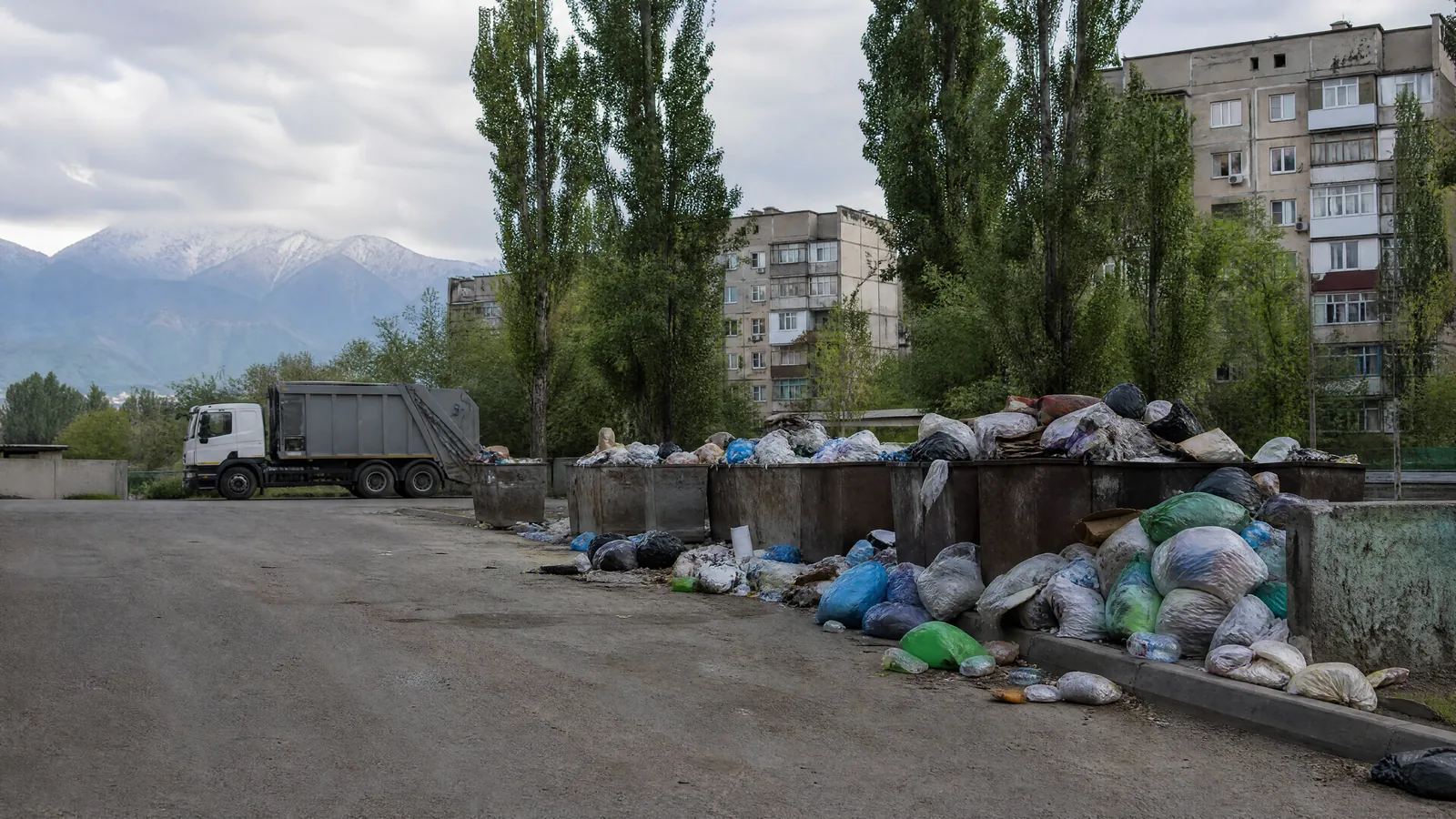

Why waste removal became a problem instead of a routine
Ten years ago a janitor with a cart could handle half a courtyard. Today the cart can't handle a single entrance. And it's not that people got dirtier. It's that waste got bulkier, lighter and faster. Packaging, delivery, renovations — all of this turned the waste problem from a sanitary one into an urban one. Waste removal stopped being routine because waste stopped being predictable.
There's more waste, but no more space for it
Reason one: packaging. Every delivery order is a box, tape, filler, sometimes a plastic container. The order arrived, the box stayed. People used to go to the store with a bag, now they get three parcels a day. The result — the impact of waste on the environment starts in an ordinary stairwell, where boxes pile up faster than anyone can take them out.
Cities grew, but the sites didn't. A new residential complex on the site of an old five-story building produces several times more garbage. The yard is small, there are two containers. And already the harm from waste shows up not somewhere far away, but right outside your window: an overflowing container, smell, flies. The garbage removal problem starts with arithmetic nobody ever did.
Transport hits a wall too. A narrow yard, parked cars, a barrier with no key for the driver. A GAZelle gets in, a KAMAZ doesn't. So you have to split the trips. Time grows, the truck goes around a second time, and the garbage waits. That's how the waste issue turns into a logistics one.
What happens when the truck doesn't show up on time
A day. Two. The container overflows, bags get stacked beside it. Wind scatters the light stuff, rain soaks the cardboard. Liquid from food waste runs into the storm drain — and now the impact of waste on the environment goes beyond the yard, into soil and water. This isn't a scare story, it's what I see every other shift.
Then the rats show up. They come for the smell and they stay. The yard stops feeling like home, people stop going out in the evening. The environmental side here isn't about landfills or global warming anymore — it's about being scared to walk past your own building entrance.
The nastiest part is when the trash gets burned. Plastic, film, PET. The smoke is acrid, it settles on laundry, on playgrounds. At that moment the harm to nature becomes direct and fast: not over years, but over minutes. And that's no longer a question of convenience.
How a city landfill differs from an illegal dump
A city landfill is a place where waste is brought in an organized way. It's guarded, it's compacted, it's at least sometimes covered with soil. It doesn't beautify the area, but it has boundaries and someone responsible. An illegal dump is a ravine behind the garages where people haul stuff at night to avoid paying. The difference is fundamental.
At an illegal dump there's no one keeping order. Rain washes out of it what would be better left unwashed. Wind scatters the light stuff all around. And the main thing — it grows. First it's three bags, then three KAMAZ trucks, then construction debris and old furniture get dumped there. The harm to nature at spots like this concentrates like in a funnel. Most often these gullies appear on the outskirts, where there's no shared container: there waste removal in the private sector on request saves the day, and after the season — waste removal from the dacha.
A city landfill isn't a gift either. But it has what an illegal dump doesn't: it's visible, it's counted, it's monitored. Waste monitoring at official sites isn't a formality, it's a way to keep the problem from growing in silence. An illegal dump stays silent until it flares up.
Who's actually responsible for waste removal in the yard
Everyone points at everyone else. Residents — at the management company. The management company — at the contractor. The contractor — at the schedule and at the fact that the truck wasn't let into the yard. In the end the waste sits there and no one's to blame. Familiar story, right?
In reality the chain is simple. There's someone who pays. There's someone who hauls it away. And there's someone who creates the trash — that's us. If even one link decides "that's not my problem," the global waste crisis starts right in that yard. Not at a factory, not at a landfill — with the decision "let someone else deal with it."
What can one person really do? Sort at least what's easy to sort: cardboard separately, glass separately, food waste separately. Don't dump construction debris in a regular container — that needs its own truck. And don't burn it. These three things already reduce the impact of waste on the environment here and now.
If you break down what happens to garbage that isn't picked up on time, the picture becomes simple:
- The container overflows, and bags start piling up next to the site.
- The wind scatters light packaging across the yard and neighboring streets.
- Rain soaks the cardboard and washes runoff into the storm drain.
- The smell attracts rats and insects, and the yard becomes unsafe.
- Someone takes matters into their own hands and hauls the trash to the nearest ravine.
- An illegal dump appears in the ravine, growing silently.
- By the time anyone notices, it takes trucks to clean up, not bags.
That's the whole arithmetic. It's not about the trucks at all. It's about trash not being allowed to wait. Not a day, not an hour. The moment it waits, the harm to the environment begins — quiet, but real.
The impact of waste on the environment: where exactly it hurts
The impact of waste on the environment isn't some abstract textbook topic — it's what you smell and see with your own eyes. Let's start with the air: an overflowing container in the yard is a source of stench that won't go anywhere until it's hauled off. Especially in summer. A mix of rotting organics, plastic and construction dust. Through an open window it drifts into a first-floor apartment. And it stays there.
Air: what an overflowing container smells like
The smell is the first thing you notice. But it's not just about that. Landfill gas, which forms when waste decomposes without oxygen, is methane and a whole cocktail of compounds. Landfills try to capture it, but illegal dumps let it escape into the atmosphere. Breathing that for decades is not a great prospect. And if people live next to such a pile? The impact of waste on the environment here isn't measured in numbers but in how you feel: headaches, coughing, irritation.
I've heard it more than once: "so what, a bag sat there an extra day." Then dogs tear that bag open, the contents scatter, and suddenly the whole yard is breathing what should have been driven away on a truck. It all starts with something small — a container not emptied on time. And it ends with smog that won't disappear on its own.
Water: how runoff from a garbage pile gets into ditches and storm drains
Rain washes everything away. Leachate — that's the liquid that forms when water passes through waste — flows into the storm drain or straight into ditches. And from there into rivers, canals, groundwater. If the pile sits on bare ground, leachate seeps down. And that's no longer just a smell — it's a real threat to drinking water. The impact of waste on the environment is at its most insidious here: the pollution isn't visible until it's too late.
In Almaty, storm drains are clogged in places, and runoff from unauthorized dumps gets into the soil near homes. I've seen a puddle with a rainbow film after rain near such a pile. That's not gasoline — it's what washed out of the garbage. Chemicals that will poison the ground for decades.
Soil and groundwater under an old dump
The soil under a dump is a story of its own. Heavy metals, oil products, leftover household chemicals — all of it builds up in the top layer. Plants grow poorly on that kind of ground or accumulate toxins. And if the dump is old, the groundwater beneath it has been contaminated for a long time. That trace will linger long after the dump is closed and covered with earth.
Waste classes matter most here. Class one waste is stuff you can't just bury: it needs special treatment. Class two and three are also hazardous, but in a different way. And class four and five are what we throw out every day. The problem is that it all ends up in one container, and by then it's impossible to separate. That's why it's so important to haul it away on time and to proper landfills.
Animals and birds that live at the dump
Rats, crows, stray dogs — that's the first wave. They find food in the waste and spread it around. Birds carry scraps onto rooftops and balconies. Rats are a direct health threat. The longer trash sits there, the more critters it attracts. This isn't about looks, it's about sanitation. The impact of waste on the environment shows up here through disease carriers.
The list of what happens at an illegal dump could go on forever. But better to put it in a table so it's clear: the global waste crisis starts with every pile like this.
| Medium | What happens | What's the danger |
|---|---|---|
| Air | Landfill gas, smell, smoke from smoldering | Respiratory illnesses in nearby residents |
| Water | Leachate seeps into storm drains and ditches | Pollution of rivers and groundwater |
| Soil | Heavy metals and chemicals build up in the ground | Poisoned land for decades |
| Animals | Rats, birds, dogs feed at the dump | Infections and filth spread into yards |
- Air gets foul from rotting and smoldering, especially in the heat.
- Runoff from a trash pile enters storm drains after rain.
- Soil under an old dump stays toxic for years.
- Groundwater gets contaminated if the pile sits on bare ground.
- Rats and birds spread leftover waste around the neighborhood.
- Waste classes determine how hazardous each type is.
- Waste monitoring is needed so things don't get out of hand.
That's only part of the picture. The world's trash problem doesn't solve itself. The longer waste sits, the stronger its impact on air, water and soil. And the more expensive it gets to fix the consequences later. I'm not an ecologist, but I see it every day on my route. And I can say one thing: hauling it away on time isn't about cleanliness, it's about safety. Removal isn't about trucks — it's about what happens to the land if you don't call them.
Waste categories and waste classes: how not to drown in them
The first time I was stumped when I showed up for a job and instead of furniture, they rolled out bags of ampoules and expired pills. An ordinary-looking yard, an ordinary container, but inside was waste you can't just toss in the back. Since then I ask the client upfront what exactly needs to be hauled. And I advise you: before you look for a truck, figure out what kind of load you're dealing with.
Waste categories aren't bureaucracy for its own sake. Which group the load belongs to determines who takes it, where it goes, and how long it stays there. Get the category wrong and the truck leaves empty while you lose a day. So let's go over the main types you see in Almaty and the logic behind how they're divided.
Household and bulky: what we haul every day
Bags from apartments, the contents of containers, an old sofa, a disassembled wardrobe, a fridge, a bathtub — all of it is household and bulky junk. The most common situation where the trouble starts: moving, renovating, a deep clean. Almost everyone working with residents takes loads like this.
One catch: what you call bulky and what actually fits in the truck bed are two different things. A whole sofa or one taken apart — two different volumes. A piano isn't the same as a fridge in weight and size. The trouble starts with the little things: the client says "a bit of furniture," and a full truckload shows up. So we estimate the volume (which almost always gets underestimated) from photos or after an on-site look.
Construction waste: why it can't go in a regular container
Concrete, brick, plaster, tile scraps, old windows and doors, packaging from building materials. This is where you need to be most careful. If you dump this into a regular yard bin, it'll crack, and the building's container sites will be out of commission for a week. Construction waste is many times heavier than household waste, and it needs different equipment — from a GAZelle to a dumpster.
The waste categories overlap here: some construction junk is already bulky, some is hazardous by composition. Paint, solvent, glue, leftover sealant — that's not "just boards." And if you've dumped them into a shared container along with tiles, you'll have to sort it out at the site, where the load might simply be refused. The impact of waste on the environment starts with exactly this kind of "everything in one bag."
Hazardous waste you can't just throw away
Mercury lamps, thermometers, batteries, accumulators, expired medicines, leftover household chemicals, medical waste from private clinics. This is a separate story. By the logic of hazard classes, the more hazardous the substance, the stricter the handling, and the fewer sites are willing to accept it. A regular household waste truck won't haul this — and shouldn't.
Medical waste goes in a separate stream altogether: dressings, syringes, IV drips. It can't go in a container or a shared truck bed. And here's where the most painful question comes up: where do you take it? There are no codes or class numbers in this article — check the current classifier for exact lists. The general logic is simple: first determine what the load is, then find someone authorized to take it.
A list of things that most often raise questions when you place an order:
- Disassembled furniture usually goes by GAZelle; assembled furniture is already questionable in size.
- Construction debris and brick require heavier equipment: a bag of concrete weighs far more than a bag of rags.
- Lamps and batteries are taken separately from general junk, even if there are only a few.
- Medical waste from private practice doesn't go where regular household waste is accepted.
- Expired medicines can't be dumped into the bin by the entrance — that's a hazardous stream.
- Leftover paint and solvent ruin the whole batch if mixed with tiles.
- Old tires and accumulators are a separate line item; they aren't taken together with furniture.
Why hazard classes get revised
Waste classes aren't carved in stone. Every few years the lists get revised: something is deemed more hazardous, something else gets moved to a less strict category. The reason is simple — new materials appear and new data comes in on how they behave at the site and in the ground. The impact of landfills on nature is studied, and the results of those observations make their way into the rules.
For someone with a bag by the entrance, this means one thing: don't rely on decade-old memory. What "used to be fine to throw away" may be prohibited today. And vice versa. That's exactly why I always clarify the composition in the order instead of trusting the phrase "regular garbage."
Waste monitoring is a whole separate topic, but one real-life example fits here. Sometimes the load looks the same on the outside but is completely different in composition, and you can't tell by eye. So it doesn't get loaded until things are cleared up. That's safer for everyone.
Once we came for an old wardrobe, and in the yard there were bags with ampoules sticking out. The client genuinely didn't get what the problem was — said he'd just cleared them out of his office. We had to explain on the spot: this isn't household junk, it doesn't go in a general truck. We sent him to the people who handle medical waste, and took the wardrobe away the same day.
The bottom line here is simple. Waste categories determine who hauls it and how. Waste classes determine how strictly it's handled. The sooner you figure out what you're dealing with, the fewer surprises at loading. It's totally possible not to drown in this — you just need to honestly answer the question of what exactly is in the bags.
A waste landfill: what actually happens there
I once dropped by a landfill — not as a driver, just to have a look. Gates, weigh station, security. And the smell you catch a block away. I never thought a dump could smell like that. But it does — and that's the first sign there's active biological life going on there. Not the kind we want to see.
How a proper landfill works
A proper one isn't a pile under the open sky. It's an engineered facility. At the bottom there's always a clay seal or geomembrane — so the leachate doesn't seep into the ground. On top — gas collection pipes, a network of wells to drain the filtrate, a monitoring system. Waste is laid in layers, each layer covered with soil, compacted with heavy machinery. This isn't a dump in the everyday sense, it's a landfill. The difference is fundamental.
A legal site accepts waste with paperwork. They check what you're bringing: household waste is the simplest, construction waste is a separate matter, hazardous waste is a whole other story. Medical waste, batteries, mercury lamps, chemicals — those don't go there. They have their own routes. At a proper facility they'll ask where the truck is from, what's in the bed, is there a manifest. No papers, no entry. And rightly so.
An illegal dump is when nobody checks anything. You drive up, dump it, and leave. There's no geomembrane, no pipes, no security. Just a ravine or vacant lot slowly turning into a stinking mountain. It's important to tell one from the other: it determines whether your waste ends up in the soil or at a controlled facility.
Leachate and landfill gas: why they get special mention
Leachate is the liquid that forms when water passes through the mass of waste. Rain, melting snow, moisture from the waste itself. At the bottom, a dark, stinking slurry collects with the full set of everything that was in the trash: heavy metals, organics, bacteria. If the bottom isn't protected, leachate seeps into the soil and then into aquifers. From there it gets into wells, rivers, irrigation. That's the harm from waste in its nastiest form: you didn't notice, but the ground is already poisoned.
Landfill gas is the second story. Waste rots, organics decompose without oxygen, methane is produced. It's flammable, it smells, it affects the climate. At landfills the gas is collected and either burned or used. At illegal dumps it just goes into the air, and sometimes self-ignites. Fires at dumps are not rare, especially in hot weather.
That's why a proper facility isn't just a pit. It's a collection and treatment system. Without it, a dump becomes a source of long-term pollution: first air, then water, then soil. And all of it near the city.
What you can see at a landfill if you go there during the day
Come by during the day and it's not a pretty sight. Bulldozers push trash around, seagulls circle overhead, and the stench is so bad it's hard to breathe. If a landfill is operating illegally, you'll spot it right away: leachate seeping along the edges, no net to catch light debris, smoke from smoldering patches. Birds are the giveaway. They flock where there's more organic waste than you can imagine.
- Landfill with a geomembrane: the bottom is sealed, leachate is collected in special tanks and hauled away.
- An illegal dump: leachate soaks into the ground with no protection at all.
- Gas is collected through a pipe system and utilized, not just released into the atmosphere.
- Documented acceptance: no paperwork, and the truck gets turned away.
- Daily covering with soil layers cuts down on smell and stops light debris from blowing away.
- Security and video surveillance — so no one dumps hazardous waste 'off the books.'
All of this applies to legal sites. Illegal ones have none of it. And then the impact of waste on the environment becomes direct and fast: rain washes leachate into a stream, wind scatters plastic all around. A couple of days later, dogs and rats are already roaming there.
Why a landfill is not a solution but a delay
Even the best landfill isn't recycling — it's storage. The trash sits there, takes up space, needs maintenance. While it sits, it slowly affects soil and water. Waste monitoring at such sites goes on for years: they measure leachate, gas, groundwater levels. And it's not just a formality — without control, everything gradually leaks back into the environment.
The problem of waste removal doesn't end when the truck drives off. It ends when the waste gets to a place where it's monitored. And if it's just dumped in a ravine, the problem is only beginning. The impact of a landfill on nature isn't a one-time event but a long process. It keeps going as long as the waste sits there. And there's only one way to stop it: don't let the waste end up where it doesn't belong.
| Feature | Legal landfill | Illegal dump |
|---|---|---|
| Bottom protection | Geomembrane or clay liner | None |
| Leachate collection | Drainage and pumping system | Seeps into the ground |
| Landfill gas | Collected and treated | Released into the atmosphere |
| Documented acceptance | Required | No control |
| Daily compaction and covering | Regular | Not done |
And here's what matters: the problem isn't that a landfill exists. The problem is that things get in there that shouldn't be. Waste categories and waste classes weren't invented for bureaucracy but to separate the safe from the hazardous. If you don't do that, even a good landfill eventually turns into a time bomb. And then the harm to nature stops being abstract and becomes very real — for those living nearby.
Read this far and still not sure about the volume? Send us a photo — we'll calculate and give you a price.
Message us on WhatsAppWaste monitoring: who watches this and how
People usually think about waste monitoring when the yard already stinks. But it starts earlier — with basic accounting. Someone has to count how many containers were hauled away, how many trips the truck made, what was left at the site after loading. Without that, the waste issue gets solved blind: trucks seem to be running, but the piles don't shrink. Because they're counting the wrong thing or in the wrong place.
I've been driving a KAMAZ around Almaty for years. And from experience I'll tell you: where the accounting is alive and not just for show, yards look different. Fewer impromptu piles by the curb, less stink, fewer rats. It's not magic. It's just that someone knows what was removed yesterday and what's left. The harm to the environment drops noticeably when waste is cleared from the site on time instead of staring at an overflowing container for three days.
What gets tracked and why: keeping tabs on removal volumes
They look at a few things. Volume: how many containers were lifted, how many dumpsters were hauled away. Weight — already on site, if it's a big facility. Trips: how many runs a truck made in a day. And separately — what was left on site after loading. Many skip that last point, and for good reason: what's scattered by the container turns into a new pile by the next day, and after rain — into a dirty streak running toward the storm drain.
Tracking isn't about numbers for a report. It shows where the system is stuck. In one yard there are enough containers, in the next — not, and people carry their bags to someone else's entrance. That's no longer about removal, but about how the sites are laid out. Sometimes it's solved with one extra dumpster once a week. But to figure that out, you have to count.
Who checks the sites and the haulers
There are several checkers, and it's not one person with a notepad. The site is inspected by whoever maintains it — the management company or the property owner. The hauler is checked on results: showed up on schedule, removed it, swept up. If the truck was late or left with a full bed, you can see it at the site right away.
There's also outside oversight — but without program names or document numbers. The point is simple: some are responsible for the site, others for removal. Sometimes there's a gap between them. One side says "the containers are overflowing," the other — "the truck comes on schedule." Meanwhile, in the yard sits what neither of them removed.
How to complain if the trash isn't being picked up
An ordinary resident doesn't need access to the accounting system. They need it gone. The steps are roughly like this — and worth keeping in mind, because things get resolved faster when the request goes to the right place and not into the building's group chat.
- Take a photo of the site — a wide shot and what's lying next to the container.
- Write down the address, entrance number, and the date when the picture hadn't changed for the second day in a row.
- Write to the management company — it's the one that maintains the site and the removal schedule.
- If there's no response, contact the hauler that services this site.
- Attach the photo to your complaint — a picture shows the volume, not just words.
- Follow up if the truck still hasn't come a day later.
This isn't bureaucracy for its own sake. A dated photo is the only thing that works. The argument "we did remove it" ends quickly when there's a morning shot and an evening shot from the same day. And one more thing: if the trash isn't by the container but has sprung up on its own — by the garages, at the end of the street, by the vacant lot — that's on the landowner. They work by the same scheme there, just a different address.
What monitoring gives you and what it doesn't solve
At first glance, it doesn't give much. You can see where it piles up, where they can't keep up, where the site isn't sized for the volume. You can see that trash categories change with the seasons: more organics in summer, construction debris by the container after a home renovation. That lets you place a dumpster in advance instead of cleaning up later.
But it doesn't solve the main thing — habits. You can set a perfect schedule, but if someone takes a bag out at 1 a.m. and drops it by a closed site, there'll be a pile again in the morning. Monitoring shows the problem, but it doesn't remove it for a person. That's about how neighbors work things out among themselves. And about how fast the truck comes when they haven't.
And honestly: without tracking volumes, you can't tell how many trucks to keep in a district. One GAZelle for ten courtyards or three — that's not about economics, it's about whether anyone can haul the stuff away before the wind scatters what's in the container. Waste monitoring is a boring thing. But it's exactly what separates a courtyard where everything works from one where complaints are filed every other day.
The global waste problem and what one person can really do
The global waste problem isn't solved at the scale of one yard, but that's exactly where it starts. The load on nature adds up from thousands of little things: a dropped bag, a sofa not hauled away, a broken fridge by the chute. It seems like one person can't change anything — you take out your junk, and tomorrow a neighbor puts out new stuff. And yet the difference between a well-kept yard and a dump is created by residents' habits, not just by the utility workers.
I've been driving a KAMAZ around Almaty for years, and I keep seeing the same thing: where neighbors have worked things out among themselves, problems get solved faster and cheaper. Where everyone's out for themselves, piles rot by the entrance for weeks. So personal effort isn't a waste of time — if you understand where it actually works and where it just turns into complacency.
Recycling: where it helps and where it doesn't
Recycling is the first thing people think of when they talk about the impact of waste on the environment. And there's an important nuance here: sorting helps when what's collected actually goes to recycling, not into the same truck as everything else. If there's one container in the courtyard and a sign next to it saying "for plastic," it doesn't do much good. People bring their bags there, then watch the truck dump it all together.
So start small: separate what definitely won't mix with food waste. Glass, metal, paper, PET bottles. Organics in a separate bag — it's always heavier. Household waste categories are simple, but that's exactly where people stumble: they confuse Tetra Pak with paper, and toss bottle caps into the general stream. One wrongly sorted pack won't change the environment, but consistency matters more than one-off bursts.
Where doesn't recycling work? In buildings where there's no room for several containers and no one to haul them separately. Then it's more honest to admit: sorting into five bags only to have it all go into one truck is self-deception. Better to put your effort into keeping bulky junk from piling up in the courtyard.
Bulky waste: why it piles up in courtyards
An old wardrobe, a sofa, a washing machine, leftover renovation debris — none of that fits in a regular container. And that's where a whole other story begins. Residents drag bulky items to the site, hoping someone will 'take it away somehow.' Utilities aren't obligated to take what doesn't fit in the bin. The result: a spontaneous dump grows in the yard, doubling in a couple of weeks.
The impact of waste on the environment in a courtyard like that is visible to the naked eye: smell, rodents breeding, runoff into the storm drains after rain. And all it would have taken was to order bulky waste removal separately. It's not expensive, especially if you team up with neighbors. One GAZelle run takes several pieces of furniture and appliances — cheaper and faster than staring at a pile under your windows for months.
The trash problem is often framed as something global, but local dumps are its most visible part. And they're solved not by protests but by concrete actions: make a call, order a truck, clean up after yourself.
How to choose a hauler and not get burned
The waste removal market in Almaty is a mixed bag: from solo operators in an old GAZelle to companies with dumpsters. When choosing a hauler, look at a few things. First — do they lock in the price before the truck arrives? If the driver quotes a sum on site and it keeps growing, that's a red flag. Second — do they have their own loaders? A promise to 'find someone' often ends with you hauling the sofa to the third floor yourself. Third — where will they take it? An honest company will say they deliver for disposal, not to the nearest tree line.
What to clarify when ordering:
- What's the body volume and will your junk fit in one trip?
- Is carrying it out from the floor and loading included in the price?
- Are there restrictions on waste types — for example, construction or bulky items?
- Where exactly will you take the load, and will it be disposed of rather than dumped in a field?
- Can you get a truck out the same day if the request comes in the morning?
- Who cleans up the area after loading — you or the crew?
Waste monitoring on the hauler's side isn't just paperwork — it's basic responsibility: show up on time, don't spill along the way, sweep up after yourself. If a company isn't ready to answer these questions, it's better to look elsewhere.
One truck instead of three trips — that happens too
Many people assume: the more junk, the more trucks. In reality, volume (which is almost always underestimated) is calculated from photos or on site. A GAZelle takes up to a ton and a half, but if the load is bulky, go straight for a dumpster. One 32-cubic-meter dumpster often costs less than three GAZelles. And your yard doesn't turn into a transfer station for days.
You can compare options by key features in the table below.
| Situation | Suitable transport | What to watch out for |
|---|---|---|
| A couple of bags and an old chair | GAZelle | Will one trip be enough, do you need carrying out? |
| Sofa, wardrobe, washing machine | GAZelle with loaders | Bulky items, careful carrying out |
| Apartment renovation | 8–20 m³ dumpster | Construction waste, weight |
| Wall demolition, lots of concrete | Dumpster 32 m³ | Volume and weight, one trip |
| An illegal dump in the yard | Several trips or a dumpster | Cleaning up the area afterward |
The harm from waste goes down when it's removed on time and to the right place. It's not a global strategy but a concrete action: agree with neighbors, order a truck, make sure the load gets picked up and not dumped in the nearest ravine. Environmental trouble starts with details, and it's solved by details too.
The bottom line
If you boil the whole article down to one paragraph: the harm from trash doesn't start at the landfill — it starts in the yard, with an overflowing container no one has emptied for a week. The problem isn't trucks or schedules; it's that waste sits longer than it should. And the longer it sits, the more expensive the cleanup gets.
Waste doesn't disappear — it moves
Garbage doesn't go anywhere after it's hauled away. It changes address: from the bin to the truck, from the truck to the site. The impact of waste on the environment continues the whole way — we just don't see it. The smell by the entrance is the first stage, not the last. Next comes leachate seeping into the ground and gas rising into the air.
Classification isn't bureaucracy — it's the logic of handling
Waste categories and waste classes weren't invented to make life harder. They're a way to understand what can be hauled together and what can't, what needs a separate truck and what can go in a shared body. Without this logic, you get a mess: construction debris tossed into a household bin breaks the compactor at the site. Or worse — a mercury thermometer rides in the same body as cardboard.
A landfill is a delay, not a solution
A landfill isn't the end of the problem — it's a pause. Waste sits there and keeps affecting the environment: releasing gas, producing leachate, attracting birds and rodents. The harm to nature doesn't stop at the landfill gate — that's where it begins. If a site isn't maintained properly, it becomes a source of trouble itself.
What depends on you personally
You can't rewrite global statistics. But you can stop dumping construction junk in a household bin. You can call a truck before the waste starts to rot. You can tell the loaders what's in your bags — cable, batteries, paint. It's not heroism, but it's exactly these little things that add up to the big picture.
- An overflowing container in the yard is already harm to the environment, not just an inconvenience.
- Waste categories determine whether you can haul it all in one truck bed or need a separate vehicle.
- An unmaintained landfill turns into a source of leachate and gas.
- Waste monitoring helps catch a problem before it becomes an emergency.
- Construction debris in a household bin breaks equipment and throws off the collection schedule.
- Booking a pickup before the waste starts to rot is cheaper and easier than dealing with the aftermath.
The global trash crisis looks huge, but its root is in a specific yard where the truck didn't show up on time. And in a specific person who decided not to drag an old sofa to the dump but to call a GAZelle. That's where to start.


