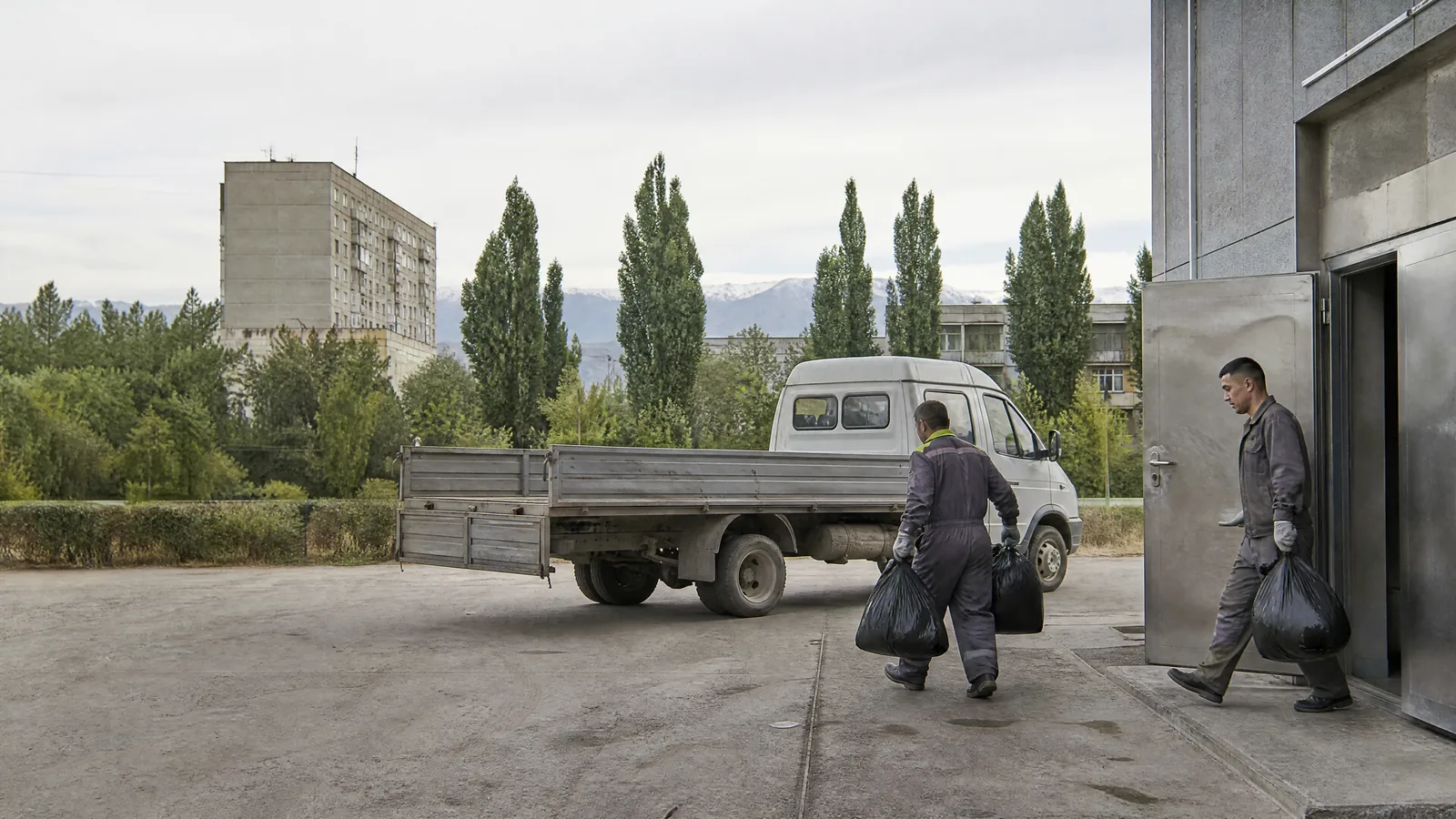
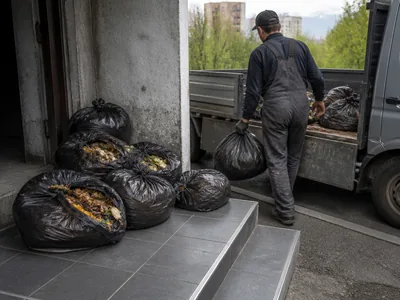
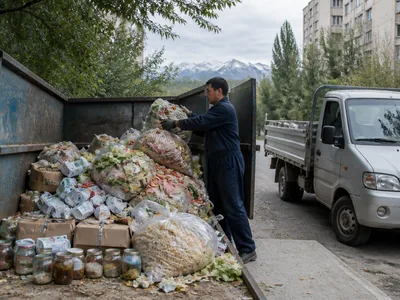
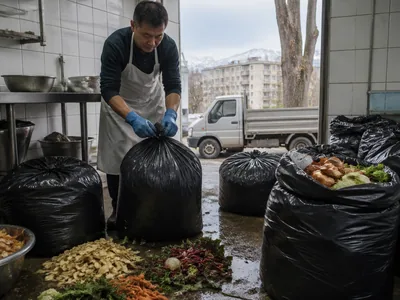
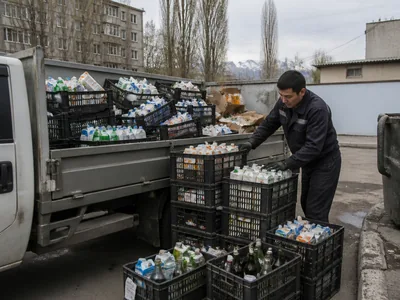
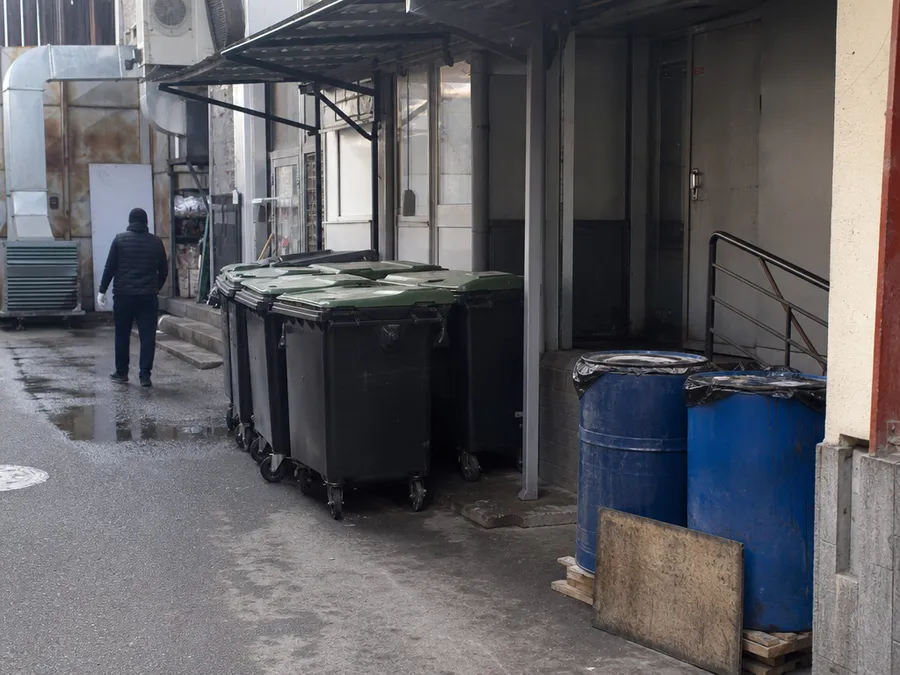
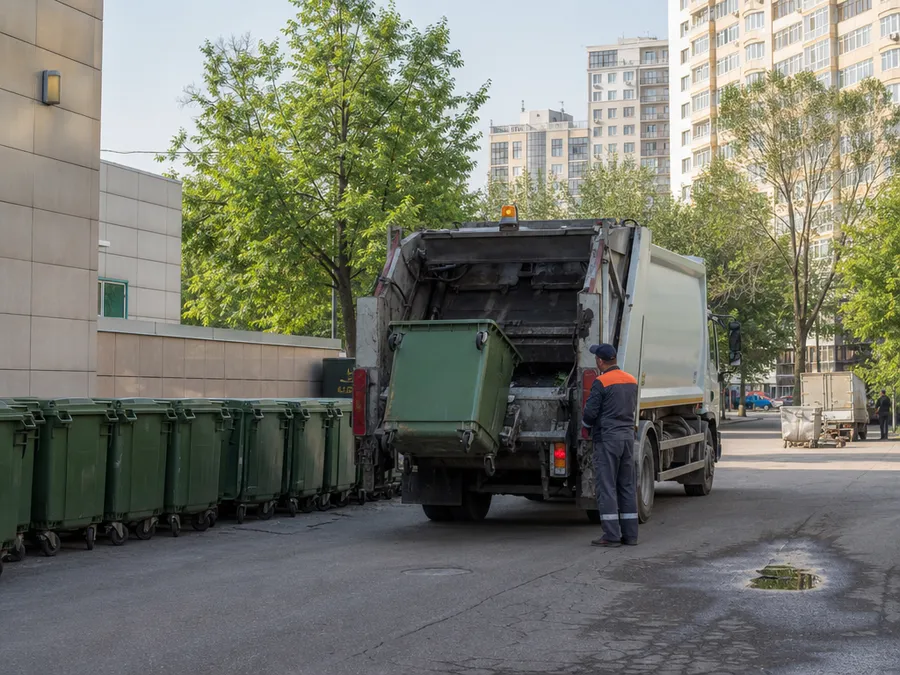
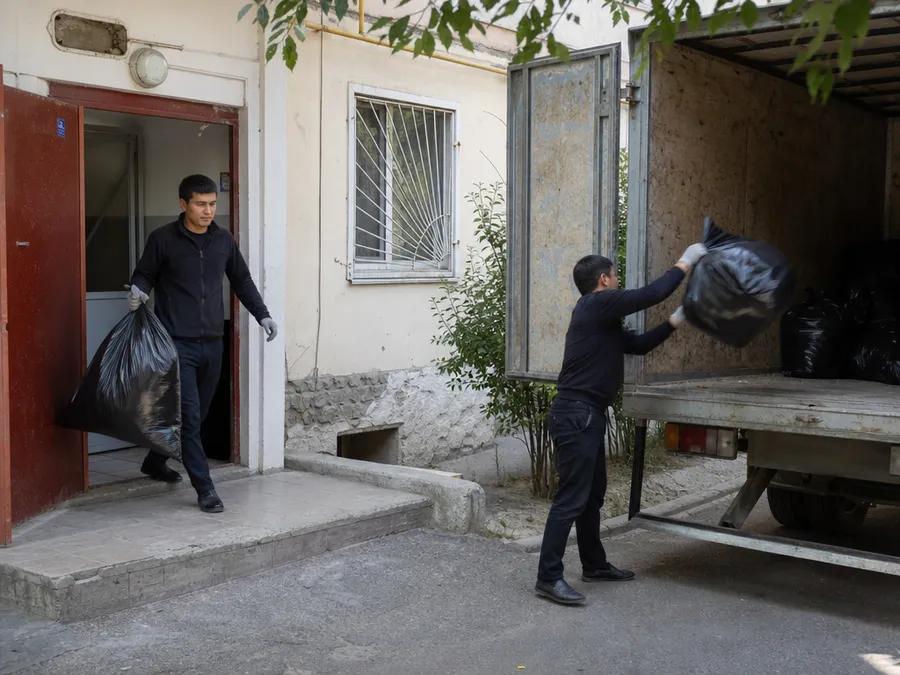
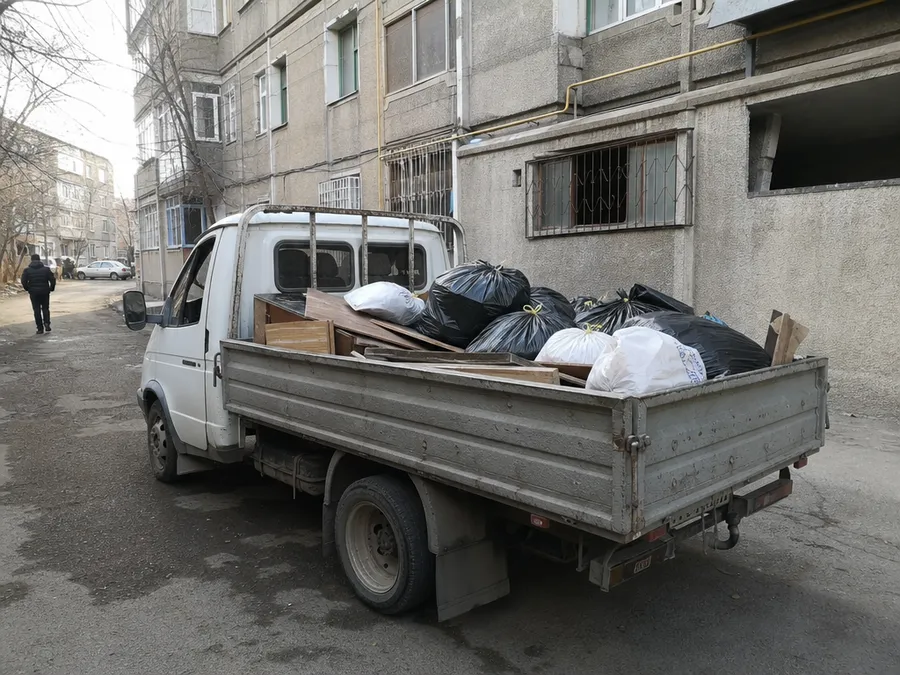
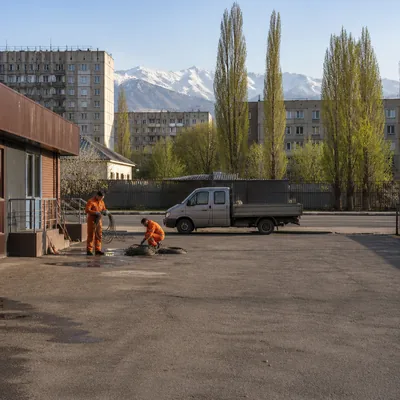
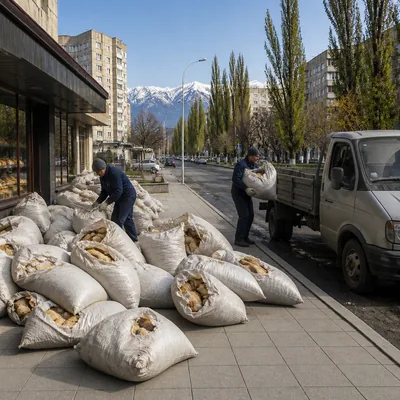
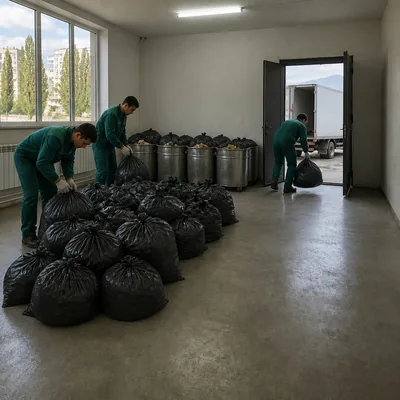
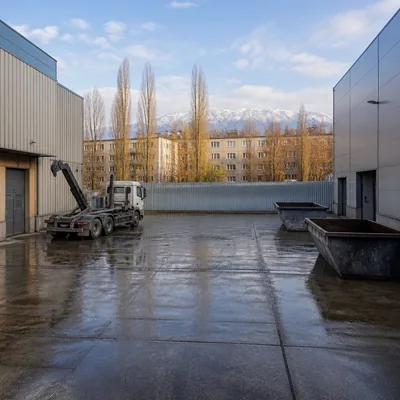
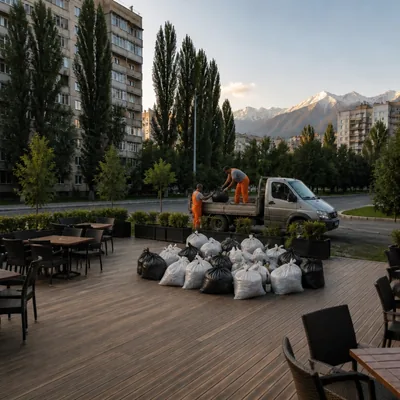
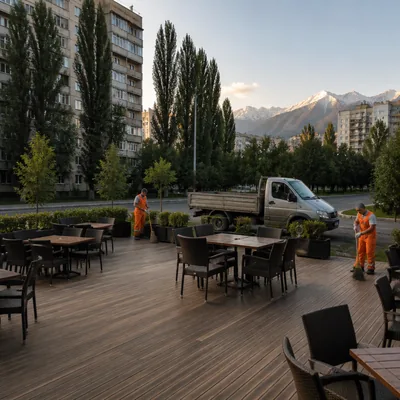
We price food waste removal from a restaurant by volume: tell us the volume and the address, and we'll quote before the truck is dispatched. A 12 m³ GAZelle fits a week's worth from an average cafe kitchen.
GAZelle 1.5 t — from 30 000 ₸ per trip
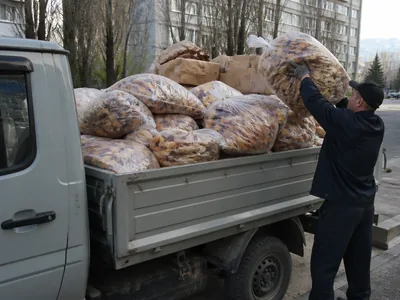
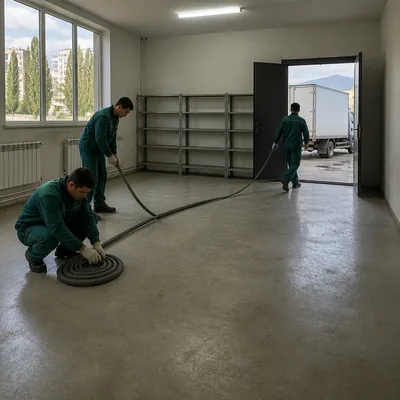
Our own loaders, they carry it out from the kitchen
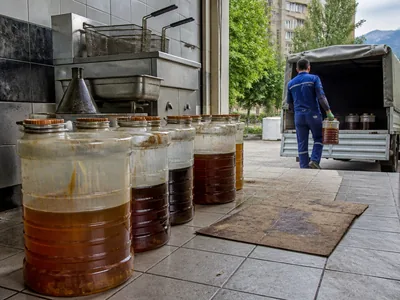
We pick up in sealed containers, no leaks
We work Mon–Sun, 09:00–21:00
We arrive after the kitchen closes
Around Almaty, outside the city — by mileage
🧮 Estimate
Food waste removal cost calculator for restaurants — no calls, no waiting
Pick your waste type, schedule, and truck — the calculator will show you an estimate. We'll confirm the number of bins and pickup time in chat.
Estimated cost: 0 ₸
The price won't change when we arrive — our loaders won't recalculate on site.
What food waste do we collect from restaurants and what goes into separate bags
Kitchen waste
Trimmings, cuts, scraps, bones — what piles up during a shift with the cooks. We take it away in sealed bags so the smell doesn't spread across the yard.
daily20–60 kgorganic waste
Expired and rejected dishes
Products written off from the warehouse and dishes that didn't sell during the day. We separate glass and packaging so the organic waste stays clean.
write-offup to 40 kgmixed
Vegetable prep waste
Peelings, tops, spoiled root vegetables after a shift. This load is wet and heavy, so we use sturdy bags, not thin ones.
vegetable prepup to 80 kgwet
Fat and oil after frying
Used oil from fryers and grease traps that you can't pour down the sink. We pour it into canisters, separate from other organic waste.
used oil20–30 Lliquid
Bread and pastry leftovers
Stale bread, cake trimmings, pastry shop rejects. The bags are light but bulky — we charge by actual volume, not by eye.
bakery10–25 kgdry
Food court food waste
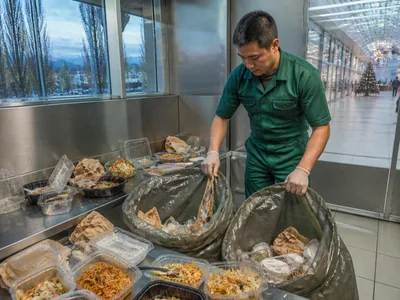
Trays and containers from the hall after the mall location closes. Often mixed with plastic and paper, so we sort on site.
food court10–30 kgwith packaging
Banquet hall waste
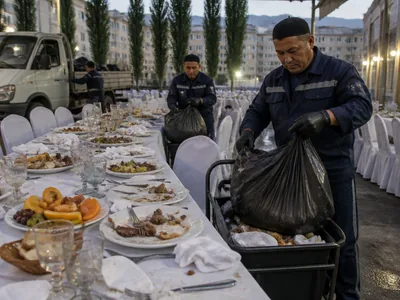
Leftovers from banquets and weddings — lots of it, late at night. We send a truck after the event ends so we don't get in the guests' way.
banquet60–120 kgat night
Expired drinks
Juices, beer, dairy and soda past their date from the bar and storeroom. We pour out the liquid and take the containers away on a separate run.
barup to 100 lliquid
💰 Services and prices
Food waste removal services and prices for restaurants in Almaty
One-time removal per shift
from 30 000 ₸ per trip, 12 m³
We pick up whatever's piled up over a day or a week — no schedule, no strings. We arrive in the window you name, usually after closing. We carry the bags from the kitchen to the truck.
For those with waste every day: we lock in a time and a truck, coming on weekdays or every other day. We shift the schedule with one call if the menu or guest flow changes.
When staff don't have time to haul bags across the whole yard, we add a crew. The loaders bring down the cans and containers themselves, and the truck leaves full.
Kitchen grease doesn't ride in the main body — it goes separately, in cans and sealed containers. That way the truck stays dry and the next load doesn't smell of fryer oil.
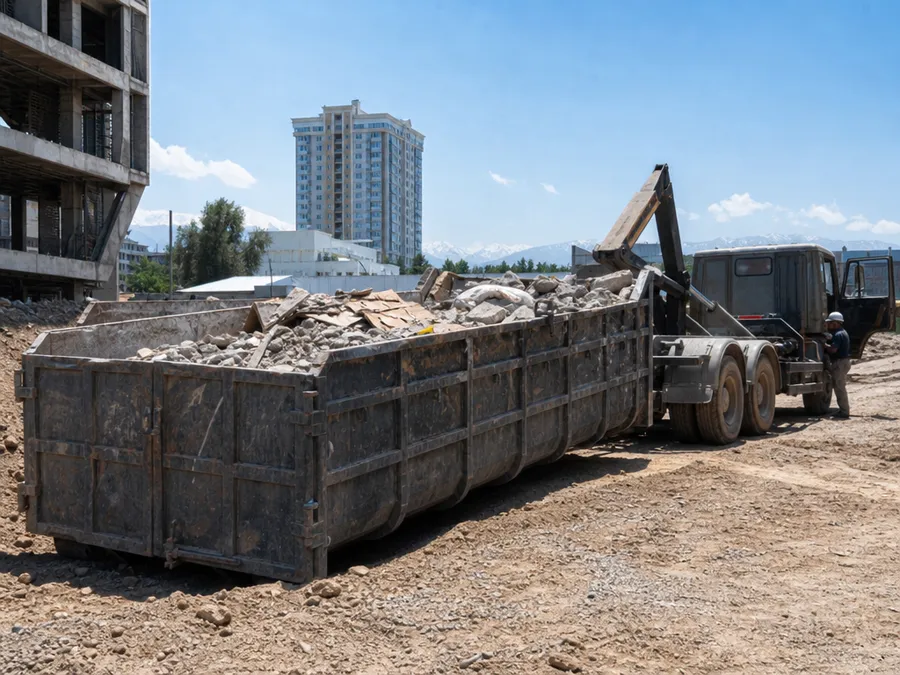
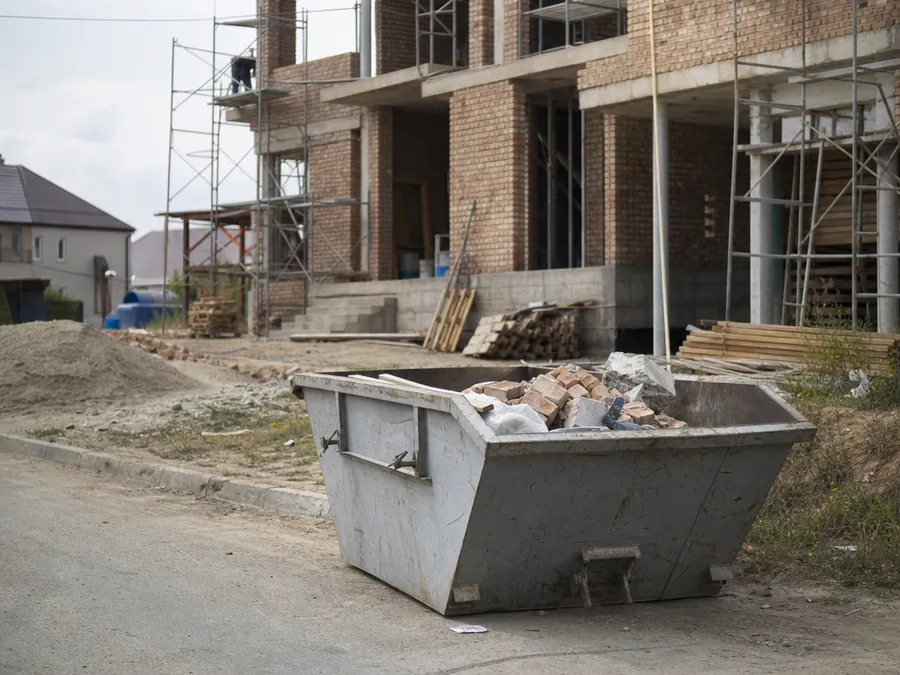
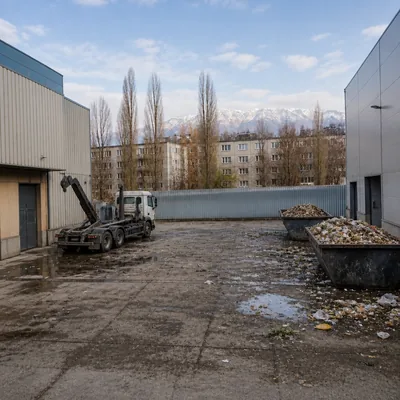
For restaurants with a big dining room and banquets — when bags are no longer practical. We place a dumpster in an agreed spot in the yard and empty it as it fills.
Price per project we calculate around your schedule
Need a closed container by the back door for a few days or a month — we'll discuss it separately. We confirm the volume, term and spot in the yard over chat, and quote the price there too.
Vehicles and pricing for food waste removal from restaurants — from a GAZelle to a dumpster
The price list shows the trucks we actually use to haul food waste from restaurants. We'll match one to your volume and schedule.
GAZelle 1.5 t
Bed volume
12 m³
Payload capacity
up to 1.5 t
ZIL dump truck
Bed volume
7–12 m³
Payload capacity
up to 7 t
KAMAZ dump truck
Bed volume
15 m³
Payload capacity
up to 20 t
Skip
Bed volume
27 m³
Payload capacity
up to 15 t
Price list for waste removal in Almaty
Valid from August 2026 · price per trip within the city
Price list for waste removal in Almaty, August 2026
Equipment
Volume
Payload capacity
Price per trip
Extra hour
GAZelle 1.5 t
12 m³
up to 1.5 t
30 000 ₸
6 000 ₸
GAZelle 2.5 t
16 m³
up to 2.5 t
35 000 ₸
9 000 ₸
Truck 5 t
25 m³
up to 5 t
40 000 ₸
12 500 ₸
ZIL dump truck
7–12 m³
up to 7 t
40 000 ₸
12 500 ₸
KAMAZ dump truck
15 m³
up to 20 t
55 000 ₸
15 000 ₸
Howo dump truck
25 m³
up to 40 t
60 000 ₸
15 000 ₸
PUHTO (skip)
8–10 m³
up to 7 t
45 000 ₸
—
Multilift
20 m³
up to 12 t
100 000 ₸
—
Skip
27 m³
up to 15 t
135 000 ₸
—
Max skip
32 m³
up to 20 t
160 000 ₸
—
Loaders:6 000 ₸/hour per person · 20 000 ₸ for a 2-person crew with a GAZelle · 48 000 ₸ for a 3–4 person crew with a ZIL · 80 000 ₸ for a crew with a KAMAZ
By volume:8 000 ₸ per m³, if it's easier to count in cubes rather than trips
Typical estimates:post-renovation 1-bedroom — 50 000 ₸ · facade work — from 60 000 ₸ with a skip · partition demolition — 88 000–135 000 ₸
Prices apply within Almaty city limits. Outside the city, mileage is added — we calculate it in chat before dispatch.
Not sure which truck you need? Send a photo — we'll pick one for you.
Food waste pickup from a restaurant — a detailed breakdown
Askhat Mukashev
KAMAZ driver
Published: Updated:
A restaurant doesn't keep its trash in one bin. The kitchen has its own containers, the bar has its own, the dining room has a third. And while a residential courtyard gets picked up on a schedule, a restaurant runs on its own: peak weekends are Friday and Saturday, and by Monday morning there's a full load again. At TRASHOFF we've worked with food service for years, and we know: what matters isn't just showing up, it's showing up after the kitchen has closed but before the trash starts to sour.
Waste removal for food service isn't just "grab the bags." Food waste is heavier than household trash, it leaks, it smells, and it needs sealed containers. We haul it separately from glass and cardboard because you can't mix them. And we do it on an agreed schedule, not on a "right now" call — otherwise the truck drives around empty and the restaurant pays for air.
In this article I'll break down how food waste differs from everything else, how we calculate volume, what happens if you leave it in the yard over the weekend, and why it costs more in hot weather. No tenge figures — those are in the price list above — but the logic: what the total depends on and when two runs come out cheaper than one.
What counts as food waste at a restaurant and what we don't take
The first thing I see when I arrive for a pickup is five or six different bags by the back door. And almost always one of them has everything mixed together: potato peels, glass bottles, cardboard boxes, and used lamps. That's not okay. Food waste is what was food or part of it: organics that spoil, leak, and smell. Everything else — packaging, glass, paper — is a different story, and we don't take it.
Why so strict? Because when organic waste mixes with dry trash, it starts rotting faster. A damp environment speeds up decomposition, and within a few hours the bag smells so bad the whole yard can tell. And if glass or plastic gets in there, someone can get cut or the bag can tear during loading. That's why right at the request stage I always ask: do you keep organics separate from packaging? If not, I explain how to sort it so the truck arrives and takes exactly what's needed.
Peels, expired items and leftovers from the serving line
The bulk of food waste from a restaurant is what's left after cooking and after serving guests. Peels: potato, carrot, onion skins, fish heads, chicken bones. Expired items: products past their date — spoiled cottage cheese, dried-out cheese, sour sauce. Leftovers from the serving line: sides that didn't sell during the day, half-eaten portions, bread.
We collect all of this separately from packaging. And the volume can vary a lot: on Friday and Saturday it's two to three times more than on Wednesday. That's why we always ask roughly how many kilograms or liters accumulate per day.
Used oil and coffee grounds are a separate story
Used oil after deep-frying is also food waste, but you need to handle it more carefully. It shouldn't go into the common bin: if you pour it into a bag with peels, the bag will soak through and tear. We collect oil in separate containers, usually in cans or bottles that you provide yourself. Waste removal for food service includes this item too, but only if the oil has already been poured into a sealed container.
Coffee grounds are another type of waste that often gets mistakenly flushed down the toilet or thrown in the general trash. They're heavy, wet and sour quickly. We collect them along with other organics, but it's better to store them separately so they don't mix with dry waste. Some restaurants collect grounds in separate buckets and then hand them over to us.
What isn't food waste and why we don't take it
Here's a list of what we don't collect as part of food waste removal. If you have these items, they need to go into separate containers and a different truck has to be called.
Packaging: plastic containers, film, grocery bags — it's not food, it doesn't rot, but it takes up space and gets in the way of compacting organics.
Glass: bottles, jars, broken dishes — when mixed with food waste, they create a risk of cuts and torn bags.
Cardboard and paper: product boxes, napkins, paper towels — they absorb moisture and turn into mush that's hard to unload.
Hazardous waste: lamps, batteries, thermometers — they can't go into food or regular bins; they need separate disposal.
Medical waste: if a restaurant has a first-aid kit, used bandages and syringes must not enter the general stream.
Construction debris: leftover tiles, plaster, chunks of wall — that's no longer food waste, and we don't haul it.
Why is this separation so important? Because if you dump everything into one bin, the landfill or recycling facility won't accept that mix without additional sorting. And no one's going to sort it by hand — that costs more than hauling it separately. In the end, the restaurant pays twice: for removing mixed waste and for disposing of it as non-recyclable.
What mixing food waste with packaging leads to
The most obvious thing is the smell. Organics without air access start rotting, releasing hydrogen sulfide and ammonia. If there's also plastic in the bag, it keeps moisture from evaporating, and the process goes faster. Within a day, you can't open that bag without a gas mask.
Second — weight and volume. Mixed waste is heavier and takes up more space. You end up ordering a bigger truck, and that's extra cost. Restaurant waste removal with separate collection is cheaper because we know exactly how much organic and how much dry waste needs to be hauled away.
Third — the risk of fines. If mixed waste is found on site, you may get a citation. We don't want to put our client in a bind, so we always remind you: separate, and there won't be any problems. Besides, when organics are kept separate, they can go straight to recycling or composting instead of the landfill.
And lastly: mixing makes loading harder. Our loaders work fast, but if there's glass or heavy items in a bag, they can tear the container. Then some of the waste spills onto the asphalt, and you have to clean it up. Better to separate right away.
All in all, if your restaurant has separate bins for organics, glass, and cardboard, you're not just following the rules — you're saving on removal. For our part, we'll always advise you on how to set up separate collection so the truck arrives and takes exactly what's needed, no delays.
How to calculate food waste volume from a restaurant so you don't overpay
When you order food waste removal from a restaurant, remember: this stuff fools the eye. A bag of potato peels weighs as much as three bags of packaging. So "we have two bags a day" isn't a volume, it's a feeling. You have to count by containers: how many 120-liter bins you roll out, how many times a day, and what they're packed with. Without that, waste removal for food service turns into a guessing game where you pay for air.
Why food waste is heavier than it looks
Moisture. Vegetable trimmings, coffee grounds, sauces — it's all water that soaks into paper and adds weight. One bag can weigh 20–25 kg, not 8 like with packaging. It's hard on the loaders and hard on the truck: overloading is not allowed. We weigh or estimate by container so we don't have to guess.
We count by containers, not by the number of bags
A 120-liter container of food waste weighs about 80–100 kg. Knowing the number of containers and frequency gives us the daily volume. For example, a café with 30 seats: two containers a day, 160–200 kg. A restaurant with 100 seats: five containers, 400–500 kg. That already affects the choice of truck: GAZelle or ZIL. If the container is non-standard, we ask for a photo — that's how we determine density.
How seating capacity affects volume
A direct relationship: the more seats, the more they cook, the more waste. But not linear. A banquet hall for 100 people will spike on the day of the event, and on a regular Tuesday — minimum. We take seasonality and workload into account: terraces in summer, less in winter. That's why it's better to make the food waste removal schedule for restaurants flexible, not rigid.
What happens if you underestimate the volume
The truck arrives, but the containers won't fit. You'll have to call a second run and pay twice. Or leave some for the next day — and that means odor, flies, risk of a fine. Better to state the real volume upfront: we'll pick a truck with a margin and won't overload the body.
Approximate daily food waste volume
Type of establishment
Seats
120 L containers
Weight, kg
Café
up to 30
1–2
80–200
Canteen
50
2–3
160–300
Restaurant
100
4–5
320–500
Banquet hall
150
6–8
480–800
The table is averaged. A meat restaurant has less waste by volume but heavier. A vegetarian one has more greens and peels — lighter, but they take up space. So a photo of the containers is more accurate than any estimate.
If you're unsure, send a photo of the container site to WhatsApp — we'll tell you which truck you need and how many runs per week. It's free and no obligation. The main thing is don't underestimate the volume, so you don't overpay for a second run.
We plan restaurant waste pickup so the truck arrives in a convenient window: after the kitchen closes or early in the morning. That way the waste doesn't sit in the heat and start to stink. And you don't waste time negotiating with the driver.
By the way, volume can change with the season: more veggies and drinks in summer, less in winter. We don't change the price retroactively, but we do warn you: if the volume doubles, you'll need a second run. That's cheaper than a fine from the sanitary service.
Important: food waste can't be mixed with other trash. If glass or cardboard ends up in the bin, we can't haul it as food waste. You'd have to sort it on site. So it's better to set up a separate container right away and not toss in just anything.
Here's what we ask when you book, so we can calculate the volume:
How many containers and what size are in the kitchen.
How often you fill them: once a day, twice, or as they fill up.
What's inside: peelings, bones, sauces, or mostly liquid.
Is there a separate container for glass and cardboard.
Where to pull up: into the yard, to the back door, or to the loading zone.
Do you need it carried down from the floor, or will the loaders take it from the ground.
These answers are enough to quote a price and not recalculate on site. If you forgot something, we'll clarify along the way, but it's better up front.
And one more thing: don't go by the neighboring restaurant's experience. They may have a different menu and different traffic. You have to calculate based on your own containers. We'll help if you send a photo.
Bottom line: food waste volume from a restaurant isn't the number of bags, it's weight and density. Count by containers, factor in the menu and the season. Then waste removal for food service will be predictable, not a surprise.
Food waste pickup schedules for restaurants: morning, evening, or on call
On Friday night the kitchen is running at full tilt. By eleven p.m. there are already three or four bins by the back door, and if they're not picked up by morning, on Saturday they'll greet the cooks with a smell that makes work impossible. That's why for restaurants we almost always schedule pickup for Saturday morning — around six or seven, while the neighborhood is asleep.
But that doesn't work everywhere. If the restaurant is in a residential building, a noisy truck at six a.m. means a fight with the neighbors. Here evening pickup saves the day: we come after the shift ends, when the dining room is empty and the kitchen has finished washing the pots. And it's not a whim — it's a matter of survival. Food waste spoils in a matter of hours in the heat: by lunch the next day the bin will reek so badly that customers will start leaving.
Morning pickup before the kitchen opens
Morning pickup is the cleanest option. The truck pulls up at six or seven a.m., while the restaurant is still closed, the loaders roll out the bins, empty them, and put them back. No guest sees a thing, and the smell doesn't have time to spread through the dining room. Plus, by opening time the kitchen already has empty bins.
There's a catch: if the restaurant is open until two a.m., by six in the morning the trash simply won't have accumulated enough. You'll either need two morning pickups a week or move it to the evening. We usually go by what actually happens: how many bins get set out per shift. If it's one or two — morning pickup every other day. If it's five or more — evening pickup, daily, is better.
Evening pickup after the shift ends
Evening pickup is great for those who close late. We arrive an hour after the last order — the kitchen has already brought everything out, the bins are full but haven't had time to heat up. We take it and go. By morning the back yard is empty and dry. Restaurants downtown often ask for this schedule, where you can't get through during the day: narrow streets, parking taken, but at night it's clear.
The downside of evening pickup: if the shift runs late and the bins aren't out, the truck leaves empty. You have to come back or push it to the morning. That's why we always ask: if anything changes, give us a heads-up on WhatsApp a couple of hours ahead. Then dispatch reroutes the truck to another address and gets to you later.
Daily in summer, three times a week in winter
In summer, Almaty heat hits forty, and food waste starts to smell within three or four hours. In July and August, we recommend daily pickup, even if the volume is small. In winter, when it's below freezing, decomposition slows down, and you can switch to three pickups a week. But that's not set in stone: if you have a lot of fish or seafood, it's better not to stretch it even in December.
By the way, restaurant waste pickup in winter sometimes gets complicated by snow: the back-door access gets buried, and the truck can't pull up close. Then the loaders have to carry the bins farther — it takes longer, but we don't abandon a client. Just let us know if your yard hasn't been cleared.
What to do on holidays and during peak season
Friday and Saturday are peak for any restaurant. On those days, volume grows by one and a half to two times. If you usually get waste picked up three times a week, then on Friday and Saturday you need to add an extra run. Otherwise, by Sunday the bins will overflow, and some of the waste will end up in bags on the ground — that's unsanitary and a fine risk.
On holidays — New Year, Nauryz, long weekends — we advise booking pickup in advance, a day or two ahead. There are fewer trucks on those days and more people who want them. If you leave it to the last minute, you could be stuck with full bins for days. We try to adapt, but we physically can't be in twenty restaurants at once.
I remember last November a restaurant on Satpayev forgot to tell us they had a banquet for a hundred people. We showed up on schedule Friday morning, and the bins were already overflowing — we had to call a second truck. Since then they call ahead, and we add an extra run on Saturday evening. It's easier for everyone.
Here are the schedule options we most often agree on with restaurants. The order isn't random: first we look at the kitchen's hours, then the neighbors, then the season.
Morning pickup at 6:00–7:00 — if the restaurant opens at 10:00 and there are no residential windows nearby.
Evening pickup at 23:00–24:00 — for restaurants in residential buildings and on narrow streets.
Daily in summer — from June through August, even with small volume.
Three times a week in winter — if there's no large amount of fish and seafood.
An extra run on Friday or Saturday — during the weekend peak.
Pre-holiday pickup the day before the holiday — so you don't get stuck with full bins.
On-call pickup — if something goes wrong, but with a couple of hours' notice.
Waste pickup for food service isn't a rigid multi-year contract. We can change the schedule every week: morning today, evening tomorrow. The main thing is that you tell us, and we adapt. After all, our job is to keep things clean outside your kitchen door, not to have the truck show up strictly by the paperwork.
If you're not sure which schedule to choose, start with two pickups a week and watch the smell and how full the bins get. In a couple of weeks it'll be clear. And we're always on WhatsApp — we'll help you figure out what works best.
Where we take restaurant food waste and what happens to it
After loading, the truck doesn't head to the city dump. Food waste from restaurants goes to a special site where it's processed or neutralized. Regular landfills won't take it: they only accept solid household waste, and food waste is a whole different story. If you think it all ends up in one big pile — no. We've been working with restaurants for years and we see the difference: restaurant waste smells and leaks differently than yard trash.
Where a particular truck goes depends on what's inside. Used oil, expired goods, peelings — all of this is disposed of in different ways. And yes, it costs more than hauling away a bag of paper. But if you leave bags of food by the restaurant wall overnight, by morning there'll be a puddle and a smell across the whole block. That's why we don't cut corners on transport.
Here are the stages the load goes through from container to final destination. Every step matters, because if the container leaks at any point, you have to start all over again.
Loading starts after the kitchen closes — otherwise the movers get in the cooks' way.
Containers are checked for leaks: gaps and cracks will spill in the truck bed.
The truck follows a route agreed with the restaurant, with no extra stops.
Unloading happens at a site where waste is sorted by type.
Disposal means recycling or incineration, not burying in the ground.
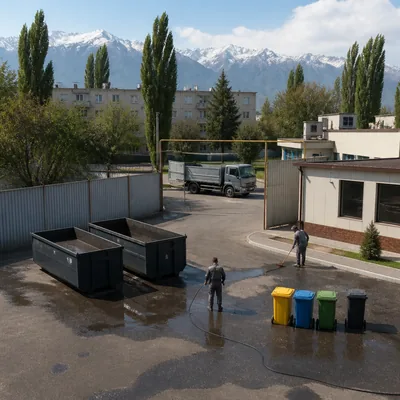
After the run, the truck bed is washed and disinfected so no smell lingers.
Why food waste can't go to a regular landfill
A regular landfill is a pit where construction debris, old furniture, and bags from apartments are dumped. Food waste isn't accepted there for a simple reason: it decomposes and releases leachate. This liquid seeps into the ground, gets into groundwater, and then we all drink that water. Unpleasant, right? On top of that, food waste at a landfill starts to rot and attracts rodents and birds. That's why we have a separate chain.
If waste removal for restaurants is organized properly, the food part doesn't mix with household waste. We haul it separately and send it for disposal. This isn't a whim, it's a necessity: it's safer for both the city and the restaurant. Fines for improper waste handling in Almaty haven't been canceled, but that's not even the point. The point is that after such a "dump," the kitchen can be put on a watchlist, and inspections will come around more often.
Stages: from the container in the yard to disposal
The first stage is loading. We arrive in a GAZelle or ZIL, depending on the volume. Movers carry out bags and bins from the back room. If your passage is narrow, let us know in advance: we'll figure out how to get it through. The second stage is transportation. The truck drives through the city but doesn't stop at other restaurants, because the route is built around your order.
The third stage is unloading. At the site, waste is accepted by weight and type. It's important that there are no foreign objects: if a bag of food contains glass or batteries, the whole batch can be rejected. The fourth stage is disposal. Organics are processed into compost or technical fat, and the water is pressed out and treated. Anything that can't be recycled is incinerated in special furnaces. Nothing is buried.
Here's a table showing how our route differs from regular landfill hauling. The numbers are guidelines for weight and timelines that we see in practice.
Comparison of disposal and landfilling of food waste
Parameter
Disposal (our route)
Landfilling at a landfill
Decomposition time
from 12 to 72 hours
from 6 months to 2 years
Weight of 1 m³
up to 350 kg
not standardized
Odor
neutralized within a shift
lingers for weeks
Risk to groundwater
minimal
high
Who accepts
specialized site
regular solid waste landfill
What happens to used oil
Fryer oil is a headache all its own. You can't pour it down the sink — it'll solidify in the pipes and clog the riser. And you can't dump it in a regular bin — it'll leak and ruin everything around it. We collect oil in sealed canisters and take it for recycling. There it becomes technical fat or biodiesel. If you've got a lot of oil — say, 200 liters a week — it's better to set up a dedicated barrel and not mix it with organics.
By the way, if oil gets mixed with food scraps, recycling gets harder. That's why we always carry separate containers for liquid fractions on our route. And yes, we warn you in advance: don't leave oil in open containers — the loaders can't take it without risking a spill.
Who's responsible for waste after loading
From the moment we sign the acceptance report, the cargo is on us. Before that — it's on the restaurant. This matters: if you left bags outside the gate and walked away, and they leaked, that's your zone. We come and pick up, but we don't store waste at our place. So it's best not to let it pile up: the schedule should be regular. Waste removal from restaurants isn't a one-off — it's a process. If the truck comes once a week but the kitchen runs every day, the volume will build up and cause problems.
We try to cover the whole cycle: picked up, hauled away, disposed of, reported. No "lost on the way" or "dumped in the wrong place." If you need paperwork for reporting, message us on WhatsApp before pickup — we'll tell you what we can arrange. But the main thing is the fact itself: the waste isn't lying around in the yard and isn't heading to a landfill. That's what a restaurant pays for, and that's what we do every day.
Read this far and still not sure about the volume? Send us a photo — we'll calculate and give you a price.
What happens if you leave food waste in the restaurant yard
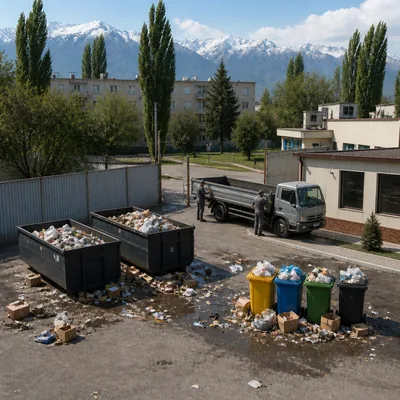
Last August, the manager of a coffee shop on Tole Bi called. Friday evening, the truck didn't show — it broke down. By Saturday morning the container smelled so bad the flower shop next door closed early. By noon the sanitary service arrived on a complaint. Not a fine — an order with an inspection. We cleaned it up together with the loaders, but the smell lingered for another day.
Food waste doesn't just stink. It decomposes faster than any other trash. In Almaty heat — thirty-five by noon — food scraps in a closed bin start fermenting in four to five hours. Heat is released, the bin warms from inside, the lid pushes up. If the container isn't sealed, by evening there's a puddle underneath.
And that's the first thing your neighbors notice — not you.
Smell and insects: why food waste spoils faster
Household trash — packaging, paper, plastic — can sit for a day and barely smell. Food waste is organic, full of moisture and protein. Bacteria work fast, especially in warmth. The smell shows up before you notice: first sour, then rotten, then just unbearable.
Flies swarm to the smell. Not one or two — a whole cloud. In a day, they lay eggs in an open bin. A day or two later — larvae. This isn't a horror story, it's basic biology. That's exactly why food service needs regular waste removal: miss it and you've got an incubator.
From experience, restaurants with open summer terraces have it worst. The smell from the bin in the yard drifts straight to the guests. No scented candles can save you.
Rodents and neighbor complaints
Rats and mice follow the smell of food. They're more active at night, hide during the day. See a rat by the bin once — consider it already living there. They breed fast, and getting rid of them is harder than preventing them.
Neighbors are a whole other story. Residents in the building next to a restaurant put up with it until the first hot day. Then the calls start — to the management company, the akimat, the sanitary service. If the restaurant rents the space, the building owner gets the complaints and passes them on to you. The landlord might not renew the lease — and that costs more than any waste removal.
Here's what usually happens if you leave food waste in the yard over the weekend:
By Saturday morning, there's a sharp smell that guests on the summer terrace can't miss.
By Saturday evening, flies start circling, and maggots appear in the container.
On Sunday night, rats show up — in the morning, you can see their tracks on the lid and around the bin.
Neighboring tenants complain to the building manager, who calls you with a complaint.
Residents of the nearest building file a report with the akimat or the sanitary-epidemiological station.
On Monday, an inspection arrives based on the complaint, and then — an order to fix the violations.
What does this threaten the restaurant with, besides the smell
An inspection isn't an instant fine, but it's a week-long headache. The inspector records violations: overflowing containers, rodent access, unsanitary conditions. Sets a deadline for fixing them. If you don't fix them — the next visit will be stricter.
Meanwhile, your reputation suffers. In Almaty, word of mouth travels fast. One post in a city public group with a photo of your bin — and evening reservations drop. Guests don't care who's to blame: they remember the sign.
Another thing: if the restaurant is in a residential building, complaints can reach the district akimat. Then the conversation is no longer about the smell, but about compliance with landscaping rules. Scheduled restaurant waste removal is the easiest way to avoid this scenario.
And yes, I'm not trying to scare you. I've just seen how one Sunday without pickup turned into two weeks of back-and-forth.
What to do if pickup is delayed
First — don't leave bags by the bin. If the truck hasn't come and the kitchen is already closed, move the containers indoors to a ventilated area or a closed utility room. Yes, there will be a smell, but it won't reach the yard or the terrace.
Second — cover the container with a tight lid or plastic wrap. It won't stop fermentation, but at least it will keep flies and rats out. If there's no lid, use any heavy board.
Third — call. Don't message and hope they'll read it an hour later. At TRASHOFF, the dispatcher is available from nine in the morning to nine in the evening, and if we're delayed, we reschedule pickup to the nearest available slot. If the delay is our fault, we let you know in advance.
Fourth — if the delay is more than a day and it's hot outside, call for an extra truck. Better to pay for one trip than deal with a fine and cleanup later. From experience, it's cheaper to haul off-schedule than to deal with an inspection.
Fifth — don't mix food waste with cardboard or glass to "make it" to the next pickup. Mixed waste smells just as bad, and it's harder to unload at the landfill. We accept such loads, but we warn you: it's not a solution, just a delay.
And lastly. If you realize the schedule doesn't work — for example, Friday volumes are always bigger — tell us. We'll review the frequency. Waste removal for food service isn't a rigid year-long contract, but a working arrangement that can be adjusted to your guest flow.
How restaurant food waste differs from cafe and canteen waste
We once stopped by a food court in a shopping mall: three spots, but one bin. And half the volume wasn't food, but cups with lids and burger boxes. That's the whole difference between one food service and another. Same word, but the load coming out is different. That's why on the request form, the first thing we ask isn't the volume, but what kind of establishment it is. From that one answer, it's already clear what containers to bring and which shift to schedule the truck. Waste removal for food service isn't about the "average city rate" — it's about a specific kitchen.
Restaurant: lots of prepared dishes and a complex kitchen
A restaurant's waste is greasy and wet. Leftover sides, sauces, broths, trimmings from the cutting board, rejects from the pass — all of it weighs way more than it looks. A litre of that slop pulls almost a kilo, sometimes more. Plus several lines: hot kitchen, cold kitchen, pastry, bar. Each has its own bin and its own moment when it has to go out.
After a shift, one person lifts a box of waste — and it's already too heavy. The bag splits at the seam. That's why at restaurants we put in rigid containers with lids, not bags in a bin by the back door.
Cafes and coffee shops: coffee grounds and baked goods
A coffee shop is a whole different story when it comes to weight. The grounds are heavy, wet, take up little space, but a litre weighs like a litre and a half. In a day, one coffee machine produces a couple of buckets of spent pucks alone. Plus expired pastries, crumbs, syrup packaging.
The volume here is small, but the smell is distinctive and very fast. The grounds start to sour by evening. I set up such points more often — but with a short stop, so we don't send a dumpster for three buckets.
Canteens and delis: peelings and expired goods
Here the main load is vegetable peelings. Potatoes, carrots, onions, cabbage. Heavy, wet, with soil. In winter, a kitchen peels half a tonne per shift. Peelings can't sit in the warm for even an hour — they start to heat up and rot from the inside. You need bins with drainage so the juice runs off instead of pooling at the bottom.
A canteen at a school or hospital adds expired stock from the warehouse and rejects from the serving line.
Food courts: mixed waste and packaging
A food court is a mixed stream. Food, sauces, napkins, cups, lids, bags. Wet and dry in one bag. You can't put a separate truck on food here: it's economically pointless because half the volume is packaging, not organics. We collect it as a common stream, but with weight in mind: packaging is light, but the leftovers under it are heavy.
A food court in a mall means taking the freight elevator, and it's better to warn about that in advance. Otherwise the truck sits idle while the loaders carry everything by hand.
Food service waste by type of establishment
Type of establishment
Main load
Weight per litre, kg
Bins and schedule
Restaurant
Ready meals, sauces, broths, trimmings
0,9–1,1
Rigid containers, 3–4 times a week
Cafes and coffee shops
Coffee grounds, expired baked goods
1,3–1,6
Lidded buckets, short daily stop
Canteens, delis
Vegetable peelings, expired stock
0,8–1,0
Containers with drainage, 5–6 times a week
Food courts
Mixed stream, packaging, leftovers
0,5–0,7
Common stream, 2–3 times a week
What we ask on the request so we don't send the wrong truck:
What kind of place it is and how many seats in the hall
Is there a separate bar and its own sink in the kitchen
Where to take it out: to the yard, the parking lot, or the basement
Who closes the shift and what time the lights go out
Is there a freight elevator if the spot is in a mall
Where the bins are now and whether they block the passage
Which staff member is responsible for taking it out on the night shift
Restaurant waste removal is about understanding the kitchen. A canteen and a restaurant produce different waste for the same revenue. And if you don't account for that, the truck arrives with the wrong bins, and the loaders drag out extra.
The bottom line: waste removal for restaurants without the hassle
If you don't have time to read the whole article, here's the gist. Food waste from a restaurant is a separate story, and you can't haul it together with cardboard or glass. We take it out separately, in sealed bins, and we do it on a schedule, not on a "right now" call. Request via WhatsApp or by phone, the price is fixed before the truck arrives and doesn't change after. Everything else is details I've laid out point by point below.
Food waste — separate, packaging — separate
A restaurant kitchen produces two different waste streams every day. The first is the stuff that spoils and stinks: trimmings, bones, spoiled sauce, plate scraps. The second is packaging: cardboard, film, glass. You can't mix them, and I'm not just saying that for effect. If food waste goes into the shared container, it'll turn sour faster than you can call a truck, and the packaging will turn into a soggy mess. That's why for food service, we always do waste removal in two separate runs or with two different trucks if the volume is large. It's not complication for complication's sake — it's the only way to avoid a stench in the yard.
In practice, I've seen restaurants where cardboard was tossed into the same bin as food waste. A day later, the bin had to be washed out twice because the cardboard got soggy and stuck. It's easier to hand over packaging separately, and that's what we do.
We count by bins, not by bags
A bag is a bad unit of measure. It gets crushed, you can compact it, and in the end you're paying for air. We count by bins: how many standard buckets or containers fill up during a kitchen shift. A restaurant with eighty seats usually produces three to four 120-liter buckets per evening. That's a precise number, and we go from there. If you say "about ten bags," I'll still ask how many liters that is, because bags come in all sizes. This way it's fairer — you don't overpay for what isn't there.
We usually count by photos of the bins or by the number of containers on site. It takes a couple of minutes in chat, but then there's no arguing on the spot.
A 120-liter bucket is the kitchen standard, we count it as the base unit.
A 240-liter container is already two buckets, often used at restaurants with high turnover.
We don't count bags without a specified volume, we just clarify the volume.
Glass and cardboard are counted separately, they're not part of the food waste volume.
If a bin is filled to the brim, we add a margin so there are no surprises.
In summer, volume goes up by ten to fifteen percent, that's normal for the season.
More often in summer, less often in winter
In hot weather, food waste spoils within hours. So in summer we come more often, sometimes every day, though in winter three times a week was enough. It's not a whim, it's a matter of sanitation: if a bin of scraps sits in the sun for half a day, the smell drifts into neighboring windows, and the calls start. We try to pick up before it becomes a problem.
In winter, the schedule is calmer, but you can't relax. During a thaw, the process goes just as fast as in summer, it just starts a bit later. That's why we always ask about your ventilation and where the bins are placed.
Request via WhatsApp or phone
We don't keep any forms on the site. You write on WhatsApp or call, give the address, volume, and preferred time. I or Yerlan Zhumabayev clarify a couple of details and quote a price. It's locked in before the truck arrives and doesn't change after, even if you add a couple of buckets. The only thing that can affect the total is mileage if the restaurant is outside the city, but we discuss that in advance.
❓ Questions
Frequently asked questions about food waste removal from a restaurant
Three standard bins take about 10–15 minutes to load if the driveway is clear and the bin is by the service entrance. If you have to search for containers in back alleys or lower them from a ramp, add another ten minutes. On average, the truck stays with you for no more than half an hour.
Yes, we take it in one trip, but only if the fat is already poured into sealed containers. If it's sloshing around in an open bucket, the loaders will pour it on site — otherwise it'll leak all over the truck bed. Tell us in advance how many cans or barrels you have so we can send a truck with extra capacity.
For small volumes — a GAZelle with a closed body so organics don't drip on the road. If there are many bins or you order once every few days, we send a ZIL or KAMAZ. We use a dumpster when you need to haul everything away at once after a deep clean. A GAZelle trip starts at 30 000 ₸.
Yes, that's actually a convenient option — the truck arrives after the last guest leaves, and you're not tripping over bins in the morning. Our hours are 9 a.m. to 9 p.m., so much later than closing won't work. But if the restaurant closes at ten, we can make it.
Ours. The crew comes in through the service entrance, rolls out the containers, loads them, and puts the empty bins back. If you need bags carried up from the basement, that's on the loaders too. One loader's hour is 6 000 ₸.
We don't leave the leftovers behind — either we load them into the same truck right away with an extra charge for the volume, or we schedule a second trip as soon as possible. No one drives off on the spot. Better to warn us that the volume might be bigger than usual — we'll send a body with extra room.
It all comes down to what the inspector or landlord requires. Message us on WhatsApp before ordering and tell us exactly what paperwork they're asking for — we'll answer for your restaurant. The removal itself is business as usual: we pick it up and take it for disposal.
To disposal — not to a regular landfill where organics just rot. Nothing spills on the way: the body is closed. We sweep the area after loading so there's no puddle left by the service entrance.
Better not. Plastic wrap, gloves, disposable dishes — that's not organic anymore, and at disposal they either separate it out or don't accept it at all. If you have a lot of that kind of trash, let us know — we'll send a truck that can take it separately.
It depends on the kitchen. Where they fry and cook a lot, bins fill up in a shift or two, and in summer it's best not to wait until the third day. In winter you can go longer, but the smell will still show up sooner than you think. Typically, food service orders removal two to three times a week.
Got a question that's not here? Ask — we'll answer in writing, no call needed.
Reviews about food waste removal from a restaurant
4,9
Based on 27 reviews on this page
A
Aliya
We recently opened a coffee shop and didn't know what to do with the grounds and leftovers. A friend recommended these guys. They came the next day and showed us how to position the bins better. They even trained us, honestly, for free.
N
Nurlan
Called at lunchtime, they arrived by evening. We run a canteen, and a fair amount piles up every day. We signed a contract, and now they haul it away on schedule without reminders.
M
Madina
We've been working with them for six months now. We have food waste, glass, and cardboard removed from the restaurant. They always arrive on time, and if anything changes, they let us know in advance. Dinara is always in touch and replies quickly.
Company replyMadina, thank you. If you add more fractions, just message us on WhatsApp and we'll adjust the schedule.
O
Olga
Overall I'm happy, we've been having food waste removed from the restaurant for six months. But once they postponed the pickup by a day, and we had to keep the bags in the back room. It hasn't happened since.
Company replySorry for that reschedule — there was an emergency at another site. We're keeping it in mind so it doesn't happen again.
G
Gulmira
Our coffee shop produces waste every day, especially after desserts. TRASHOFF staff come in the evening and take everything away. The price is quoted in advance and doesn't change later.
Y
Yerzhan
We run a shashlik place, fat and bones every day. We used to haul it ourselves in our own car, but the smell was awful. Now a bin comes once a week. The problem solved itself. I recommend it to anyone in food service — you won't regret it.
Company replyYerzhan, glad it worked out. For fat, sealed containers are better — we can advise if needed.
M
Madina
Friday, the place was full, and we had a delivery in the evening. I called Daniyar at six, he arrived by eight. He took the fat, bones, and vegetable trimmings. We finished before the end of the shift. Thanks for not making us wait until morning.
A
Aidana
Our canteen is small, but there's a fair amount of fat and peelings every day. Now we don't think about where to put it. They arrived by ten, and by lunch everything was clean.
M
Marat
Our restaurant is on the second floor, no freight elevator — I thought we'd have to carry everything down ourselves. Two guys came, took it all out themselves, I just signed. Yerlan warned it would take about forty minutes, and that's exactly how it went.
Company replyThanks, Marat. If the volume grows, just let us know in advance — we'll adjust the bin.
Zh
Zhanar
We have a banquet hall on the ground floor, no windows, and the smell was awful. Dinara immediately said we needed a bigger bin and that they'd come twice. That's what we did. Now guests don't complain.
V
Viktor
I ordered waste removal for a food business for the first time. Spent a long time looking for someone to take on a small volume. Here they agreed right away and came the next day. The price is fixed, no extra charges.
Y
Yelena V.
A small cafe, three tables. I thought no one would come because of the volume. They came. Pleasantly surprised.
S
Sergey
we've been working with them for a long time, they arrive quickly, take everything. especially convenient that they come on schedule, no need to call every time.
G
Gulnaz
There's a lot of food waste at the cafe, especially on weekends. I contacted TRASHOFF, and they came that same evening. The driver is very polite, he loads everything himself.
A
Aslan
We were closing the restaurant for renovations and needed to clear out all the fridges. They came in the morning and took everything in a couple of hours. Then they cleaned up after themselves. I recommend them if you need it.
Company replyThanks, Aslan. If you need us again, just write.
D
Damir
we've been working with these guys for a year now, everything is clean and no smell. they arrived yesterday morning while we were still closed. very convenient for our schedule.
A
Aigul S.
Overall everything's fine, but last Friday the truck arrived an hour late — they had an accident on the road. They warned us and apologized. Otherwise no complaints, they haul it away clean.
Company replyAigul, thanks for understanding. There really was a traffic jam on Rozybakiev on Friday, now we allow more time.
B
Bauyrzhan
We've been working with TRASHOFF for a long time — they pick up food waste from our restaurant every day except Monday. Yerlan usually comes, and he always gives an hour's notice. They sweep the area after loading — that's important, the neighbors are watching.
Company replyYerlan sends his regards. Thanks for noticing those details.
A
Ainash
For a long time we couldn't find anyone to remove food waste from the restaurant; regular trash haulers refused. Here they organized everything: containers, schedule, documents. Yerlan Zhumabayev came for an inspection and explained everything. We've been working together for a year now, all stable.
Company replyAinash, thanks for the detailed review. Glad we could sort out the paperwork.
A
Asel T.
We've been working with TRASHOFF for two years, they pick up food waste from our cafe on Abay. The truck arrives at opening, and by the time we're cooking, everything's already gone. It's convenient not having to find transport ourselves.
S
Sergey P.
After the shift closed, we had a full tank of food waste and no energy to haul it ourselves. Askhat arrived around midnight, took everything and swept the area. A small thing, but nice.
Company replyAskhat loves night shifts, credit to him. Get in touch.
N
Nurlan
Called in the morning, and by lunch they were at the gate. They took everything quickly, even grabbed the old boxes from the storage room. They quoted the price upfront, no extra charges.
D
Dinara Askarova
They come to our canteen twice a week. They collect food waste and even clean the containers. The price is agreed in advance and doesn't change later.
T
Timur
We run an ashana, every day we serve first and second courses. Lots of waste, a regular GAZelle couldn't fit it all. Now they bring a bin. Once every two days is more than enough.
T
Timur
I called a GAZelle after the cafe closed, needed the leftover food removed urgently. They arrived within an hour. Loaded everything up and swept the area. Fast and no fuss.
O
Olga
After renovations, a pile of boxes and old food was left in the back room. I called a GAZelle, they came quickly. Askhat helped carry everything out and even swept up after themselves.
M
Marat
We run a pizzeria, dough and toppings are left over constantly. I called a truck for the morning, they arrived earlier than scheduled. The loaders carried the bags into the truck themselves, I just showed them where.
Showing 3 of 27
Want the same? Describe your task — we'll calculate and give you a price before the truck arrives.
Articles of the Administrative Offenses Code of Kazakhstan, amounts in MCI for 2026, and who's responsible for the garbage — the carrier or the client.
Restaurant food waste removal — and other waste removal services
Order restaurant food waste removal today
You can't let food waste from a restaurant pile up — smells and insects appear faster than the truck arrives. Just tell us how many bags and when it's convenient — we'll come the same or the next day.