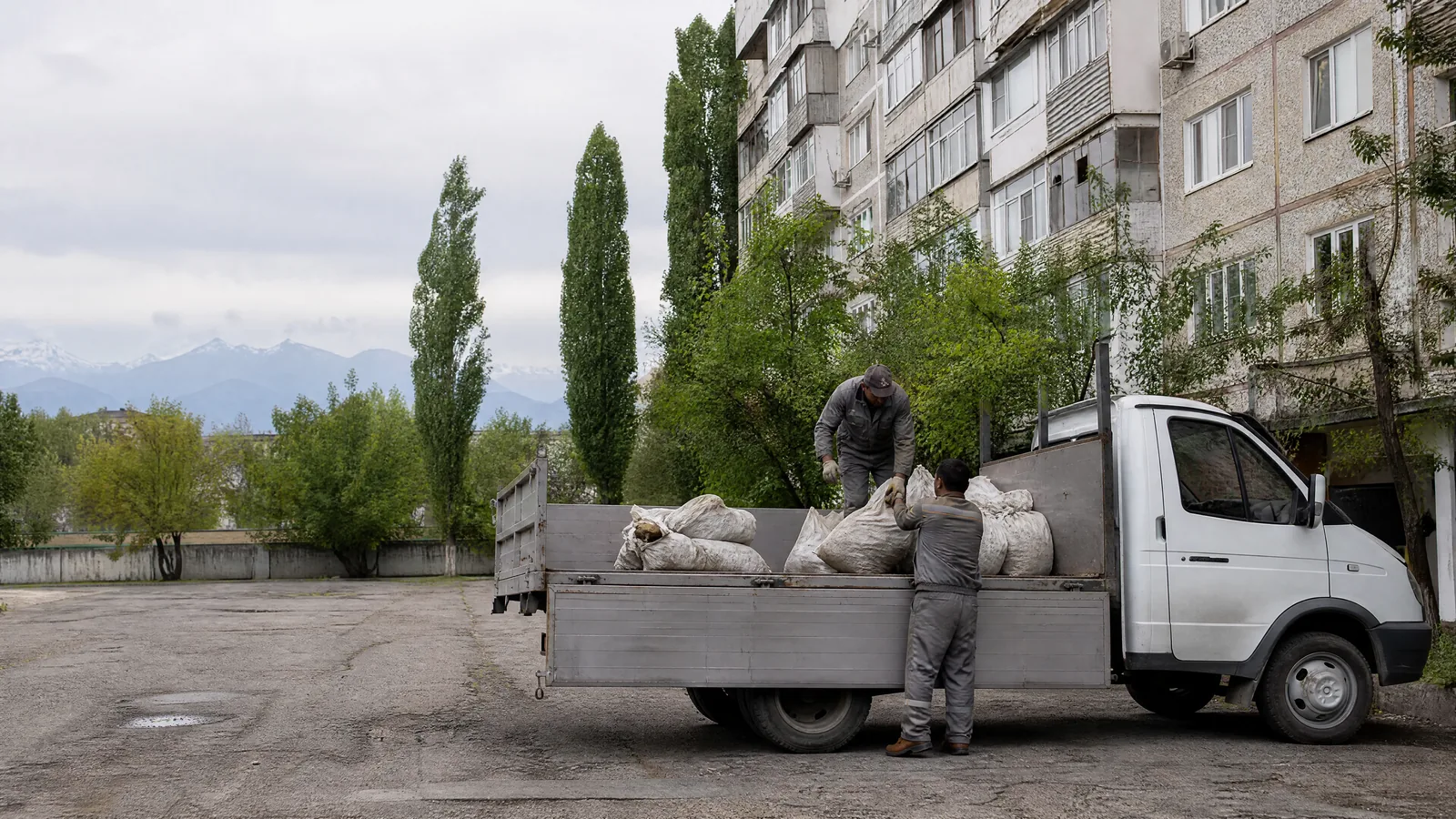
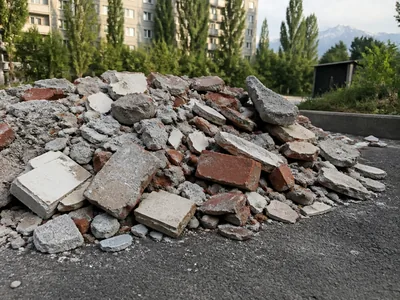
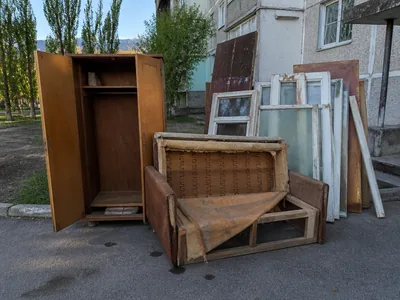
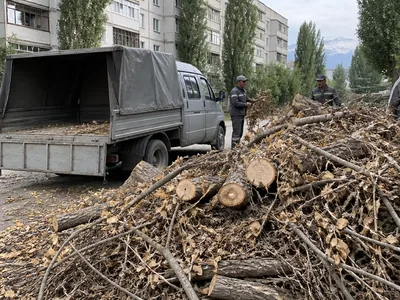
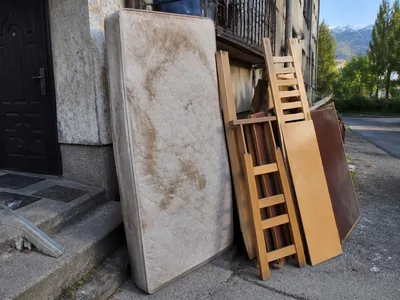
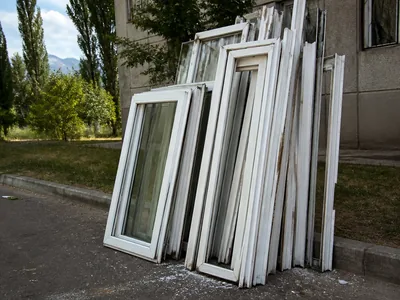
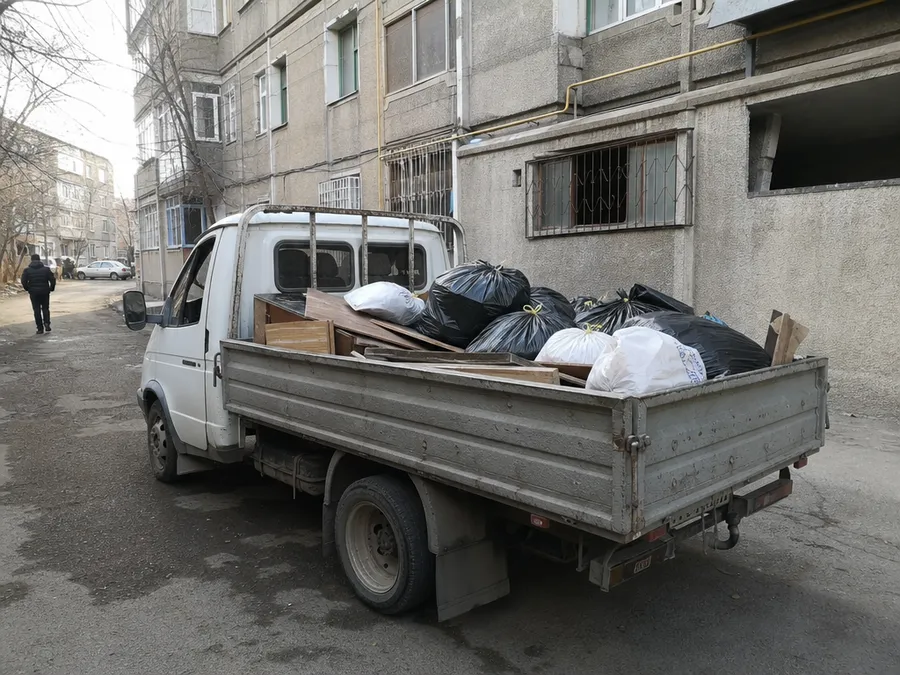
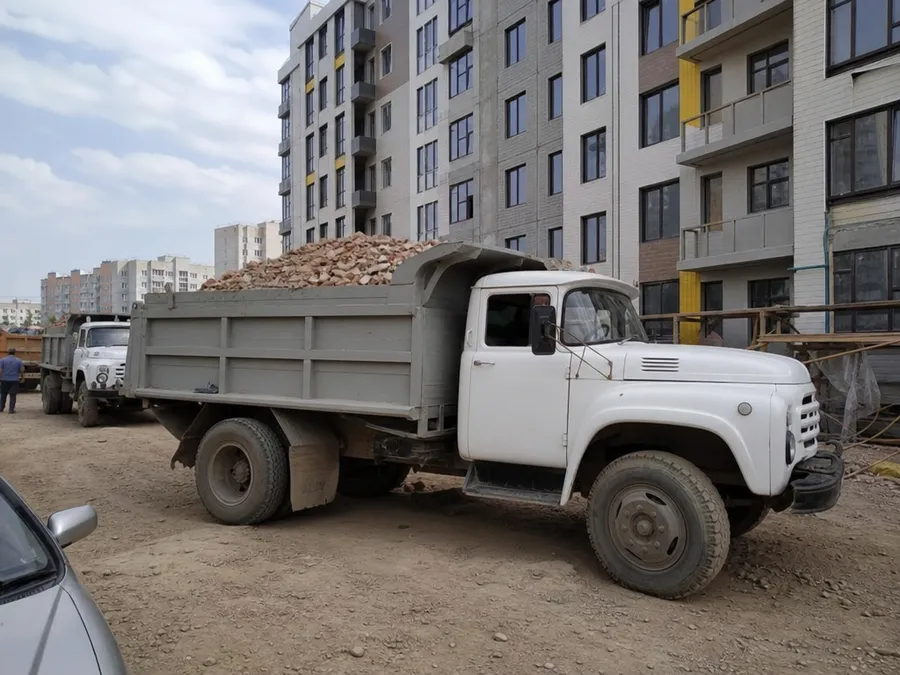
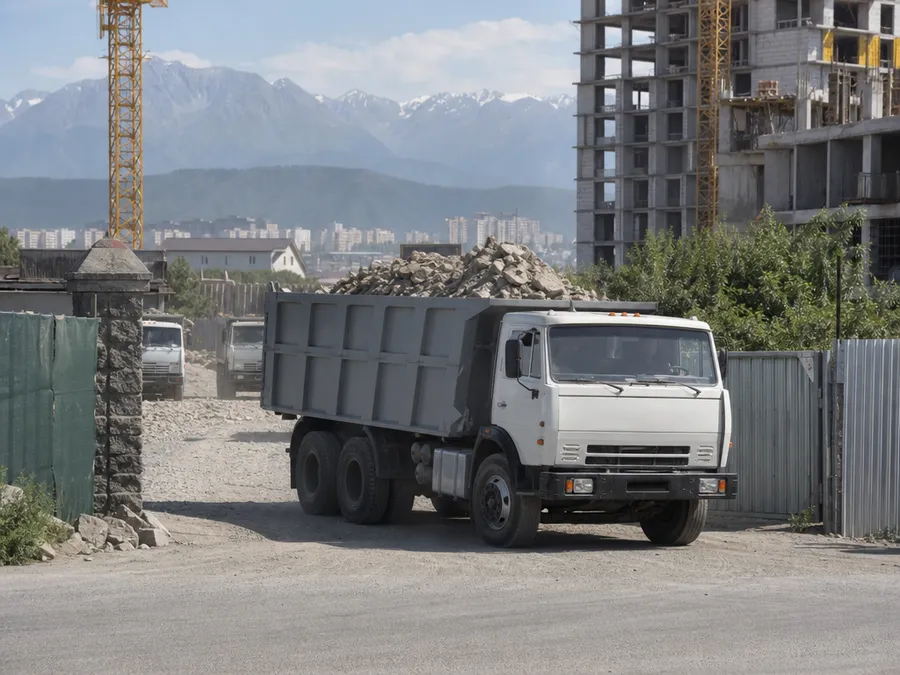
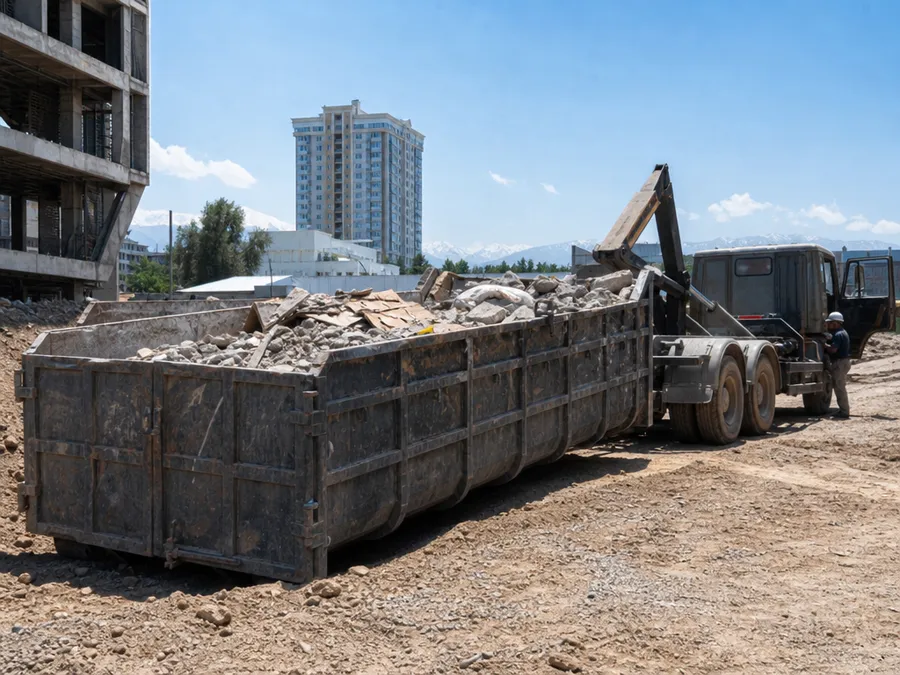
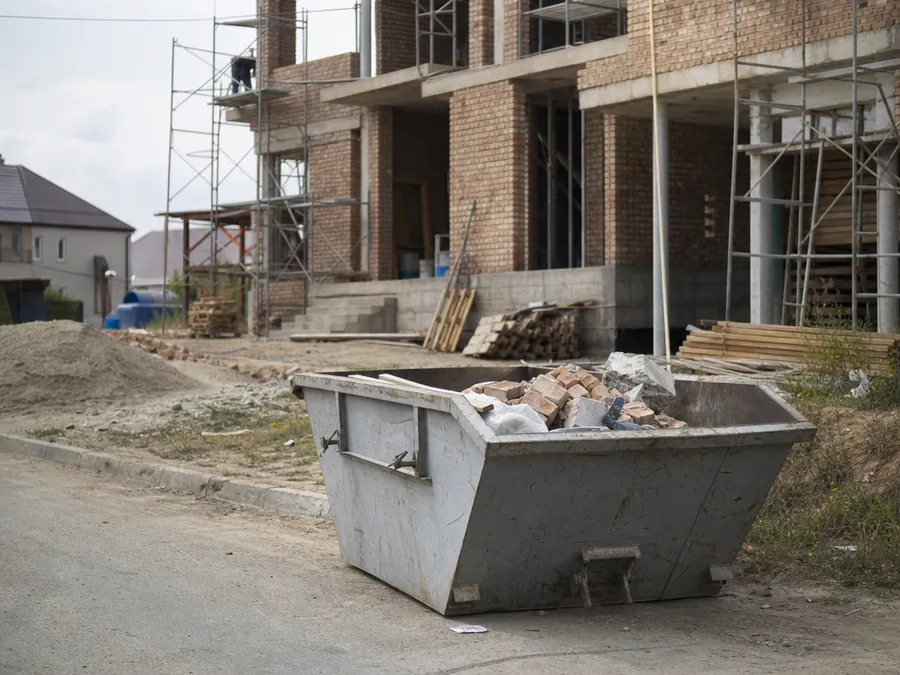
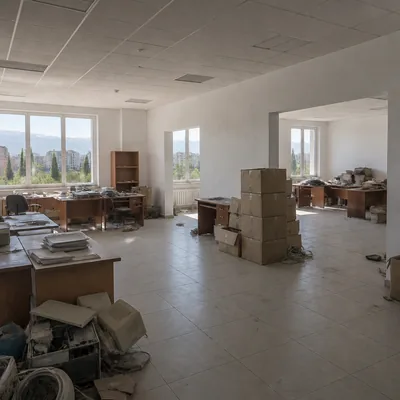
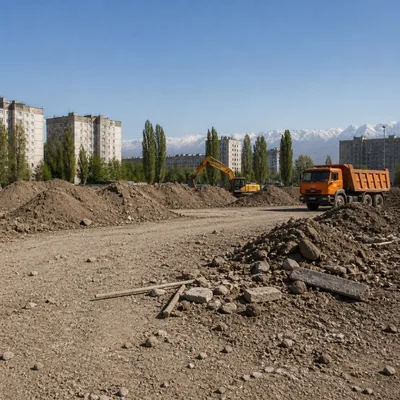
Broken brick, plaster, tiles, chunks of screed. A GAZelle holds 12 cubes of this at 1.5 tons, but if there's a lot of concrete, we go by weight and send a KAMAZ.
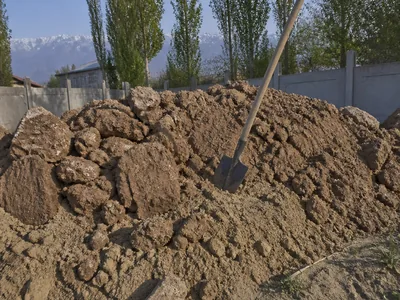
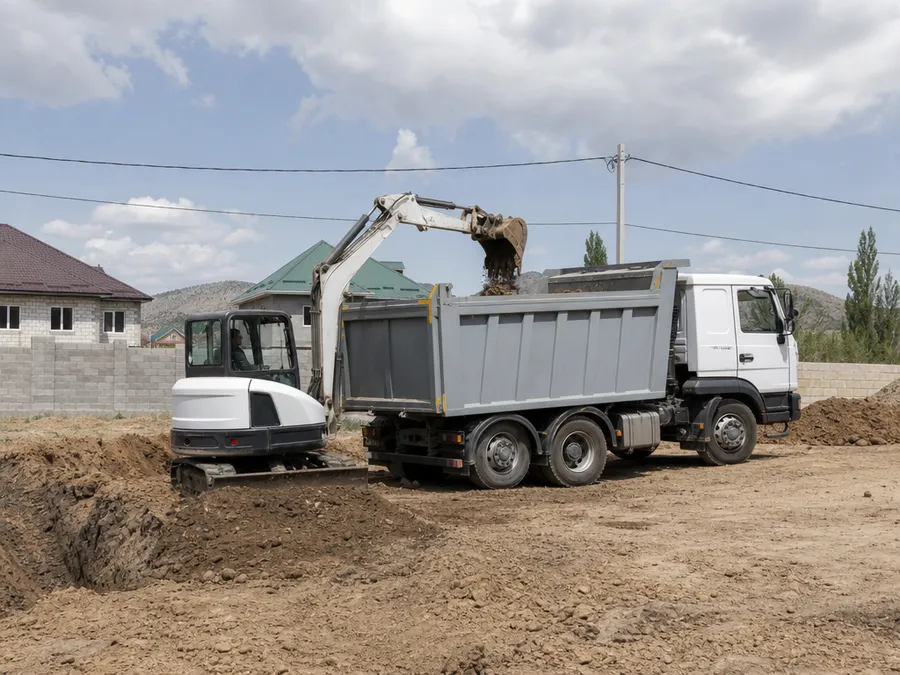
Earth after digging, clay, sand from the plot. Heavy load — a GAZelle will hit its limit at one and a half cubes of weight, so you need a dump truck here.
Valid from August 2026 · price per trip within the city
Price list for waste removal in Almaty, August 2026
Equipment
Volume
Payload capacity
Price per trip
Extra hour
GAZelle 1.5 t
12 m³
up to 1.5 t
30 000 ₸
6 000 ₸
GAZelle 2.5 t
16 m³
up to 2.5 t
35 000 ₸
9 000 ₸
Truck 5 t
25 m³
up to 5 t
40 000 ₸
12 500 ₸
ZIL dump truck
7–12 m³
up to 7 t
40 000 ₸
12 500 ₸
KAMAZ dump truck
15 m³
up to 20 t
55 000 ₸
15 000 ₸
Howo dump truck
25 m³
up to 40 t
60 000 ₸
15 000 ₸
PUHTO (skip)
8–10 m³
up to 7 t
45 000 ₸
—
Multilift
20 m³
up to 12 t
100 000 ₸
—
Skip
27 m³
up to 15 t
135 000 ₸
—
Max skip
32 m³
up to 20 t
160 000 ₸
—
Loaders:6 000 ₸/hour per person · 20 000 ₸ for a 2-person crew with a GAZelle · 48 000 ₸ for a 3–4 person crew with a ZIL · 80 000 ₸ for a crew with a KAMAZ
By volume:8 000 ₸ per m³, if it's easier to count in cubes rather than trips
Typical estimates:post-renovation 1-bedroom — 50 000 ₸ · facade work — from 60 000 ₸ with a skip · partition demolition — 88 000–135 000 ₸
Prices apply within Almaty city limits. Outside the city, mileage is added — we calculate it in chat before dispatch.
Not sure which truck you need? Send a photo — we'll pick one for you.
Breakdown: which truck to order for what volume of trash removal
Aigul Serikkyzy
Request manager
Published: Updated:
A situation familiar to anyone who's started a renovation or cleaned out a garage: the trash is already sitting in your yard, and you have no idea what truck will come for it. It seems like 'trash removal Almaty' is just one thing, but actually there are a dozen different truck bodies hiding behind that phrase. And which one pulls up to your building determines whether you haul everything away in one go or end up paying for a second trip.
At TRASHOFF, we answer the same questions every day. A client says, 'I've got about five cubic meters,' but in reality it's twelve, plus a couple of tons on top. Or the opposite — they order a big skip because they're afraid it won't all fit, and half the container goes back empty. Honestly, almost no one knows the exact volume before we show up.
This article isn't about which truck we'll sell you. It's about how to calculate. We'll break down the difference between a cubic meter and a ton, why trash density changes everything, where the line is between a flatbed and a dump truck, and why sometimes two trips are cheaper than one big one. After reading, you'll be able to tell the manager the volume and type of waste so they immediately know what to send.
How to estimate trash volume before ordering a truck
First things first: you need to figure out the volume before you call, not after. Once the truck is at your door, it's too late to negotiate. And the driver won't wait while you recount the bags. So spend ten minutes before you book a garbage truck.
Walk around the yard and count the bags — that's the quickest estimate.
Go through the rooms and note where else there's stuff that hasn't been taken out.
Count the odd items separately: furniture, pallets, boxes, appliances.
Put it all in one list and add a buffer for what you forgot.
Call or message on WhatsApp and give the total.
Specify the floor, elevator, and the spot where the truck can park.
Now let's break down each point separately, because that's where people make mistakes.
How many cubic meters are in a standard construction waste bag
A standard construction waste bag is 50–60 liters, so roughly 0.05–0.06 cubic meters. Easier to remember this way: one cubic meter takes 17–20 such bags. If the bags are packed with broken brick or tile, they're heavier, but the volume is the same. Puffed up with dust and insulation — lighter, but still the same cubic meters.
I usually tell clients not to count bags one by one, but to pile them up and mentally estimate: how many such piles fit in a GAZelle bed. A GAZelle bed is 1.5 tons — 12 m³. On paper that's two hundred forty standard bags, but bags don't stack without gaps and hit the weight limit, so we take up to 50 bags in a GAZelle. At a glance such a pile seems smaller than it is. That's normal, and I'll explain why next.
Another thing: bags come in different sizes. Household ones are sixty liters, construction ones are a hundred twenty. If you mix them, count by the average — about eighty liters. Eighty liters is 0.08 cubic meters, so twelve and a half bags per cubic meter. Don't memorize the number, just keep in mind that a cubic meter is about a dozen large bags.
Estimating by rooms and types of renovation
A room under renovation always has a roughly known volume. A one-bedroom apartment with demolition of old finishes yields about four to five cubic meters. A two-bedroom — seven to eight. A three-bedroom — already ten to twelve, and that's without removing furniture. Plaster knocked off walls gives a lot of volume but little weight, while screed is the opposite.
If you only changed wallpaper and painted the ceiling, there's almost no trash — a couple of bags. If you removed tiles in the bathroom, that's already a cube to a cube and a half of broken stone. A cosmetic renovation of one room rarely exceeds a cube. A major renovation of an entire apartment is consistently more than 12 m³, and one GAZelle won't cut it.
The bathroom is a separate story. An old cast-iron bathtub weighs about a hundred kilograms by itself, and together with tiles and screed, a bathroom can produce up to two cubic meters. Keep that in mind when you order a truck to remove waste after the bathroom.
Pallets, boxes, and old furniture: how to count odd items
Odd items are the hardest to count because they don't stack neatly. A standard pallet is about 0.1 cubic meters disassembled and up to 0.5 cubic meters if loaded. A sofa takes about one and a half cubic meters if not disassembled. A wardrobe — one cubic meter. A fridge — a little over a cubic meter. A washing machine — half a cubic meter.
Boxes are deceptive. A large TV box is only 0.2 cubic meters, but there are usually a dozen such boxes, and they don't pack tightly. If the junk is loaded in bulk, there are gaps between items, and the truck fills up faster than you think.
It's better to disassemble furniture. A disassembled wardrobe takes three times less space than an assembled one. This isn't a money-saving tip — it's a way to fit into one truck instead of two. And yes, carrying old furniture down from the fourth floor without an elevator is a separate story, more on that below.
Why 'by eye' almost always underestimates the volume
There's a simple reason: people look at the pile from above, not from the side. From above it looks small. From the side it's twice as big. Plus your brain rounds down in your favor, because you want it all gone in one trip and for less money.
From experience, people almost always underestimate — by about thirty percent. They order a GAZelle for twelve cubes, but it turns out to be fifteen. Then there are two options: either some of the trash stays in the yard, or a second truck comes. A second trip is never cheaper than just getting a bigger truck in the first place.
What to do? Argue with yourself. Once you've named a number, add a third to it. Not because we want to sell you a bigger truck, but because that's the statistic: people almost always undercount. If there's space left in the truck — no big deal, but if there isn't enough, you'll lose a day and money.
Another reason for underestimating is trash you forgot about. Old tires behind the garage, formwork boards, cans with leftover paint that you can't just throw away. When you're counting, walk the whole property, not just the room where the renovation happened.
And lastly. If you're unsure, take a photo of the pile and send it to WhatsApp. A photo shows the volume better than a description. We'll check it against the truck dimensions and tell you what fits — a GAZelle, a ZIL, or a dumpster. It's faster than guessing and more honest than naming a number at random.
The difference between a cubic meter and a ton and why it matters when ordering a truck
The client says: "Five cubes." The dispatcher asks: "And what's the weight?" And that's where it starts. Because a cube and a ton are two different characteristics, and confusing them means ordering the wrong truck. Truck volume — how much space the trash will take up. Payload capacity — how much weight the truck can carry. And they don't always match.
What truck volume shows, and what tonnage shows
Truck volume is measured in cubic meters. It's geometry: length times width times height. A 1.5 t GAZelle carries 12 m³, a KAMAZ — 15 m³, a max dumpster — 32 m³. You'd think the bigger the cube, the more trash. But no. Every truck has a second limit — how much weight it can lift. A 1.5 t GAZelle is 1500 kilograms. Anything heavier, it won't carry, even if the truck is half empty.
Tonnage is about mass. It depends on the material: brick, concrete, and soil weigh far more than styrofoam or cardboard. So when you say "five cubes," the dispatcher will still ask: "What's in there?" It's not nitpicking. It's to avoid sending a GAZelle where a dump truck is needed.
Why light trash and heavy trash behave differently
Light trash — branches, cardboard, old furniture, packaging — takes up a lot of space but weighs little. This kind of load is limited by truck volume. You can fill a 12 m³ GAZelle to the ceiling, and it'll easily carry those 12 cubes, because the weight will be within a ton. Heavy trash is different. Concrete chunks, brick, tile, soil — take up little space but weigh a lot. A bucket of concrete the size of a bucket weighs twenty kilograms, and a cube of concrete is already about two tons. A 1.5 t GAZelle can't even carry one cubic meter of concrete: it'll exceed the payload capacity.
So the question "how many cubes" without specifying "of what exactly" is half an answer. And if you say "construction waste," the dispatcher will understand: that's probably heavy. And if it's "old furniture" — light.
Comparing light and heavy trash
Type of waste
Approximate weight of 1 m³
What limits the load
Branches, cardboard, furniture
0.1–0.3 t
Bed volume
Household waste
0.3–0.5 t
Bed volume
Construction (brick, tile)
1.0–1.5 t
Payload capacity
Concrete, soil
1.5–2.0 t
Payload capacity
What happens when weight runs out before space
The truck arrived, the bed looks empty, but you can't load any more. That's not the driver's mistake. It's overloading. If a GAZelle rated at 1.5 t has already taken on a tonne and a half of concrete, it won't go anywhere, even if there's plenty of space left. The driver will say: that's it, we're done. And you'll have to call a second truck. Or overload it, but that's a risk: the truck will sag, the brakes won't work, and there might be a weigh station on the way out of the city. No one has canceled the fines.
It can go the other way too: the trash is light, the bed is packed to the brim, but there's no weight. Then the limit is volume. A GAZelle's 12 m³ is its ceiling, whether you're loading foam or feathers. It just won't fit any more.
So when you order a garbage truck, it's important to give not just the approximate volume but also the type of trash. Then the dispatcher will pick a truck that avoids both overloading and an empty run.
How not to overpay for a bed that can't be filled
The most common mistake is ordering a truck with a big bed just in case. For example, a 27 m³ container for light trash is a good deal if there really is a lot of trash. But if it's heavy concrete, the container can't take the full volume: it'll hit its weight limit. And you'll pay for the truck, not the actual weight. You'll end up paying for 27 m³ but hauling away 10.
On the other hand, a small GAZelle for light trash is often the best option. It'll take all 12 cubes, and it'll be one trip. If there's more trash, you can order a 2.5 t GAZelle (16 m³ bed) or a 5 t truck (25 m³).
To avoid overpaying, do this:
Give the approximate volume in cubes — even just by eye, by the number of bags or the pile in the yard.
Describe what the trash is made of: concrete, brick, wood, appliances, furniture.
Say whether there are heavy items: a bathtub, a stove, a safe, large debris.
Clarify whether you need manual loading or you have equipment.
Ask the dispatcher which truck fits that volume and weight.
If you're unsure, send a photo — it helps estimate the volume more accurately.
Remember: the price depends on the truck and the trip, not on how many cubes you mention.
And one more thing: don't be afraid to ask again. Better to ask an extra question before dispatch than to sort out on site why the truck can't take all the trash. Ordering a garbage truck isn't a lottery, it's a calculation. And the more accurately you describe the load, the fewer surprises.
Trash density: what changes the truck calculation
An old sofa, a concrete screed, and cardboard boxes can take up the same volume — say, six cubes. But they'll weigh completely differently: two people can lift the sofa, but even a GAZelle can't lift the screed. If you don't account for density, you'll order a bed by volume, and the truck will arrive and won't be able to move. Or the opposite — you'll get a one-tonne dump truck, and it'll be hauling air.
Density is the weight of one cubic meter. For concrete it's close to two tonnes, for dry cardboard it's close to fifty kilograms. The difference is forty times. So saying "I have five cubes" without specifying what it is tells the dispatcher nothing. He'll ask what the load is, and only then name a truck.
Let's take it step by step. First, we'll look at the types of waste by weight, then how that relates to load capacity, and finally why two trips are sometimes better than one big one.
Heavy waste: concrete, brick, soil, screed
After demolishing walls, floors, or a foundation, you're left with what's called construction debris. A cube of this trash weighs from 1.5 to 2.2 tonnes. Brick with mortar is closer to two. Soil, especially wet, is about 1.6–1.8 tonnes per cube. Screed with rebar is the heaviest, up to 2.5 tonnes per cube.
Here the body volume barely matters. Payload capacity is what counts. A GAZelle with a 12-cubic body physically can't take more than a ton and a half — meaning it won't haul more than one cube of concrete. The rest has to be unloaded. A garbage truck in Almaty for loads like this is a dump truck with a big weight margin.
Medium weight: wood, furniture, old parquet
Wood and furniture are the most deceptive category. A wardrobe takes up a lot of space but weighs little. But old parquet removed from the floor is already heavier: it has nails, glue, sometimes concrete crumbs. A cubic meter of disassembled furniture is about 300–400 kg. A cubic meter of parquet is up to 700–800 kg.
Purely by volume, such a load falls on the bed. Twelve cubic meters of a GAZelle will be almost completely filled with furniture, but the weight won't even reach a ton. In this case, renting a garbage truck isn't about payload capacity but about volume. The main thing is to pack things compactly, not just toss them in.
Light and bulky: cardboard, insulation, household junk
Cardboard, foam plastic, mineral wool, old things — here the density is minimal. A cubic meter of cardboard weighs about 50–70 kg, insulation even less. But they take up a huge volume. Such trash needs to be pressed or torn up, otherwise the body will be full in twenty minutes.
The paradox: light trash is often more expensive to remove than heavy trash. Because you pay for the truck and the trip, not for the weight. If ten cubic meters of foam plastic weigh three hundred kilograms, you still pay for a full body. And then the question arises: take a smaller truck or compact it.
How density determines which truck will even go
The dispatcher asks just two questions: what kind of trash and roughly how many cubic meters. The answers immediately cut out half the fleet. Concrete and soil — only a dump truck, because the bed won't hold. Furniture and wood — a flatbed or a GAZelle if the volume is small. Cardboard and insulation — anything, but with compaction in mind.
A beginner's mistake is ordering by volume and forgetting about weight. Or the opposite: seeing only tons and then being surprised the body is too small. The rule is simple: heavy stuff we count in tons, light stuff in cubic meters. Mixed loads — we take the worst indicator.
Once we came to dismantle a bathroom, the client said: 'It's two cubic meters, max.' But there was tile, concrete screed, and a cast-iron bathtub. The GAZelle sank onto its springs, we barely got out. Since then I always ask: 'What exactly is the trash?'
That's why ordering a "garbage truck Almaty" without specifying details is a lottery. At TRASHOFF, we try to find out everything over the phone so we don't send a truck for nothing. Sometimes we ask for a photo — it's faster than guessing.
If you're unsure, call. Ordering a garbage truck isn't buying a pig in a poke, it's a conversation after which it becomes clear what exactly will arrive. Better to spend five minutes on questions than half a day on overloading.
And another thing: don't mix heavy with light in one body without a margin. Concrete on the bottom, cardboard on top — and the bed is already sagging. Better two trips with different trucks than one overloaded.
First separate the heavy fractions — concrete, brick, soil — and calculate their volume separately.
Light junk — furniture, cardboard, insulation — estimate by eye, but with a twenty percent margin.
Weigh mixed loads by the densest component, not the average.
If the trash is in bags, clarify what they're stuffed with: construction debris or packaging.
For loose loads — sand, soil, crushed stone — give tons instead of cubic meters if you know.
Photos of the pile from different angles help the dispatcher choose the right body more accurately.
Don't order a truck 'by eye' with a big margin: you'll overpay for air.
Density isn't some abstract idea — it's the number that decides how many trips you'll pay for. Ignore it and you'll either overpay or put your equipment at risk. You don't need either.
Flatbed or dump truck: how to choose a truck for trash removal
Arguing about which body is better is like arguing about the weather. It all depends on what exactly you're loading and where the truck needs to pull in. And also — who's going to toss those bags: your movers, ours, or the neighbor from the third floor you talked into helping for a cup of tea. Ordering a garbage truck starts not with choosing a model, but with answering a simple question: is the waste loose or piece-by-piece?
If it's old boards, branches, a sofa, tires, bags of construction debris — you probably need a flatbed. If it's soil, sand, crushed stone, dirt from digging a pit, loose plaster — a dump truck. But there are exceptions here too, which we'll get to.
Hand-loading a flatbed: when it makes sense
A flatbed truck takes more volume than a dump truck with the same payload capacity. A GAZelle with a 12 m³ body and up to 1.5 tons payload is a classic for apartment renovations. It'll fit an old kitchen set, three doors, bags of tile, and still leave room for baseboards. You have to toss all that in by hand — over the side. If the trash is in the yard, at ground level, it's fine. If it's on the fifth floor with no elevator, count your strength and time.
We often hear: "I don't have much, about five cubic meters." We show up — there's eight cubes on the site, and all of it has to be lifted off the ground and loaded into the truck. So when ordering a truck, it's better to say right away not "not much," but an approximate composition: what kind of trash, how many bags, whether there are large items.
Dump-truck unloading: what you need on site
A dump truck is great because it unloads itself. Raise the body — and everything slides out. No one's swinging a shovel, no one's prying out the last boards. But that convenience comes at a price: a dump truck needs a spot where it can raise its body. In a yard with wires overhead or between two parked cars, it won't be able to. And if it can, there's a risk of hitting something with the body.
So before calling a garbage truck, we always ask: is there access, is there room to maneuver, are there wires hanging. If the spot is tight, the dump truck will come, but unloading might drag on. Or you'll have to unload partially, in chunks — which is already inconvenient.
There's also a nuance with weight. A ZIL dump truck with a 7–12 m³ body takes up to 7 tons. A KAMAZ with a 15 m³ body — up to 20 tons. But if you fill it with something very heavy, like wet sand, the truck can go overweight. We keep an eye on that separately.
Access and body-height limits
The side height on a GAZelle is about a meter to a meter and a half. That means you have to lift each bag to that height. Your back will thank you if you arrange for movers in advance. A dump truck's side is higher, but loading there is usually done from above, with an excavator or from a hopper, not by hand.
Another thing — vehicle dimensions. A GAZelle can get into a narrow yard and under an arch. A KAMAZ can't. If you're ordering garbage truck rental in Almaty for a site in the center where the streets are narrow, it's better to warn us upfront. We'll pick a vehicle that can actually get in, not one that looks good in the price list.
Sometimes the yard is closed by a barrier or there's a height limit. Then even a GAZelle might not get through. We discuss this before dispatch so we don't send a truck for nothing. If access is impossible, the trash will have to be carried to where the truck can pull up.
Why sometimes both options work for the same trash
We'll take old furniture. You can haul it out with a flatbed GAZelle, stacked neatly. Or you can order a dump truck and just toss it in — there's plenty of room. The difference is how fast you load and how much effort you spend. Flatbed — slower, but cheaper per truck. Dump truck — faster, but you need space to unload.
Or construction debris: broken brick, plaster. You can put it on a flatbed too, but loose material is easier to load into a dump truck. If the volume is small, a flatbed will do. If the volume is large and you have loading equipment — a dump truck.
Here's what we usually ask when you order a truck to haul away debris, so you don't overpay for an extra body:
Is the debris loose or piece-by-piece: this determines whether a dump truck can unload completely.
Is there access for a dump truck to raise the bed, or is the yard too tight.
Who loads: your people, our loaders, or equipment like an excavator.
How high up is the debris — on the ground, on the second floor, or on the roof.
Do you need a rear-loading garbage truck if it's household waste, not construction.
How long will loading take: an hour or all day — this affects the choice of truck.
Flatbed vs dump truck: a side-by-side comparison
Parameter
Flatbed truck
Dump truck
Loading method
By hand or crane, over the side
From above, with an excavator or from a bin
Unloading
By hand or with equipment
Self-dumping, by raising the bed
Site requirements
Enough space to park
Space to raise the bed and maneuver
Typical debris
Furniture, boards, bags, tires
Soil, sand, gravel, heavy rubble
Side height
Lower, easier for hand loading
Higher, designed for top loading
And one more thing: a dump truck isn't always the better deal. If there's little debris but it's heavy, a dump truck can go overweight faster than a flatbed. Density decides everything, not just volume. And if you're unsure, it's best to call and describe the situation — we'll tell you what to order.
Read this far and still not sure about the volume? Send us a photo — we'll calculate and give you a price.
Two trips or one big truck: how to calculate the savings
From experience: a big body isn't always the better deal. Sometimes it's the opposite — one large bin gets stuck in a dead end, and you pay for downtime, not transport. So compare the full picture, not the price per trip: how many runs, how much time, how many people are holding the truck at the entrance. Sometimes two runs with a GAZelle go smoother than one trip with a heavy truck that can't fit into the yard.
Let me start with what actually determines the number of runs. Volume is first. Weight is second. Density is third, and it's the one most often forgotten. Twelve cubic meters of construction rubble can weigh more than twenty cubic meters of old furniture, and that changes everything: one truck will take it by volume but not by weight. That's why ordering a garbage truck is a conversation about two numbers at once, not one.
When a small truck goes where a big one can't
Yards in Almaty are a story of their own. Arches, parked cars, wires over the entrance, a tight turn by the playground. A GAZelle with a twelve-cubic-meter body slips through where a KAMAZ wouldn't even start to turn around. And it's not about saving money — it's about whether the truck can reach your pile at all.
If the debris is deep in the yard, behind a barrier, or in an area with height restrictions, a large body is out of the question right away. You'll either have to carry it out to the road or call a small truck. Carrying out is a separate job, and it costs time. That's where the fork appears: pay for several runs or for manual overloading.
A narrow arch into the yard — a large dump truck physically can't get in, only a GAZelle.
Wires over the entrance limit height, a bin with a lift won't pass there.
A barrier and security require a pass, and a truck under the windows will be delayed.
Debris deep in the yard will have to be carried out to the road by hand.
The parking lot is taken by residents — heavy equipment will park and block the exit.
The turnaround in the yard is tight, a heavy truck won't turn around without backing in.
How long does manual loading take versus a dump truck
Manual loading isn't a ten-minute job. Furniture, doors, boards, bags — all of it goes into the truck piece by piece, and twelve cubic meters can take more than an hour. A dump truck is faster, but only if the load is loose: soil, brick rubble, sand. Building materials and junk won't work with a dump truck — they still have to be loaded by hand or with equipment.
Plus downtime. The truck sits by the entrance while the crew carries everything. If the yard is a thoroughfare, someone will definitely ask you to move. We usually warn: the bigger the volume, the longer the loading, and that time also factors into the cost-benefit. From experience, an hour of manual loading is about a GAZelle's worth, if you work without smoke breaks.
Why a second trip isn't always more expensive than the first
It seems like two trips means double the price. Not necessarily. The first trip often goes the long haul, the second is short, to the same site. And if the truck is already in your area, the second run costs less than ordering a separate truck from the other side of town. We take that into account when we calculate the estimate.
Another thing: when you order a truck to remove trash twice, you pay for two equipment arrivals, but not for two full shifts. The crew is the same, travel time is less, unloading downtime is less too. So "two trips" isn't a budget killer. Sometimes it's the only option if a large truck can't fit in the yard.
How volume and density dictate the number of trips
Simple logic: first we count the cubic meters, then multiply by density to get tons. If the tons fit within the payload capacity — done, one truck. If not — either reduce the volume by sorting by hand, or split it into trips. Trash removal by truck is planned exactly like this, not by guesswork.
And another thing. Dense loads — rubble, soil, concrete — are better removed with a dump truck or skip: both volume and weight match up. Light and bulky — furniture, containers, branches — go with a GAZelle, but sometimes in two trips. Ordering a garbage truck in Almaty almost always starts with this question: how many tons and how many cubic meters do you have. Answer that, and we'll pick the right truck.
Separately about access. If the truck can't park by the entrance and the carry distance is long, time goes up, and it's better to take a smaller truck but bring it closer. Renting a garbage truck then is calculated not by trips but by crew hours. And honestly: in half the cases, the client later says they regretted getting a large truck in the yard.
And lastly. Don't chase one big truck just because you're afraid it won't all fit. You can order a truck for trash removal in two runs — that's fine. The main thing is that the trash doesn't sit for a week waiting for a heavy truck that can't get through the archway.
Mistakes when ordering a truck for trash removal and their consequences
Five cubic meters is five cubic meters, but only in a math problem. In a yard on Tashkentskaya, a client confidently stated: "About six cubes, no more." A twelve-cubic-meter GAZelle arrived. We loaded a little over half, and off we went. An hour later it turned out that in the second pile was an old sofa that no one had moved, and a bunch of boards. Result: a second trip. And a second payment. Annoying, but predictable.
Mistakes when ordering a truck for trash removal are almost always not about the equipment, but about inattention to detail. In this section, we'll go over the four most common situations. And show how they're solved on the spot, so you don't overpay for air.
What to do if the volume turns out to be more than declared
The most common one. You say five cubes, the loaders see ten. The reason is eyeballing. A person looks at a pile and sees what they want to see. Especially if the trash lies in an uneven layer. Or if part of it is already compacted and part is loose.
If the volume is bigger, you have two options. First — agree to a second trip or call a bigger truck. Second — leave some of the trash behind, if there's somewhere to leave it. Sometimes it's cheaper to pay extra for a truck that takes everything at once than to run a GAZelle twice. Do the math on site: if the volume difference is noticeable, a bigger truck is almost always cheaper than two trips.
What you shouldn't do: try to shove the extra on top. It's dangerous for both the loaders and the truck body. Overloading is a separate story, more on that below.
The truck arrived, but the driveway is too narrow
In old courtyards, it's the same story every time. The arch is three meters, a GAZelle fits through by the mirrors, but can't make the turn. Or the wires are low, or parked cars are bumper to bumper. The driver won't risk scraping the side against the wall. He'll stop wherever he can.
Then you have options. First — carry the trash to where the truck can pull up. That means extra carrying, but sometimes there's no way around it. Second — order a smaller truck that can squeeze through the arch. Third — call for a dumpster that gets placed on the spot and picked up later when it's full. We often recommend a dumpster for narrow courtyards: it doesn't need to park by the entrance, it just sits and waits.
If you know the driveway is problematic, say so right when you place the order. The phrase "our courtyard is tight" will save you forty minutes on site and the driver's nerves.
The trash is heavy, but the truck is built for light loads
A cube and a ton are not the same thing. This is the main mistake when ordering. Concrete rubble, brick, old plaster, soil — all of it weighs way more than it looks. A GAZelle rated for a ton and a half can take twelve cubes of styrofoam, but the same twelve cubes of concrete it won't pull. Not even close.
What happens when you overload? The springs sag, the truck rides unevenly, braking distance grows. The driver may refuse to go. Or he'll get stopped at the first checkpoint and forced to unload. In the end, the trash stays put, and you lose time and money.
The solution is simple: if there's anything heavy in the trash, give us a heads up. Then we'll pick a truck by weight, not by volume. For heavy loads, we have dump trucks with a capacity of up to seven tons and more. A KAMAZ takes twenty tons — but that's a whole different story and a different order.
How to adjust your order on site without extra hassle
Even if you got the estimate wrong, all is not lost. We don't leave a client stranded. If there's more trash than planned, you can pay extra for the additional volume or call a second truck. If there's less — no problem, just pay for what was actually removed. The price is fixed before dispatch, but if the volume turns out smaller, we'll recalculate.
The main thing — don't stay silent. Tell the driver or call the dispatcher. We're reachable on WhatsApp and by phone. Adjusting an order is easier than it seems if you're honest from the start.
Here's a table to help you navigate typical mistakes and their consequences.
Common mistakes when ordering a truck and their consequences
Mistake
What it leads to
How to fix it
Volume underestimated
Second trip, double payment
Pay extra for a bigger truck or leave some trash behind
Weight not accounted for
Overload, driver refuses, fine
Warn about heavy fractions, choose a dump truck
Narrow driveway
Truck can't get in, downtime
Order a dumpster or move the trash to the parking spot
No place to unload
Nowhere to put the trash, loading drags on
Clear the area in advance or choose a dumpster
Silence about problems
The driver arrives unprepared
Mention the tight courtyard, heavy trash, low wires
A couple more things people often miss. If the trash is on the lawn or a flowerbed, it needs to be moved onto a hard surface — otherwise the loaders can't get to it. If there's a barrier gate in the courtyard, let us know in advance so the driver doesn't wait. If the trash is in bags but the bags are tearing, it's better to repack it into heavy-duty ones or order extra.
And remember: garbage truck rental in Almaty isn't just "they came and took it away." It's teamwork. The more accurately you describe the situation, the faster and cheaper it'll go.
Our experience shows: half of all problems are solved with one phone call. Don't hesitate to ask. We've been at this for years and we've seen it all. A narrow courtyard, trash on the fifth floor with no elevator, a concrete slab that can't be lifted without equipment. All of it is solvable.
The main thing is not to mess up the main thing: don't underestimate the volume and don't confuse cubic meters with tons. Then ordering a garbage truck goes smoothly. And trash removal by truck won't turn into a quest.
Underestimating the volume: the client sees five cubes, but it's actually ten, and that's a second trip.
Ignoring the weight: concrete and brick are heavier than they look, a GAZelle won't haul them.
Narrow passage: a three-meter arch, the truck won't fit, you need a dumpster or to move the trash.
No place to unload: trash on the lawn, loaders can't get to it.
Silence about problems: you didn't mention the barrier gate, the driver waits and loses time.
Trying to stuff extra on top: overload, risk of an accident and the driver refusing.
Ordering a big truck "just in case": half the bed rides empty, you overpay.
That's everything you need to know about mistakes. Next — briefly about the main thing: how to order a truck for your trash.
The bottom line: how to order a truck for your trash
If you boil the whole article down to one thought, it's this: count cubic meters and tons, not bags. Five bags of construction debris is about 0.3 cubic meters and 250 kilograms. Five bags of old furniture is already 2 cubic meters and 300 kilograms. The difference in volume is almost sevenfold. That's why "order a truck for waste removal" starts not with "how much does it cost" but with "what exactly is there."
We calculate volume and weight before the call
Volume is easy to calculate: length times width times height of the pile, in meters. If the trash is in bags, estimate how many bags fit in one cubic meter. A 120-liter bag — that's about 8–9 per cubic meter. Weight is trickier. It can only be estimated roughly, by the type of waste. Brick and concrete are the heaviest, branches and foam are the lightest. The manager will ask for both anyway.
We determine the type of waste and its density
Density is the weight of one cubic meter. For construction debris it's about 1.2–1.6 tons per cubic meter. For old furniture and wood — 0.2–0.4 tons per cubic meter. If the density is higher than the truck's payload allows, you'll hit the weight limit, not the bed capacity. That's exactly why a ten-cubic-meter dumpster can't always be filled with ten cubic meters of concrete. First we calculate weight, then volume — and choose the truck by whichever limit is lower.
We choose between a flatbed and a dump truck
A flatbed is a GAZelle or a truck with an open bed. They're convenient to load by hand, from above, from the ground. A dump truck — ZIL, KAMAZ, Howo — dumps the trash itself, but needs room to pull up and raise the bed. A dumpster and a multilift bring an empty container, you fill it, then it's hauled away. For an apartment renovation, a flatbed GAZelle is usually enough. For tearing down walls — a dump truck. For a construction site with a constant flow of trash — a dumpster.
What to clarify with the manager when ordering
Before you place an order, go over a few things. It'll save you both time and money.
Address and exact arrival time: will the truck be able to pull up for loading, is there a ban on entering the yard.
What kind of waste: construction, household, green or mixed — the density and the truck depend on this.
Do you need loaders and which floor to pick up from: carrying stuff down from the third floor with no elevator is a whole different story.
Is there access for a dump truck or a skip: a narrow yard and low wires rule out big bodies.
Who carries the waste out of the apartment and stacks it in the truck: we can do it ourselves, but let us know in advance.
Where to dispose of it: if the waste is sorted, some of it can go to recycling instead of a landfill.
And one more thing: don't hesitate to send a photo of the pile on WhatsApp. From a photo we almost always give a more accurate volume than from words. And the price is fixed before the truck arrives and doesn't change after. If the driver shows up and sees more waste than you said, he won't just quietly drive off — we'll get in touch and figure out what to do: add a trip or order a bigger truck.
So the whole sequence looks like this. First you estimate the volume and weight, then you determine the density, then you choose between a flatbed and a dump truck, and only then do you call. If you do it in that order, renting a garbage truck in Almaty turns from a lottery into an ordinary everyday task. And if you're unsure — write to us, we'll figure it out together.
❓ Questions
Questions about ordering a truck and waste removal in Almaty
Don't look at the number of bags, look at what's inside. Light stuff — old boards, cardboard, rags, foam — a GAZelle with a 12 m³ body can handle. But concrete, brick, tiles, soil — that's weight, and here a GAZelle gives up quickly: you'll hit one and a half tons with a couple of cubes. Send a photo on WhatsApp, we'll tell you what to take.
A 1.5 t GAZelle trip — from 30 000 ₸. If you need loaders to carry out and load, that's separate: 20 000 ₸. We'll give the exact amount after a photo, because volume (which is almost always underestimated) decides everything.
Yes, a second run is a second run — that's just how it is. But we don't just drive off and leave you hanging: if we see it won't fit, we tell you right away and offer either to load more on the same trip or come back. Sometimes it's more honest to bring a KAMAZ right away — it works out cheaper than two trips with a GAZelle.
If the truck's already here and you realize you need a bigger bed, give us a call. We'll send whatever's free, but that takes time. That's why we ask for photos in advance: a couple of shots save you half a day.
We work Mon–Sun, 9 a.m. to 9 p.m. Saturday and Sunday are regular days, no weekend surcharge. The only thing is, Saturday morning slots go fast, so it's better to book a day or two ahead.
Up to you. You can just get removal: you bring it to the truck, we load and haul it away. Or you can hire a crew — then the guys come into the apartment or yard, carry it out and load it themselves. One loader costs 6 000 ₸ per hour, but usually people get a crew for a GAZelle, it's faster.
Construction waste, furniture, junk, branches, soil — all of that is fine. What's not allowed in the shared truck body is anything hazardous: batteries, paints, solvents, medical waste, tires by the stack. Batteries, lamps, and old household chemicals we take as a separate request: separately from other waste, to a specialized organization. If you're unsure — ask in chat, we'll tell you right away.
Yes, if there's a barrier or a guard post, order a vehicle pass in advance — sometimes it takes a day to arrange. We'll arrive in the agreed window, but without a pass they won't let us into the yard. Let us know if the entrance is narrow — a GAZelle can get almost anywhere, but it's better to know ahead.
Either way. Cash on the spot or bank transfer — whatever's easier. The price is fixed before the truck arrives and doesn't change after, no last-minute extra charges for "floors" or "weight." All the details are in chat or over the phone from the website.
We do, but outside the city mileage is added to the trip — we calculate by distance. Give us the address and we'll figure it out in advance so there are no surprises on site. By the way, dacha trash is often light: if it's mostly branches and grass, a GAZelle will do.
Got a question that's not here? Ask — we'll answer in writing, no call needed.
Reviews about ordering a truck and about waste removal by our crews
4,9
Based on 32 reviews on this page
T
Timur
I needed to remove trash from two apartments in the same building. I ordered one GAZelle, but it wasn't enough — had to call a second one. The manager warned me this could happen, but I didn't listen. The second truck arrived two hours later. The price was fair, no hidden fees. Next time I'll listen to advice.
Company replyThanks for the feedback. Yes, it's always better to estimate volume with a margin — photos don't show everything.
M
Miras
I called a GAZelle to remove old furniture from my home. The loaders worked quickly, finished in an hour.
M
Madina
We had a big volume after demolishing walls. I thought it would take two trips, but Yerlan said a GAZelle would be enough. And so it was — loaded to the side and taken away. Very pleased that we didn't have to overpay.
Company replyThanks, Madina! Yerlan knows his stuff.
S
Svetlana
I called, explained that I needed to remove a sofa and a bunch of boxes. Dinara suggested a GAZelle would be enough. And so it was — everything was taken in one go.
Company replyThanks, Svetlana! Dinara sends her regards.
Y
Yerzhan
Removed waste from the dacha. The GAZelle was loaded completely, nothing was left behind.
S
Saule
I ordered a GAZelle for trash removal. Everything was fine, they arrived quickly.
B
Bauyrzhan
Ordered a GAZelle to remove furniture from an old apartment. A sofa, a wardrobe, a pile of junk. The loaders worked smoothly, carried everything out in an hour. Filled the body to the brim, didn't need a second trip. They didn't raise the price, even though the volume turned out bigger than I'd said on the phone.
A
Aigul
I ordered a GAZelle for trash removal in Almaty. Everything fit in the 12-cubic-meter bed. The workers were fast and careful.
S
Sergey
Ordered a GAZelle for waste removal after renovation. They came fast, took everything, the yard stayed clean.
Y
Yerasyl
GAZelle 12 cubes, loaded to the brim. The guys helped bring the wardrobe down from the fifth floor.
Zh
Zhanna
I needed to remove old windows and doors. The GAZelle arrived in two hours. They took everything, left nothing behind.
O
Olga
I ordered a GAZelle to remove junk from the garage. They arrived an hour after I called. Everything was taken out quickly.
A
Askhat Mukashev
I called them when a pile of construction waste was left after renovation. Askhat estimated from the photos that a GAZelle would be enough, and he was right. They arrived at ten, and by noon everything was gone. I was especially pleased that they swept the area after loading — the neighbors didn't even notice.
Company replyThanks for the feedback. We always sweep — it's part of the job.
M
Marat K.
A 12-cubic body, filled to the brim. Didn't need a second trip.
Company replyGlad we fit it into one trip. Come back anytime.
V
Viktor
Ordered a truck for waste removal. The guys arrived on time, loaded everything quickly. The price didn't change.
A
Alibek
They postponed the arrival by an hour once, but warned me in advance. The work itself was done well, the bed was loaded completely.
Company replyThanks for understanding. We try to give notice of any delays right away.
A
Asel
Ordered a GAZelle to remove old furniture. They arrived at nine, by eleven the yard was empty. No complaints.
A
Aidos
I needed a truck for old furniture. A GAZelle was enough, the bed was almost full. The loaders worked without breaks.
Company replyThanks, Aidos! Glad everything fit.
D
Dinara Askarova
Dinara helped me choose the right truck — I had no idea how many cubic meters I needed. From the photos of the trash, she said a GAZelle would be enough. And it was. They arrived, loaded, and took it away. No surprises with the money.
R
Ruslan
Ordered a truck to remove garbage from the dacha. They arrived on time, loaded quickly. Swept the area.
O
Olga
Arrived on time, took all the junk. Everything was smooth.
G
Gulnar
I called the GAZelle at nine in the morning, by eleven everything was cleared. The workers carried it out themselves, no problems at all.
G
Gulmira
I called in the morning, and by noon the truck was already at my building. They were removing junk from the garage — old tires, paint cans, boards. The loaders carried everything out themselves; I didn't even have to help. The bed was full, but everything fit. I recommend them if you need it done fast.
A
Alina
Called a garbage truck to haul away junk after renovation. Everything was smooth, no complaints. They gave the price right away.
Company replyThanks for the feedback! We always try to give the price upfront.
A
Aigul Serikkyzy
Aigul said right away that one GAZelle wouldn't be enough — I had twenty old windows. Ordered two trucks, both arrived almost at the same time. The yard was cleared in half a day. Thank you.
Company replyThanks for writing. Windows are a heavy load, better to play it safe on volume here.
D
Dmitriy
Ordered a GAZelle for construction waste removal. They came fast, loaded up, and left. All good.
N
Natalya
We waited for the truck a bit longer than promised, about an hour. But they came, loaded quickly, swept the yard. Overall I'm happy.
Company replySorry for the delay — there was a traffic jam on Ryskulov that day. Glad it all worked out.
Y
Yerlan Zhumabayev
At first I thought a GAZelle wouldn't be enough — I had a big pile after demolishing a partition. Yerlan suggested sending a truck and checking on site. They arrived, loaded, and it turned out to fit exactly. If it weren't for his advice, I would have overpaid for a dumpster. Everything was taken away for disposal, the yard is clean.
Company replyThanks for trusting us. Glad it fit.
D
Daniyar
Needed to remove waste after a renovation. The GAZelle arrived on time, the loaders carried everything into the body themselves. Fast and no fuss.
M
Marina
The truck arrived an hour and a half late, but they warned us. Otherwise — great job, took everything in one go.
Zh
Zhanar
GAZelle for 12 cubic meters, took everything in one go. Good.
A
Azamat
I was removing garbage after apartment renovation. Ordered a GAZelle, they arrived on time. The loaders were careful, didn't damage anything.
Showing 3 of 32
Want the same? Describe your task — we'll calculate and give you a price before the truck arrives.
Articles of the Administrative Offenses Code of Kazakhstan, amounts in MCI for 2026, and who's responsible for the garbage — the carrier or the client.
Order a garbage truck right now — message us on WhatsApp
If the garbage is already sitting in your yard waiting — message us on WhatsApp. Describe the volume and address, we'll pick a truck and give you the price per trip.