Anar
Everything's good, but I'd like you to come a bit earlier. Otherwise all fine.
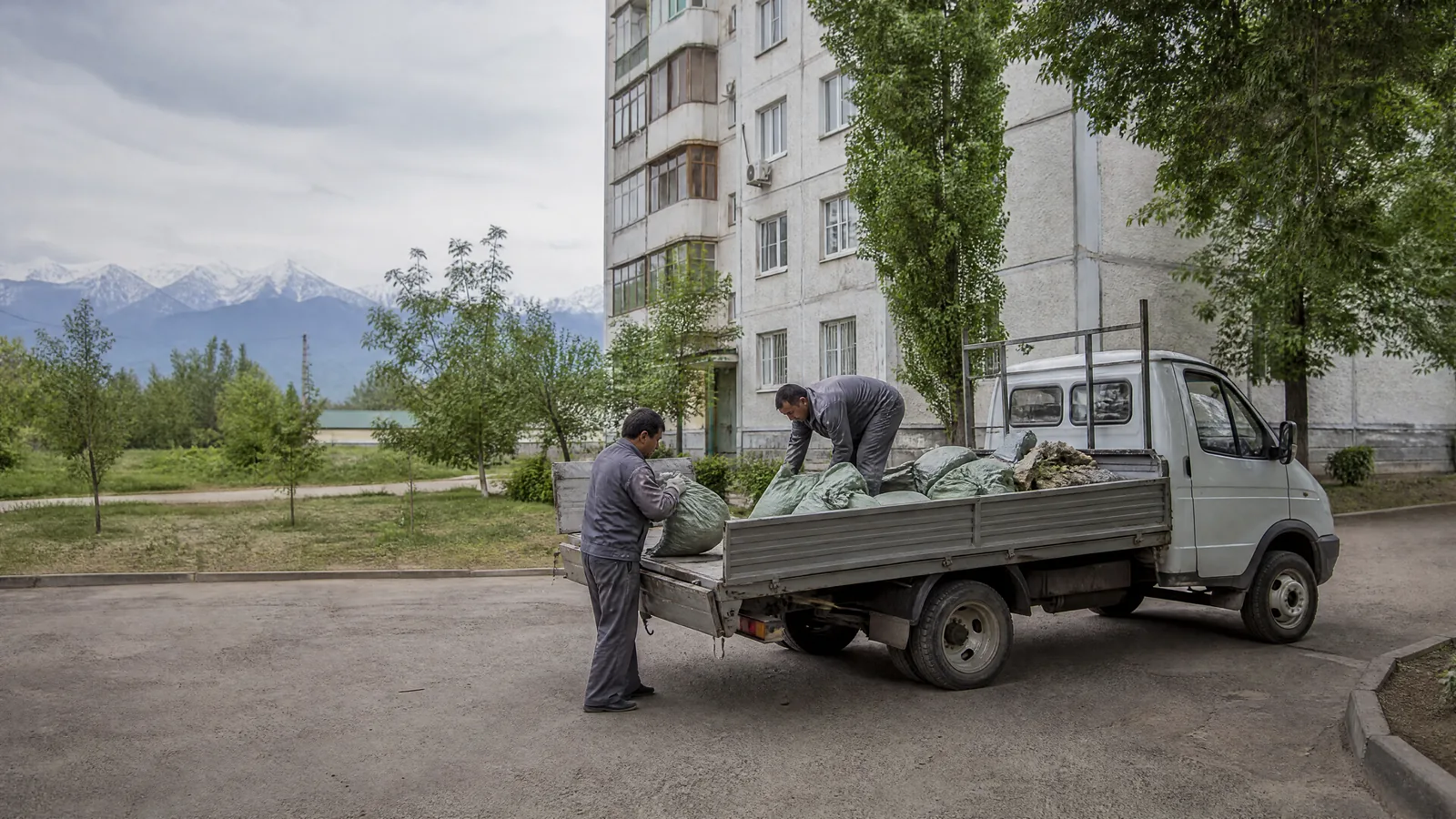
A 12 m³ body holds up to 50 bags or a sofa plus garage junk. It'll even fit through a neighborhood arch.
Take a photo of the pile and send it to WhatsApp — that's fairer than eyeballing it from a message. People usually underestimate the volume: there's a "little heap" in the corner, but in reality it fills half a flatbed GAZelle.
The amount is final. Once the truck arrives we don't recalculate upward. If there's more trash than in the photo, we'll discuss the volume on site before loading.

Bags, boxes, old bits and pieces from the apartment. A 12 m³ bed fits roughly one room's worth of clutter, if you go by volume rather than weight.
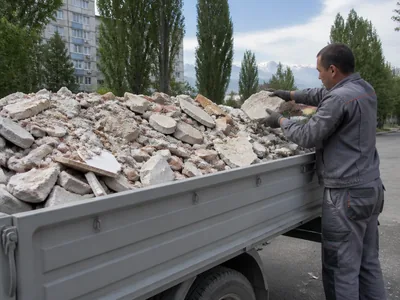
Concrete, brick, tiles, gypsum. Here weight matters more than volume — the bed is 12 m³, but it won't take more than 1.5 t. If there's a lot of concrete, better to go straight to a KAMAZ.
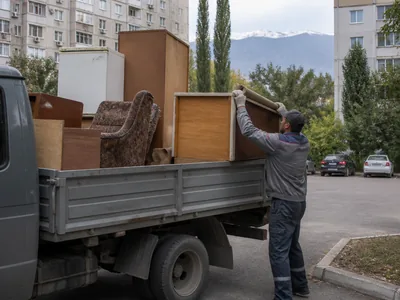
Sofa, wardrobe, fridge, old furniture. A GAZelle takes all of it in one run, and the loaders carry it down from the floor themselves.
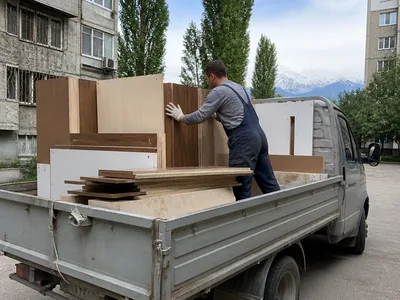
Wall units, cabinets, sawn-up shelves. If the furniture is taken apart and stacked, treat it as regular bulky waste, just neatly packed.
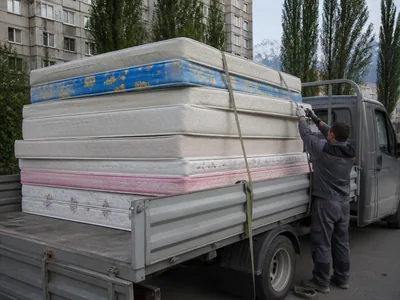
Sofa beds and beds that won't fit down the chute. A couple of mattresses go in one run, and if there are sofa cushions lying nearby, they'll fit too.
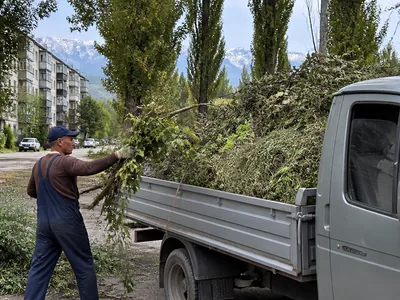
After pruning a tree in the yard or felling on your property. The bed holds about 12 cubes of greenery, but the volume usually gets underestimated — branches spring back.
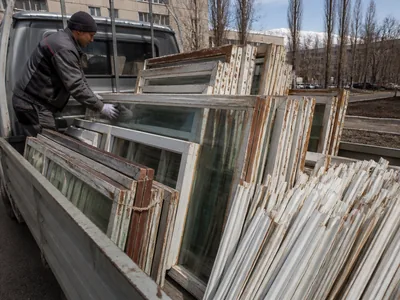
Double-glazed units, frames, glazing beads. The main thing here is not to break them while loading, so we take out the glass or pad it if the client asks.
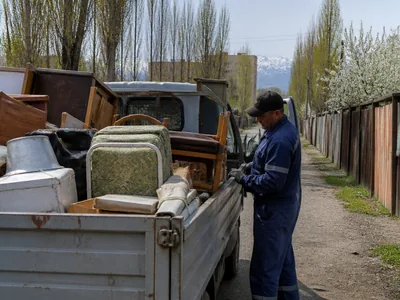
Clutter from a dacha or garage, old stuff from your plot. The GAZelle fits down narrow streets where a KAMAZ can't turn around — that's its main advantage in private areas.
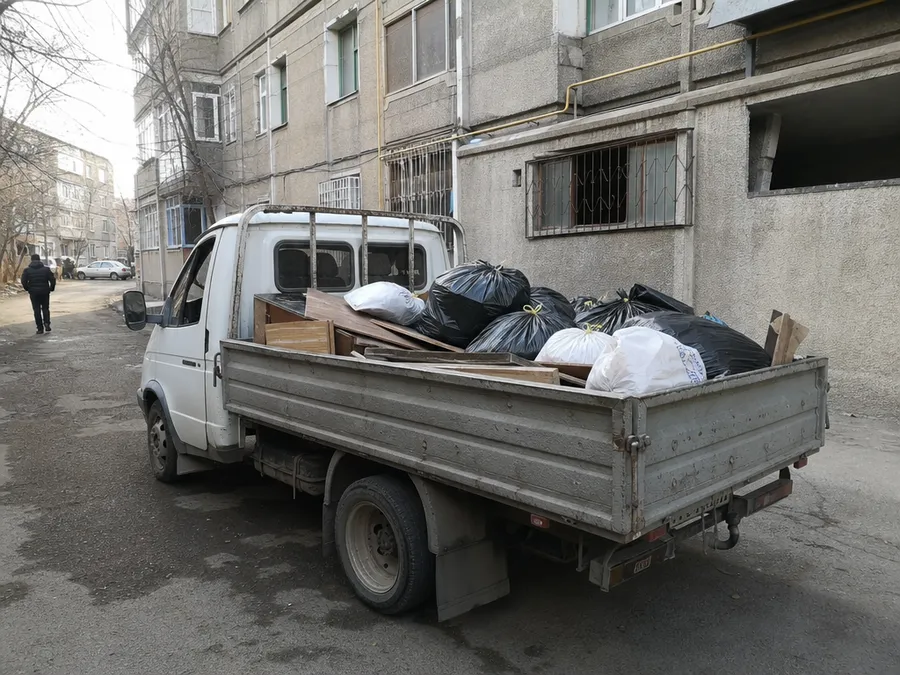
Standard service: we arrive, load, and haul away. This includes the trip to the landfill and back across Almaty. If you need a second run, it's counted separately — it's cheaper to just tell us the volume from a photo upfront instead of guessing.
Book a run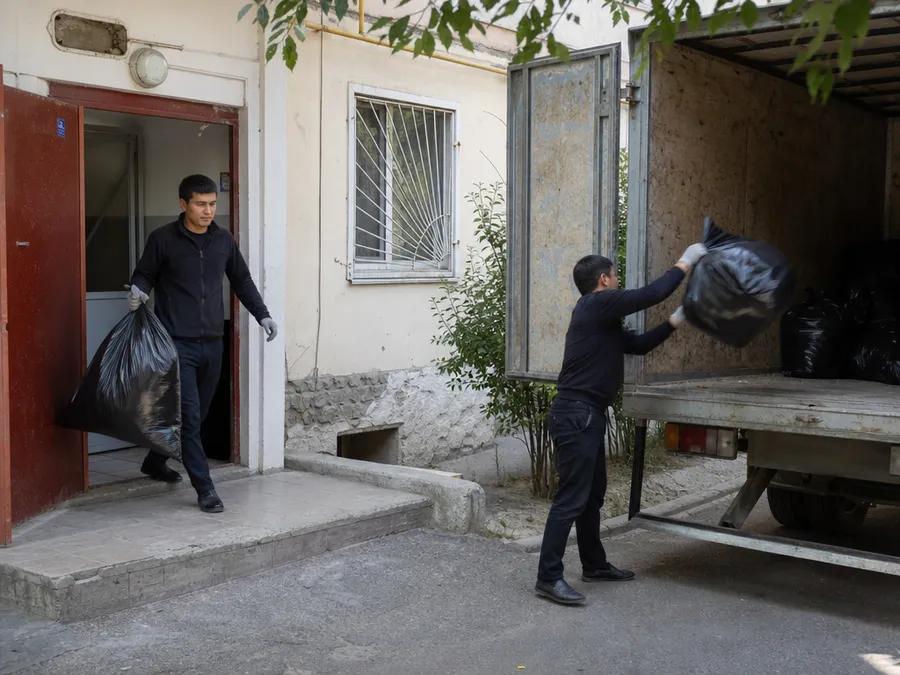
Handy when there's more junk than one pickup can handle, or you need it moved around the yard. We don't count with a stopwatch — it's by the fact: if we're held up an extra hour because of your renovation, you pay for the hour.
Add an hour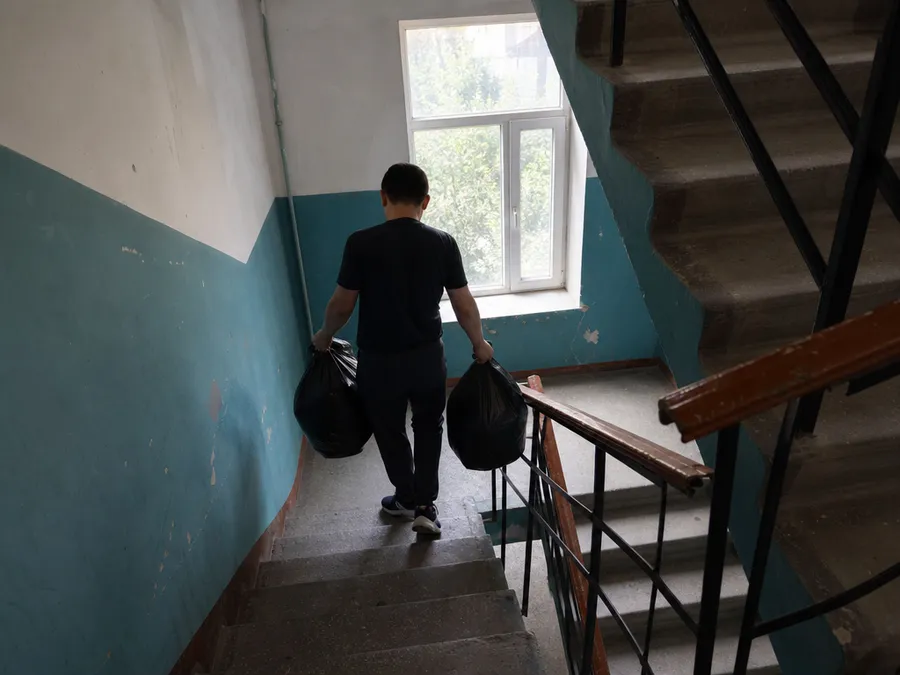
A two-person crew carries bags, furniture, and construction debris down from any floor. They work fast because hauling stuff down stairs is their job, not yours. Often booked for walk-up buildings without elevators.
With loaders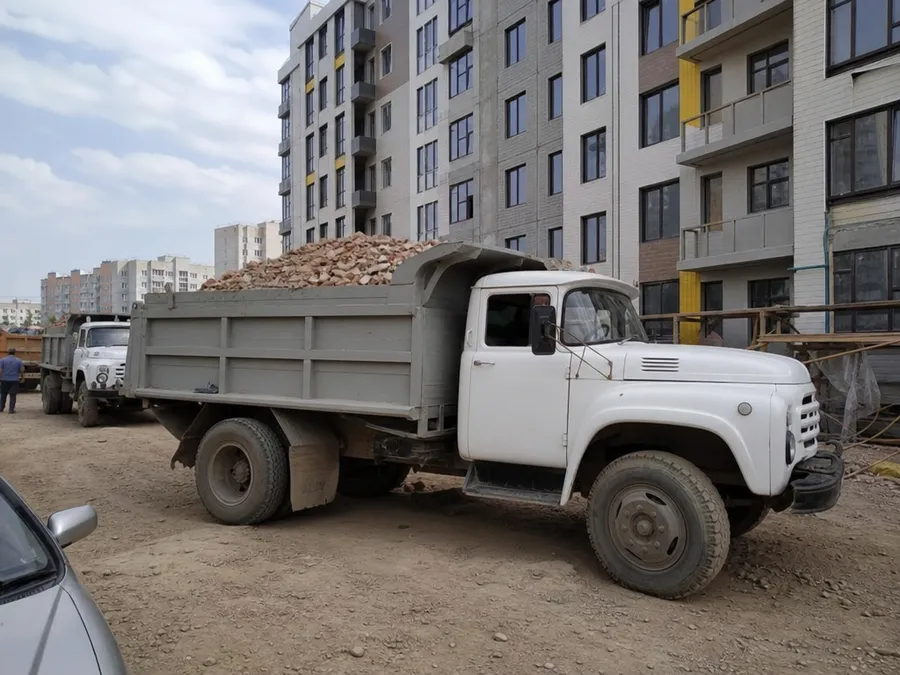
When the volume won't fit in one bed — say, after renovating two rooms. We calculate the total volume and tell you how many runs it'll take: sometimes it's more honest to get an 8 or 20 m³ dumpster so we're not driving back and forth.
Calculate runs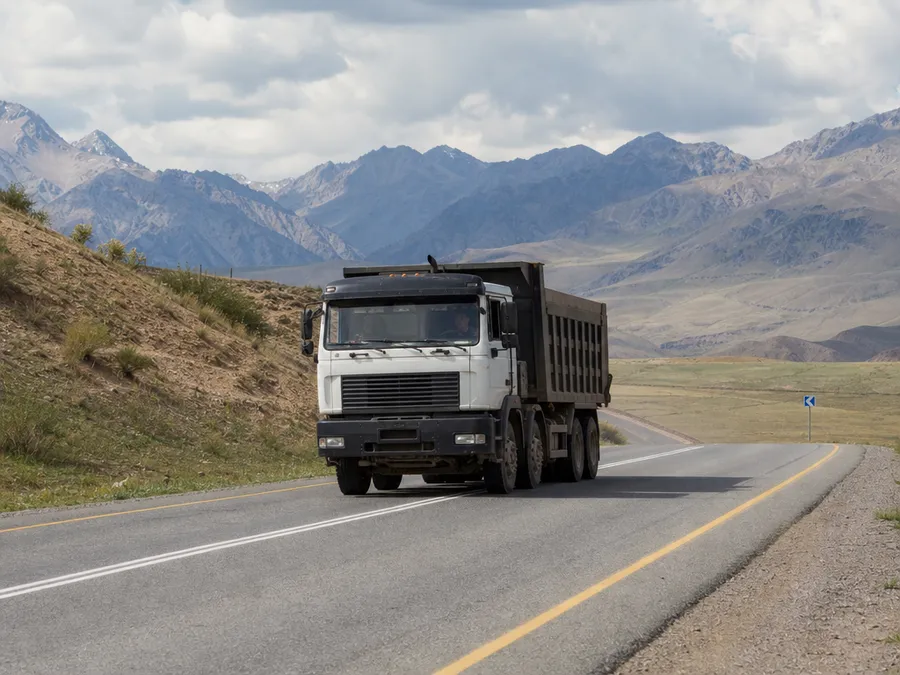
Dachas, plots, and nurseries outside Almaty. Mileage is added to the run price — we often go to Kaskelen and Talgar, and we calculate the mileage in advance. No discounts for distance, but no hidden fees either.
Outside the city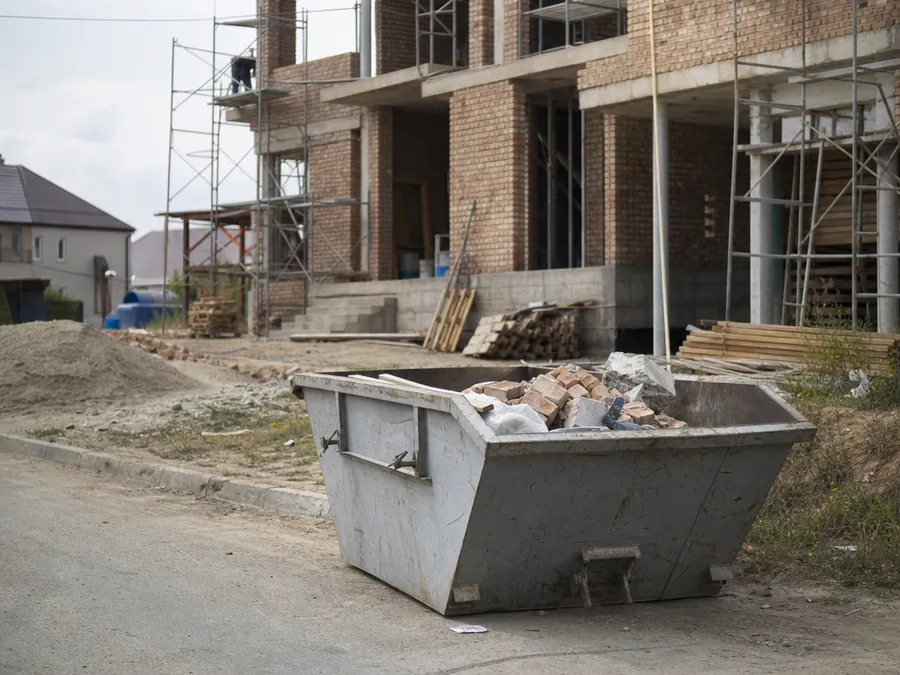
We leave a container for a day or two while the renovation is going on. The rate depends on the duration and location, so we quote separately in chat — message us on WhatsApp. We don't give a flat rate for long-term stays upfront; it's all counted by the day.
Message us on WhatsAppA run on a 12 m³ GAZelle starts at 30 000 ₸ — the price already includes a driver and travel across Almaty. Loaders are separate: 20 000 ₸. If you count by cubes, it's 8 000 ₸.




Valid from August 2026 · price per trip within the city
| Equipment | Volume | Payload capacity | Price per trip | Extra hour |
|---|---|---|---|---|
| GAZelle 1.5 t | 12 m³ | up to 1.5 t | 30 000 ₸ | 6 000 ₸ |
| GAZelle 2.5 t | 16 m³ | up to 2.5 t | 35 000 ₸ | 9 000 ₸ |
| Truck 5 t | 25 m³ | up to 5 t | 40 000 ₸ | 12 500 ₸ |
| ZIL dump truck | 7–12 m³ | up to 7 t | 40 000 ₸ | 12 500 ₸ |
| KAMAZ dump truck | 15 m³ | up to 20 t | 55 000 ₸ | 15 000 ₸ |
| Howo dump truck | 25 m³ | up to 40 t | 60 000 ₸ | 15 000 ₸ |
| PUHTO (skip) | 8–10 m³ | up to 7 t | 45 000 ₸ | — |
| Multilift | 20 m³ | up to 12 t | 100 000 ₸ | — |
| Skip | 27 m³ | up to 15 t | 135 000 ₸ | — |
| Max skip | 32 m³ | up to 20 t | 160 000 ₸ | — |
Prices apply within Almaty city limits. Outside the city, mileage is added — we calculate it in chat before dispatch.
Not sure which truck you need? Send a photo — we'll pick one for you.
Message us on WhatsAppPeople often add furniture, appliances, or old clutter from the balcony to the junk. It's the same run, just packed tighter — the price doesn't go up by itself.
From "need it gone" to "swept up and gates closed" usually takes one day. Here's the step-by-step.
Request a GAZelleTell us what needs to go and, if possible, send photos. That shows the volume and whether a 12 m³ bed is enough.
We estimate volume and weight, quote the GAZelle price or say you need a bigger truck. The price is locked in on site.
The truck arrives at your address, around the city — from 30 minutes. If you need morning or evening — you choose the window yourself.
The loaders carry out bags and furniture, saw up what won't fit through the door, and load it into the bed. The area stays clean.
We head to disposal, not to a roadside outside the city. We come back empty, so a second run to the same address won't break the bank.
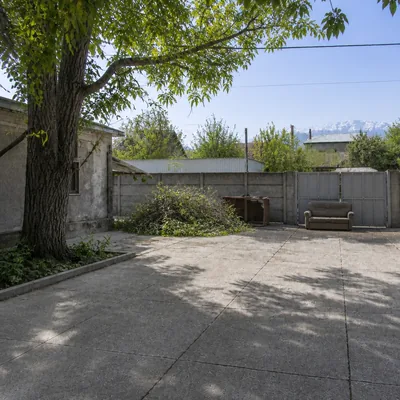
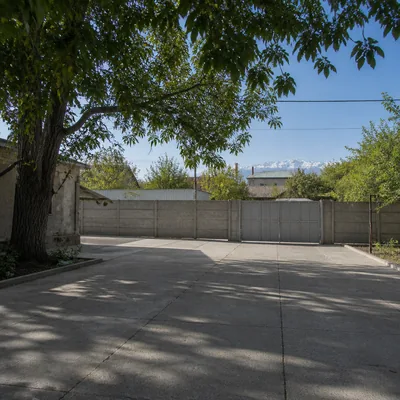
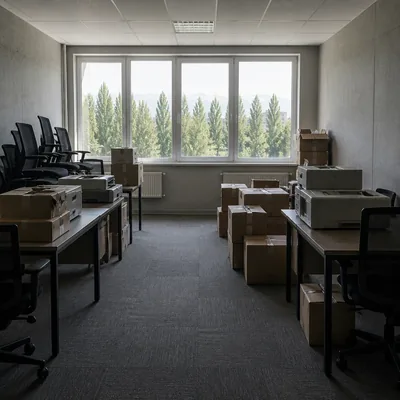
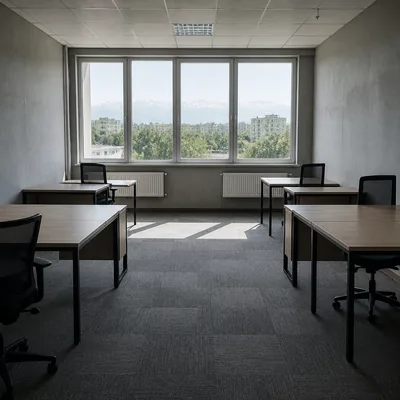
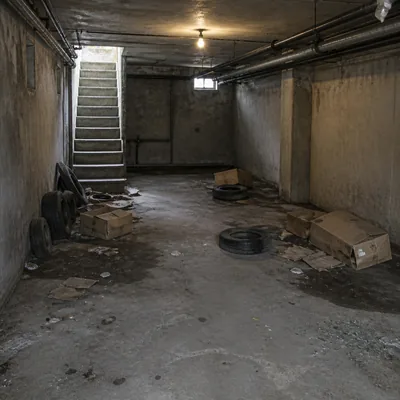
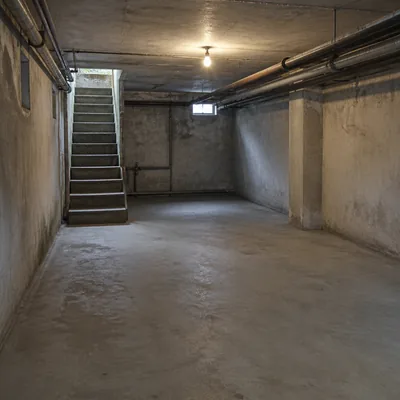
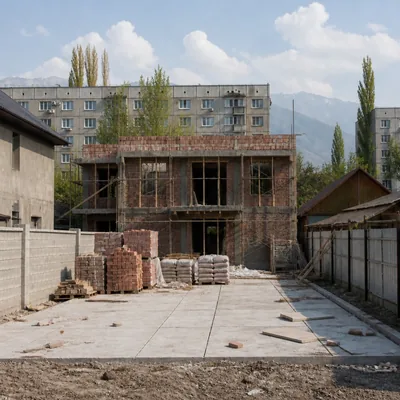
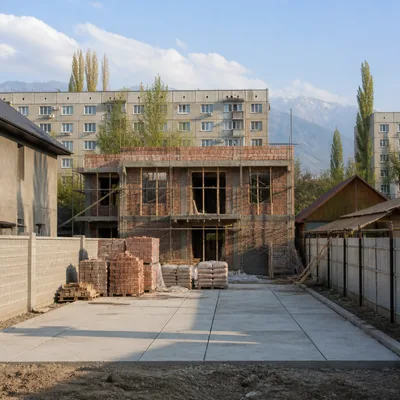
Below are typical courtyards: how a place looks before and after one GAZelle run.
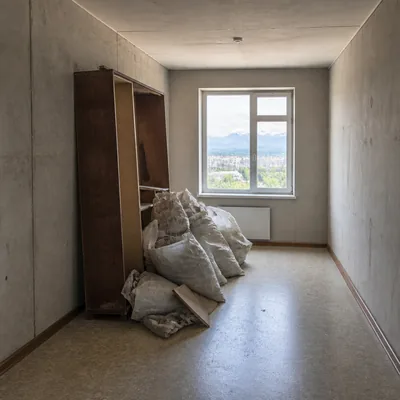
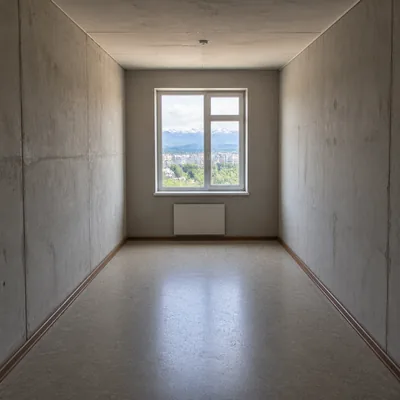
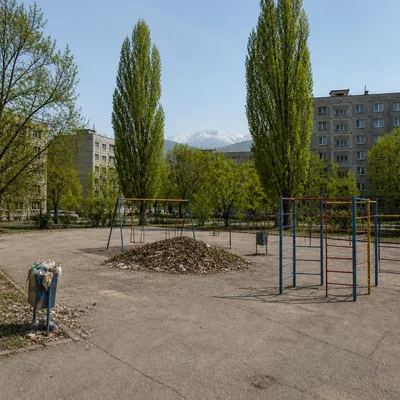
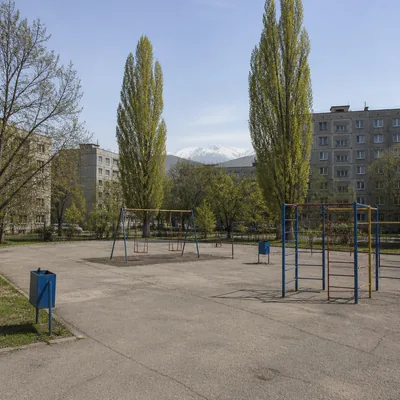
We're not a car rental or a dispatch service with freelance drivers. These are our people: from the ones loading to the one answering the phone.







A woman from Almalinsky district calls: “I need a GAZelle for trash, there's stuff left after renovation.” We arrive — twenty bags, an old sofa, leftover laminate, and a fridge. The bed is 12 cubic meters. We size it up on the spot: it won't fit. Annoying, but there's nothing to redo it with — the second truck is only tomorrow. Stories like this happen every week. And almost always it's not that the GAZelle is too small, but that the volume was estimated by eye.
Removal by GAZelle isn't just "load it up and drive off." It's about picking the right body, how many people to send up to the floor, whether the truck will fit under the archway in the yard, and what to do with whatever didn't fit. People choose a GAZelle for its flexibility: it squeezes in where a KAMAZ or ZIL wouldn't even try. But flexibility has a price — 12 cubes is exactly 12 cubes, and you can't stretch them.
Below is a breakdown without tenge figures. About what makes up the volume, how bags differ from pallets, why two GAZelle trips are sometimes cheaper than one big truck, and how to calculate so you don't overpay for air in the bed. Plus — what we bring as standard and what to prepare if the trash isn't just in the yard but on the fifth floor with no elevator.
The GAZelle bed is a box of 12 cubic meters. Sounds solid until you start loading it. In reality, volume is a flexible concept, and it depends on what you're filling it with. Bags of dry junk — lots will fit. Bags of broken brick — half. Concrete — a third at best. Density decides.
We had a case in Auezovsky district: a woman ordered a GAZelle for household trash removal after moving. Twenty boxes, an old wardrobe, a mattress. She thought it was too little. We arrived, loaded it in forty minutes, and there was still room left. A week later her neighbor called the same truck for leftover tiles — and it didn't fit. Tiles are heavy, they eat up volume instantly.
The first way — bags. The most common in GAZelle trash removal. A standard bag is 60–70 liters if not stuffed to death. The bed holds about 150–180 such bags if packed tightly, no gaps. But start tossing them randomly — and half the volume goes to air between the bags.
The second — pallets. Builders often leave pallets with drywall scraps, tile packs. A pallet takes almost a cubic meter but weighs little. 8–10 pallets fit, and that's it, the bed is full. Bulk is the third way, for loose materials: sand, soil, gravel. Here volume and weight go hand in hand. A cubic meter of sand is about 1.6 tons. A GAZelle will take a ton or a bit more, so less than a cubic meter. That's all the math.
I already mentioned the gaps between bags. But there are other volume eaters. Bulky items — a sofa, a fridge, a washing machine — don't take up much space individually, but you can't compress them. A disassembled sofa is a cube plus. A fridge is another cube. Plus the bags that need to go somewhere.
Another thing: if the loaders throw trash from a height, the bags rip and the contents spill. Then you have to sweep and repack — and that takes time. We always say: better to spend twenty minutes stacking than to stand there later wondering how to squeeze in the unsqueezable. Trash removal by GAZelle with loaders includes this stacking by default. Without it, the volume goes nowhere.
The third factor is the body shape. A GAZelle is a van with wheel arches inside. The arches eat up the corners. If you're loading long items — boards, profiles — they won't fit crosswise, you'll have to lay them lengthwise and lose height. So 12 cubes of paperwork turn into 8–9 real ones. It's not a trick, it's physics.
Payload is one and a half tons. At the same time, the vehicle's curb weight is about two and a half tons. Gross weight is four. So do the math: more than a ton and a half of cargo is already an overload, even if the body looks empty. The traffic police don't like that, and the vehicle drives worse.
Where do problems start? Concrete chunks, cement screed, ceramic tiles, bricks. A cubic meter of concrete weighs about 2.4 tons. One cube of brick — 1.8 tons. Tiles — up to two tons per cube. So a GAZelle can take one cube of concrete — and that's it, no more. And the body looks empty! That's why construction debris removal by GAZelle often requires two trips where one would have been enough by volume.
Household trash is a different story. Paper, plastic, rags, foam — they weigh little. You can fill it to the ceiling and the vehicle will go. But there's another problem: volume. Soft trash doesn't hold its shape, it settles, you have to tamp it down. Experienced loaders know: heavy stuff on the bottom first, then light stuff on top. That way weight is distributed and volume is used more densely.
What won't fit is anything you can't disassemble or compress. A bathtub — cast iron or steel — takes up a lot of space and weighs a fair bit. Two or three cubes will go under it if you don't cut it up. A heating boiler, a water heater, large radiators — also bulky. They're usually removed separately or with loaders who'll disassemble them on site.
Long items won't fit: pipes over three meters, boards, timber. A GAZelle isn't extended, the body is about three meters. Anything longer will have to be cut or you'll need a different vehicle. Also, don't count on a GAZelle if there's really a lot of trash: after a major renovation of a three-room apartment, 20–25 cubes remain. That calls for a ZIL or KAMAZ, otherwise you'll be making three trips.
And one more thing: if the stairwell is narrow and there's no freight elevator, carrying everything out takes time. It's not about the body volume, but about how much trash actually makes it into the truck in an hour. Loaders aren't robots. But if you tell us in advance that it's the third floor and there's no elevator, we'll send enough people. That way removal with loaders goes faster and without surprises.
You're clearing out junk after a move — an old wardrobe, a washing machine, boxes. You think: "A GAZelle will handle it." But it's not that simple. 12 cubes can fit about three cubes of furniture if you don't take it apart. And if you do take it apart, those same three cubes shrink to one and a half. That's why before loading we always check exactly what you're planning to throw out.
We go to apartments, private houses, and dachas. Most often it's the standard set: old furniture, appliances, leftover renovation stuff. We haul construction debris too, but that's a separate story — this section is about household junk.
Where to put it all? If the trash is in bags — great, the loaders will carry it out. If not — you'll need to sort out packaging. We'll help, but it's better to prepare in advance. And yes, if you're in Almaty, a GAZelle run is exactly our thing. We work all over the city.
Usually people order a GAZelle for household junk after clearing out one to three rooms. It could be stuff left by previous tenants, old furniture, mattresses, rugs. The volume is like this: 10–15 bags plus 2–3 large items. It fits in 12 cubes without a problem, as long as you're not taking a fridge and a bathtub at the same time.
If it's a three-room apartment being fully cleared out, you might need two trips. But we'll tell you in advance so you're not surprised.
What matters: hazardous waste — lamps, batteries, paints — doesn't go in the general truck bed. We take it as a separate request: apart from other trash, to a specialized facility. We don't take medical waste. Everything else is fine.
We dismantle wardrobes and wall units — it's more compact that way. Sofas usually go whole, but if the frame is rotten, better to take it apart. We remove fridges, but they must be defrosted and the doors taken off. Washing machines are fine too, but you need to drain the water.
What we don't take apart: pianos (heavy, need special equipment), safes (too heavy), large mirrors (they break). Let us know about these right away — you might need a different truck.
Generally, gazelle household trash removal is mostly about furniture and junk. If you're unsure, send a photo on WhatsApp and we'll advise.
If the trash isn't in bags, you need to prepare it somehow. You can use boxes, old bags, or just a pile by the entrance. But keep in mind: the movers won't dig through a pile and sort it. Everything should be more or less compact.
We bring trash bags with us, but for an extra fee. Better to pack everything yourself in advance — it's faster and cheaper.
For dachas: we usually remove dry branches, leaves, old furniture. If there's construction debris, that's fine too, but that's a different section.
It doesn't happen that we take everything in one trip if the volume exceeds 12 cubes. You'll have to order a second truck. It doesn't happen that we take the trash without you present — someone needs to open the door and show what to load.
It doesn't happen that we remove what's prohibited by law. And it doesn't happen that we quote a price over the phone without seeing it — at least roughly, from a photo. But that's in another section.
Here are the typical categories of household trash we haul by GAZelle:
If something's not on the list, ask — chances are we'll take it too.
| Type of waste | Approximate volume | Details |
|---|---|---|
| Furniture not taken apart | 2–3 cubes | Takes up a lot of space, better to dismantle |
| Disassembled furniture | 1–1.5 cubic meters | Compact, but takes time to disassemble |
| Home appliances | 0.5–1 cubic meter | Needs prep: defrost, drain the water |
| Bags of junk | 10–15 bags = 0.5–0.9 cubic meters | Easy to load if tied shut |
| Yard waste | 3–5 cubic meters | Branches, leaves — light but bulky |
This table will give you a rough idea of how much space your junk will take up. For a more precise estimate, send a photo or we can take a look on site.
After renovating a third-floor apartment, you're left with the kind of junk you can't just carry out in bags. Concrete chunks, pieces of screed, broken tiles — all of it weighs way more than it looks. A 1.5-ton GAZelle means exactly one and a half tons, period. Overloading isn't just a risk to the suspension — it causes real problems on the road: the truck sags, braking distance grows, and you can get fined at a checkpoint. And while a 12-cubic-meter bed is a decent volume, you can't fill it to the top with concrete. Physics: one cubic meter of concrete rubble weighs about 1.8–2 tons. So anything over 0.8 cubic meters at a time is already too much. That's why hauling construction debris in a GAZelle is always a trade-off between volume and weight.
The heaviest stuff is screed and concrete. A chunk of screed the size of a suitcase can weigh 50–70 kg. A concrete floor slab is even heavier. Broken brick runs about 1.2–1.5 tons per cubic meter. Gypsum is lighter, but if it's wet, the weight doubles. Tile is heavy too, especially porcelain stoneware. If you load all this mixed together without watching the weight, you can easily overload the truck without even noticing. The consequences aren't just a fine — the truck might not even make it out of the yard: it'll get stuck on a slope or bottom out on uneven ground. That's why we always ask what kind of junk it is when you book. If we hear "concrete" or "screed," we calculate weight, not volume.
From experience, the most common mistake is thinking you can stuff 12 cubic meters with anything. You can't. Half a bed loaded with heavy stuff can already put you over the limit. So it's better to underload than overload. It's not about saving money — it's about safety and staying on schedule.
I remember a job in Auezovsky district: the client had piled old screed in the yard, we tossed it all into the bed, and then I look — the tires are almost touching the wheel arches. We had to unload some of it back. Ever since, I always say: if it's screed, call a 2.5-ton GAZelle, don't risk it.
Screed and concrete are never loaded in a heap. Even level with the sides is already the weight limit. If you pile it higher, the truck simply won't drive properly. There's another catch: screed often comes in chunks with gaps between them. The volume seems there, but the weight is less. But if the screed is crushed into fine rubble, it packs tight and the weight shoots up. So we always look at the fraction size. Large chunks — you can go slightly above the sides, but still carefully. Fine rubble — only level. And one more thing: it's best to load screed toward the front of the bed, closer to the cab. That way the load is distributed more evenly and the truck handles better.
We've run into this more than once: the client says, "It's only half a cubic meter." We show up — and it's tightly packed screed weighing over a ton. So if you're not sure, take a photo and send it to WhatsApp. We'll estimate both weight and volume from the photo. It's free and saves time.
Bags are easier to carry out, especially if there are no loaders. You can bring them down one at a time, they don't spill, and they're easy to lift. But there's a downside: bags take up more volume. In the body they sit loose, with air between them. If you load it bulk, more weight fits, but it's harder and messier to carry out. Most often we recommend bags for heavy trash — it's easier to control the weight of each load. And for light stuff (insulation, drywall), bulk works too. But if you're ordering a GAZelle with loaders, they'll decide what's easier. We bring both bags and a wheelbarrow with us.
One more thing: the bags need to be sturdy. Regular trash bags tear on bricks. You need construction bags made of thick polypropylene. If you don't have them, we can bring our own — but it's better to discuss that in advance.
It's easy to tell: if the debris takes up more than half the truck bed and it's heavy, chances are it won't go in one trip. Either it won't fit by volume, or it'll be overloaded. In such cases we offer two options: either a 2.5-ton GAZelle (16-cubic-meter bed, higher payload capacity), or two trips with a 1.5-ton GAZelle. The second option is often better if you need it gone fast and a bigger truck isn't available. But money-wise, two trips are almost always more expensive than one trip with a bigger truck. Worth keeping in mind.
What to do step by step if you have construction debris:
If there's really a lot of construction waste — don't try to cram it all into one GAZelle. Better to order a bigger truck or a second run than to pay for an overload and take risks. We're always in touch and will suggest the best option. A GAZelle for trash removal in Almaty is flexible, but not limitless. Assess the volume and weight realistically, and the removal will go smoothly.
Will the GAZelle driver load it himself? Technically yes — if it's ten bags by the gate. But when we're talking about the fourth floor with no elevator, one pair of hands isn't enough. Working with loaders isn't about the driver being lazy, it's about physics: one person can't lift 12 cubes and a ton and a half at once.
I often hear: "Why loaders, we'll do it ourselves." Two hours later they call back — back pain, elevator broken, neighbors complaining. In the end they pay twice. But it can go the other way too: they order three loaders for household waste removal by GAZelle, and there are just two bags. Overpaying. So let's figure out how many people you actually need.
One person can handle it if the debris is already on the ground floor or in the yard. Or if the volume is small — up to three or four cubic meters. For example, after cleaning out an apartment: an old wardrobe, a couple of bags, an armchair. Here the driver and one loader will be done in half an hour.
The second case is a private house where everything's been carried out to the gate. The GAZelle is right there, all that's left is to toss it in. Another option: an office move where the boxes are already on a cart and the elevator works. One loader plus the driver — that's fine.
But there's a catch: if there's more stuff than it seemed, one loader will stretch the loading to two hours. And an hour of a GAZelle sitting idle is money too, even if it's not in the price list. Sometimes it's cheaper to just take two right away.
Two is the workhorse. 80% of construction debris removal orders by GAZelle get done with a pair of loaders. They lift the sofa, bags of tiles, leftover screed. If there's a working elevator — even better.
A third is needed when the floor is high, there's no elevator or it's small. Say, fifth floor of a khrushchyovka, narrow stairwell, and you have to carry bags of concrete. Two take turns, the third swaps in. Or when the debris is heavy: old cast-iron radiators or bags of sand. Here the third isn't a luxury, it's a necessity.
Another factor is dimensions. If you need to get out a fridge or a wardrobe, the third helps maneuver through the doorway. Without one, you might scratch the walls and have to take the door off.
Here's a quick guide so you don't have to guess:
| Situation | Floor/elevator | Loaders | Loading time |
|---|---|---|---|
| Debris in the yard, up to 4 m³ | 1st floor, no elevator | 1 + driver | 30–40 min |
| Apartment after renovation, 6–8 m³ | 2–5 floor, elevator available | 2 | 1–1.5 hours |
| Heavy construction debris, 10–12 m³ | 3–9 floor, freight elevator | 3 | 2–2.5 hours |
| Khrushchyovka without elevator, 5th floor | 5th floor, no elevator | 3 | 2.5–3 hours |
The numbers are approximate, based on experience. In reality, it all depends on how neatly things are packed and whether you have a way to haul it.
While the GAZelle is on its way, you can do three things that will save you an hour. First — pack small items into bags or boxes so the loaders don't run back and forth for each thing. Second — bring everything you can out to the landing or to the elevator. Third — clear the path: remove rugs, take off doors if they're bulky.
If possible, disassemble large furniture. A wardrobe taken apart into shelves takes up less space in the truck and weighs less. Same with a sofa: removing the armrests saves half a cubic meter. It's not mandatory, but it speeds things up.
And warn the concierge or neighbors if you're working during lunch. Sometimes it saves you from a scandal.
They don't repair the elevator or fix the stairs. If the elevator is broken, that's your responsibility — you'll have to carry everything up the stairs, and the time will increase. They don't remove debris from locked premises if there's no key. They don't dismantle load-bearing structures — that's demolition, a separate matter.
Also, loaders don't sort: what to take and what to leave is up to you. And they're not responsible for items you didn't mention in the order. So it's best to say right away if there's anything non-standard — a piano, a safe, a bathtub.
Finally, they don't clean up small debris after loading — the driver does that, but only within the truck bed and the loading area. If it's scattered in the stairwell, you'll have to sweep it yourself or arrange it in advance.
Here's a short list of things to clarify when ordering:
And remember: the price of a GAZelle run doesn't change with the number of loaders, but loading time can affect the cost if you're paying by the hour. So it's better to give us the real picture right away, not "two bags" when there are twenty.
If you're not sure how many people you need, just describe the situation on WhatsApp. We'll advise you, and you won't overpay for extra hands.
Read this far and still not sure about the volume? Send us a photo — we'll calculate and give you a price.
Message us on WhatsAppAlmaty is a city where the same address can be a breeze or a nightmare. It all comes down to the courtyard. In Auezovsky District, there's a wide area by the entrance, and a GAZelle pulls in and turns around with no problem. But in Almalinsky or Medeusky, there's a two-meter arch, and the driver already knows: it won't fit. We see this difference every day, and it affects everything — loading time, the number of movers, and whether a second truck is needed.
Removal by GAZelle in Almaty is first and foremost about dealing with yard geometry, not just body volume. Over the years we've built up routes where we know every turn. But even those don't help if the truck is coming for the first time: old districts change, barriers go up in yards, and sometimes the entrance is just blocked for repairs. So we always ask: is there an archway, how big is it, where are the cars parked. It's not a formality — it saves the run.
A 1.5-ton GAZelle with a 12 m³ body is about 2.2 meters tall and just under two meters wide. That's its pass into courtyards where a semi or a KAMAZ would simply get stuck. But there are nuances. In new residential complexes, the entrance is often through an underground parking with a height limit — a GAZelle won't go down there, even though there's plenty of space in the courtyard. In older buildings, there are narrow driveways between parked cars, and the driver spends twenty minutes just squeezing in. And sometimes the courtyard is completely closed to trucks by residents' decision. Then we work from the street: movers carry bags through the courtyard by hand.
If the arch is lower than two meters or the driveway is blocked, the truck stays outside the courtyard. It's not a death sentence, but it adds work. That's why we ask about the arch right when you place your order. Sometimes a client says, "Oh, the arch is fine," but in reality it's two meters ten centimeters, and the GAZelle barely fits, taking off the antenna. Better to be safe and warn us than to turn around on the spot.
In private neighborhoods it's a different logic. There are no stairwells, but there are gates, narrow streets, and sometimes dirt roads after rain. A GAZelle works in these places more often than big trucks: it's lighter, doesn't sink into mud, and can turn around in a small spot. But there's a downside — in some alleys the truck just won't fit between the fences. Then the trash gets carried to the nearest point where the body can reach. That adds a hundred or two meters on foot, and that's time.
Out on the outskirts — Talgar Highway, Kaskelen, Boralday — the mileage starts adding up. That doesn't mean the pickup itself changes: same truck, but distance gets added to the price. We always tell you upfront so there are no surprises. And one more thing: outside the city there's often no centralized pickup, so a GAZelle is the only option to quickly clear construction debris after a renovation.
Timing matters. In the morning, from about eight to ten, courtyards are still free — people have left for work, cars are gone. After six in the evening, it's the opposite: parked so tightly that a GAZelle can't get through. So we try to schedule deliveries in the morning or midday, when there's room to maneuver in the courtyard. If a client asks for evening, we warn that loading may take longer, and sometimes we'll have to work from the street.
One more thing — barriers. In new courtyards they're often closed, and someone needs to open them. That adds time for coordinating with the concierge or neighbors. We don't hang up, but we're honest: if the barrier isn't opened, the truck can't get into the courtyard. Then either the client meets us and opens it, or the movers carry the trash out to the gate. The second option takes longer and is harder, but sometimes it's the only way.
Sometimes the GAZelle stops a hundred meters from the entrance — and that's normal. Then a simple sequence kicks in. Here's how it looks in practice:
This sequence works in Almaly, Nauryzbai, and the private sector too. The only difference is the distance the loaders have to carry. But because of that distance, it's sometimes cheaper to order a GAZelle with loaders than to try to save money and haul it yourself. A GAZelle with loaders isn't a luxury — it's a way to avoid throwing your back out on the third floor with no elevator.
And lastly: if you know your courtyard is tricky, tell us when you book. We'll pick a time when the neighbors have driven off, or suggest carrying everything out to the street. A GAZelle is flexibility, but flexibility works better when we know about obstacles in advance.
A GAZelle has a 12-cubic-meter body and can carry up to 1.5 tons. That's not as little as it seems, but it's not elastic either. Most often the client thinks: 'oh, a couple of sofas and some bags.' But in reality, we estimate the volume (which is almost always underestimated) from photos. Once we arrived — there was an old wardrobe, three windows, a cast-iron bathtub in the courtyard. None of that would fit in a GAZelle. We had to carry it.
Weight is the second trap. 12 cubic meters is volume, but if you fill it with concrete chunks, you'll hit 1.5 tons at a third of the truck. Beyond that — overload, and we won't risk it. So sometimes a GAZelle is chosen not because the volume is enough, but because the load is light: bags of paper, foam, old things. And if the load is heavy — no matter how you slice it, you need a dump truck or bigger.
Maneuverability also dictates the choice. A GAZelle can squeeze through an arch, park at the entrance, get into a tight courtyard. A dump truck won't go there. But if the trash is floor screed and wall tiles, its volume is usually 3–5 cubic meters, and its weight is close to 3 tons. A GAZelle is out of the question here. We look at a ZIL or KAMAZ.
Another point: the number of trips. Two trips with a GAZelle means loading twice, driving twice, unloading twice. And time. If the site is far from the landfill, the second trip will eat up the whole day. Sometimes it's easier to take a bigger truck and haul everything in one go. But not always: if the courtyard is tight and a heavy truck can't get in, you'll have to use a GAZelle for several runs.
Here's a table to help you decide. It's about what we covered above: volume, weight, maneuverability, trips.
| Truck | Bed volume | Payload capacity | When it fits |
|---|---|---|---|
| GAZelle 1.5 t | 12 m³ | up to 1.5 t | Light household trash, tight courtyards, arches |
| GAZelle 2.5 t | 16 m³ | up to 2.5 t | Medium renovation, old furniture, boxes |
| Truck 5 t | 25 m³ | up to 5 t | Bulky junk, a few rooms, light construction debris |
| ZIL dump truck | 7–12 m³ | up to 7 t | Heavy construction debris, screed, tiles, bricks |
| KAMAZ dump truck | 15 m³ | up to 20 t | Large volumes, wall demolition, concrete |
If the junk is light and the yard isn't made of rubber, two GAZelle trips work out better than one big one. Because a heavy truck simply won't make it to the entrance. Or the yard is parked up so tight there's no room to turn around. So we load in parts. First trip — bags and boxes, second — sofas and wardrobes. Takes longer, but there's no other way.
The second case is when the junk appears gradually. Say, the renovation goes in stages: today the wallpaper comes off, next week the floors. No point waiting and saving up until there's enough for a KAMAZ. Easier to haul it away with a GAZelle as it piles up. And you don't clutter the yard.
A dump truck is for when weight matters. Concrete, brick, screed, soil. Anything heavier than 1.5 tonnes per 12 cubes. Even if the volume is small, the weight can be critical. For example, a chunk of concrete slab the size of a fridge weighs close to a tonne. Sure, you can load it into a GAZelle, but you won't fit much else.
You also need a dump truck when the junk is loose. Sand, crushed stone, earth after digging. You don't bag that — you just dump it in the bed. The dump truck tips it itself. A GAZelle can't do that — you'd have to unload by hand.
A skip is a container that gets delivered and left on site. Handy when the renovation drags on for months: you toss in the junk, call, and it's taken away. But a skip takes up space in the yard, and not every yard will allow it. A GAZelle comes on call, picks up, and leaves. For a renovation with a tight schedule and limited space, a GAZelle is often more convenient.
However, if the volume is already over 20 cubes, a skip is more cost-effective: no need to split into trips. Here we look at the situation. The main thing is not to haul in a GAZelle what's obviously too heavy.
Air in the bed is when you order a GAZelle but the load is light and takes up half the space. Or the opposite: the load is heavy but there's little of it. In both cases you pay for the vehicle, not the load. To avoid overpaying, calculate volume and weight in advance. We always ask for a photo or video. They show whether it'll fit or not.
Here's what to estimate before ordering:
If you're not sure, call us. We'll tell you which truck fits your debris. And don't forget: booking with loaders means not just a truck but people who'll carry everything out and load it. Sometimes that makes all the difference.
If you've read this far, you already get it: the GAZelle is an honest vehicle, but a small one. Twelve cubes and one and a half tonnes is not a marketing volume but a real one. You won't fit more in, no matter how you jump. So the main rule is to calculate the volume before ordering, not when the vehicle is already at the entrance. Below is a summary of everything above, no new details. Just the points people most often forget.
First: heavy waste goes separately from light waste. Construction debris, tiles, concrete — that's weight. Branches, foam, cardboard — that's volume. Mix them and you'll either overload or underload. Second: don't stack household waste bags higher than two meters, or they crush the bottom ones and tear. Third: bulky items — a sofa, a fridge, a wardrobe — go on the floor and get secured, not tossed on top. These three rules cover most problems when removing waste with a GAZelle.
The dispatcher will ask anyway, but you can prepare in advance. Say exactly what the load is: household, construction, or mixed. Mention if there are bulky items and how many. Give the floor and whether there's an elevator — that determines how many loaders you'll need. If the truck can't pull up to the entrance, warn us: the distance to the bed sometimes matters more than the volume itself. And ask right away about waste removal by GAZelle — the price depends on the district or the volume — so there are no surprises. Honestly, it's better to ask twice than to reschedule the pickup.
Mistake one is measuring debris in bags instead of cubic meters. Bags come in all sizes, and "twenty bags" looks different to everyone. Mistake two is underestimating the weight. A ton and a half is, say, about seventy bags of concrete rubble, and that's it. Mistake three is forgetting about oversized items. Mistake four is not checking whether a GAZelle can get into the courtyard. From experience, most rescheduled pickups happen because the truck couldn't get in. And the last one: not ordering loaders when it's the third floor and there's no elevator. A trip with loaders doesn't cost that much more than hauling it yourself afterward.
Sometimes everything seems clear from the description, but on site it turns out there's twice as much waste. Then don't guess — call or message us on WhatsApp right from the entrance. From a photo or description, we'll tell you if one truck is enough or if you need a second. If you're unsure whether the sofa will fit with the bags, call too — that's normal. In Almaty, waste removal by GAZelle is routine, and we can almost always adjust on the fly if you give us a heads-up. And if the waste is already out by the curb, take a photo of the pile and send it — that's faster.
And lastly. Waste removal by GAZelle is great for small volumes and tight spaces. But if you've got thirty bags of construction debris or a whole apartment after renovation with a concrete screed — tell us honestly. We'll pick a bigger truck so we don't have to send the GAZelle twice. Sometimes two runs cost more than one ZIL. You need to do the math before loading, not after. That's basically everything worth keeping in mind.
Depends on the bags. A standard construction bag of 50–60 liters is about 0.05–0.06 m³, so by volume a 12 m³ bed would fit 200–240 of them. But we're limited by payload: per trip a GAZelle takes up to 50 bags, and if there's concrete or tile inside — about thirty. Send a photo of the bags to WhatsApp, I'll give you a more precise answer.
A GAZelle is about 2 metres wide and around 2.5 metres tall. It can get into most Almaty courtyards, including between trees and parked cars. About the barrier: if you have a code or remote, no problem. If not, the driver will wait at the entrance and the loaders will carry the bags to the gate. From experience, the tightest spot in courtyards is the archway between buildings, but we usually get through.
No, the GAZelle is the most popular vehicle in our fleet, so we usually dispatch quickly. Weekends and Friday evenings are harder — book in the morning. For trips outside the city, add time for mileage. I'll give you the exact window after your request on WhatsApp: I'll tell you exactly when the truck can be at your place. Around the city, dispatch is from 30 minutes.
Absolutely, and that's what most people do. The loaders will carry the bags out of the apartment, bring them down by elevator or stairs (if the elevator's out), and load them into the GAZelle. A GAZelle with loaders is one of the most common requests for renovations. No extra charge for floors: going up and down is already included in the crew's rate.
A 1.5 t GAZelle trip starts at 30 000 ₸, loaders — 20 000 ₸.
Then two options. Either we send the same truck for a second run, or we order a bigger vehicle right away — a KAMAZ or a dump truck. Decide on the spot: if more than a third of the volume is left after the first load, a second truck from the start is the better deal. The driver won't leave until he's agreed with you on what to do with the rest.
Hazardous waste: mercury lamps, batteries, loose old tires, chemicals, barrels of unknown liquid. Construction and household waste — anything goes, including furniture and plumbing fixtures. If you're unsure, message me on WhatsApp what exactly you've got and I'll advise.
Yes, GAZelle waste removal works seven days a week — Mon–Sun from 09:00 to 21:00. Saturdays and Sundays are busier, so it's best to book a day ahead. We don't charge extra for weekends: the rate is the same as on weekdays. The only thing is if the landfill on your route is closed at the weekend, I'll take it to another one, which might add a few minutes.
GAZelle run, 1.5 t — from 30 000 ₸. The price already covers the truck (up to 1.5 tonnes), disposal and sweeping the spot after loading. Loading is separate: a two-man crew — 20 000 ₸. No hidden fees for floors, stairwell turns or a "tricky" driveway — the price is locked in before the truck arrives and doesn't change after. Extra hours, if the job runs long, are billed separately: 6 000 ₸ per hour.
Yes, we work with both individuals and companies. Cash, transfer, invoice payment — whatever suits you. For companies we prepare a full set of closing documents, including acts and a contract. We agree on all amounts in writing, no "surprise" on site.
Take a photo of the pile or the bags and send it to WhatsApp, plus write the address and what kind of trash it is (renovation, old furniture, household junk). From the photo I'll figure out whether it all fits in 12 m³ or if you need something bigger. It's free and no site visit needed, and on site the driver will confirm the number once more before loading starts.
Got a question that's not here? Ask — we'll answer in writing, no call needed.
Message us on WhatsAppEverything's good, but I'd like you to come a bit earlier. Otherwise all fine.
Thanks for the GAZelle trash removal service. The workers are very neat, they quickly collected everything and took it away. They told us the price in advance.
A GAZelle was exactly what we needed. Big volume, compact truck, got into the courtyard without any trouble. Thanks to Yerlan for being so quick.

Very convenient that this service exists. The GAZelle arrived on time, the loaders carried everything out. I'm happy.
I contacted TRASHOFF on a neighbour's advice. I needed to remove old furniture and junk from the garage. The GAZelle arrived on time, they took everything, swept the area. Happy.
They removed it fine, but there was a slight delay. They said the truck was stuck in traffic. Otherwise no complaints.
Overall fine, but we waited an hour longer than promised for the truck. Though once they arrived, they worked fast. They didn't raise the price, as agreed.
I needed to get rid of the trash after renovating my apartment. I chose a GAZelle because it's cheaper. They arrived on time, carried everything out, I didn't even have to help.
I ordered a GAZelle. They arrived on time, carried everything out and loaded it. Very happy with Dina's work coordinating the process.
We had construction waste removed by GAZelle with loaders. The crew arrived on time, loaded everything in 40 minutes. Special thanks to Askhat, who organised it all.

I needed GAZelle waste removal in Almaty. I called TRASHOFF. The workers know their job well, and the price is affordable.
I called a GAZelle to remove old furniture. They arrived quickly and took everything away. No complaints.
Called in the morning, by lunchtime the GAZelle was already at the entrance. They carried out an old sofa, a wardrobe and a pile of junk from the balcony. Fast, clean, no fuss.

Ordered a GAZelle to remove trash after renovation. They came quickly, took everything, cleaned the area. The price is fair.
We ordered a GAZelle for household waste removal. They arrived an hour after the call. Worked fast and carefully. Didn't damage anything.
I ordered a GAZelle after a renovation. Thought 12 cubic meters wouldn't be enough, but everything fit. The loaders carried it all out themselves, even swept up after.
Construction debris removal with a GAZelle is just what you need after a renovation. The truck arrived at the appointed time, the loaders quickly loaded everything. I recommend TRASHOFF.
Great service. I ordered a GAZelle with loaders. The guys worked like a team, loaded fast and hauled it away. Fixed price, which is very convenient.
I used the GAZelle waste removal service. Everything was fast and clean. The price was agreed in advance, no extra charges.
Good company, but on the day of the order they delayed the arrival by two hours. Then they did everything well. I might use them again.
Showing 3 of 20
Want the same? Describe your task — we'll calculate and give you a price before the truck arrives.
Message us on WhatsAppChecked us out? Drop us a line — we'll pick the right truck for your load.
Message us on WhatsAppCollection, sorting, crushing, secondary raw materials — the steps in order and what actually gets recycled.
How medical and industrial waste differ from household waste and what's required of the hauler.
Illegal dumps on the outskirts, soil and groundwater: what happens when waste goes to the wrong place.
Articles of the Administrative Offenses Code of Kazakhstan, amounts in MCI for 2026, and who's responsible for the garbage — the carrier or the client.
If the trash is already sitting on the site and you're tired of waiting, a gas-powered GAZelle can go today or in the morning. Send a photo to WhatsApp and the address in one message.
Tell us how the pickup went — it helps us and anyone choosing a hauler.



